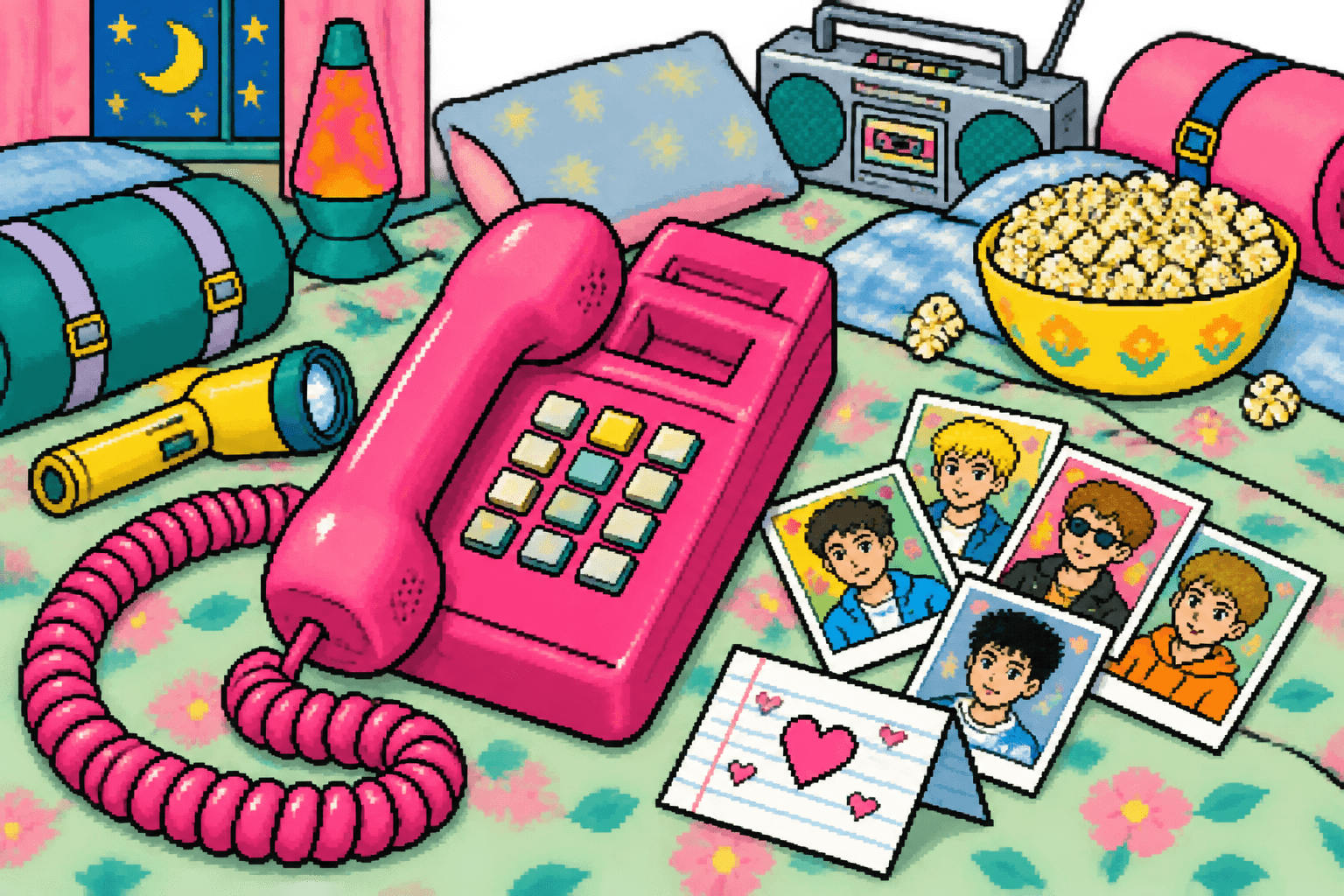
The phone was pink. Not a soft pink. A loud pink. The pink of a highlighter, or a bathing suit at Target, or the specific shade of Barbie box that the human eye locks onto in an aisle from thirty feet away. It sat in the middle of the board, on its own little cradle, taller than any other piece of any other board game in the house, and it was the phone. That was the point of the game. The phone was going to talk to you.
You were nine. There were four of you on the carpet. Someone's mom had just closed the door and yelled that popcorn was up in ten minutes. You picked up the plastic handset. You pressed a number. A man's voice, buried in some chip inside the pink plastic, said:
"Hi. This is Steve. Just so you know, the guy who likes you? He's at the mall."
You wrote this down.
The Premise Was Deranged
The premise of Dream Phone was that one of twenty-four boys had a secret crush on you, and the only way to find out which one was to call every boy in the neighborhood until you narrowed it down. That was the game. Milton Bradley, in 1991, printed twenty-four cartoon boy faces onto small cards, gave each one a first name and a hobby, and built a plastic telephone with a speaker that would speak clues into your childhood living room.
Nobody thought this was strange at the time. You would call Wayne. Wayne would answer. Wayne would tell you that the guy who liked you was not wearing a hat, which felt personal, and then Wayne would hang up. You would then call Bruce. Bruce would tell you that he had seen the guy who liked you at the beach. Sometimes a boy would call you - the phone would ring, unprompted, and a voice would say hey, it's Alan, it's not me and hang up. Alan didn't even give you a hint. Alan just wanted you to cross him off.
The premise of Dream Phone was that one of twenty-four boys had a secret crush on you, and the only way to find out was to call every boy in the neighborhood until you narrowed it down. In 1991. On a plastic phone.
The Boys Had Names Like Steve and Bruce
Let's talk about the boys.
The boys of Dream Phone were named Steve, Bruce, Wayne, Todd, Alan, Rick, Chad, and eventually you ran out of dads and started naming them things like Brett and Jason and Doug. They were drawn in that specific early-90s Milton Bradley illustration style - big hair, big teeth, a slightly-too-wide grin, a graphic tee that said things like MUSIC or MALL or in one memorable case just PIZZA. They looked, uniformly, like they were about to ask you a question you would not want to answer.
You had opinions about them. You had a preferred boy. You wanted it to be Dan, because Dan had a cool jacket. You did not want it to be Wayne, because Wayne had a mustache. Wayne, who was drawn to be nine or eleven or somewhere in that range, had, on the card, a mustache. Nobody at Milton Bradley had flagged this. The Wayne card went out to hundreds of thousands of homes in America, and you would pull it out of the stack in the box, and you would look at Wayne's little pencil mustache, and you would put Wayne face-down.
The game did not care about your preferences. The chip inside the phone had already picked a boy, and that boy was going to be Steve, or it was going to be Bruce, and there was nothing you could do about it.
- Dan - cool jacket, unspecified vibe, unclear intentions
- Rick - fine
- Brett - honestly forgettable
- Alan - always said it's not me
- Todd - always at the arcade, seemed busy
- Steve - fine but somehow the answer forty percent of the time
- Wayne - the mustache
- Bruce - once described his own outfit as "very hot"
The Voice
The voice on the Dream Phone was one adult man, and he was doing every boy.
He didn't try to hide it. He would answer as Steve, and then twenty seconds later he would answer as Bruce, and it was the same guy. He would drop his voice for the older kids and raise it for the younger ones, but you could tell. You could always tell. There were twenty-four boys and one voice, and the voice sounded like he had recorded the entire game in one afternoon in a studio in Springfield, Massachusetts, drinking a coffee, reading off a script that a Milton Bradley writer had put in front of him.
"Hi. This is Chad. It's not me. Bye."
He would say bye in the same tone as hi. He was not committed. He was working. He had been told to sound like a nine-year-old boy calling a girl at a slumber party, and he had said okay, and he had done that thing forty-seven times in an afternoon, and now he was going home. You could hear all of this in the voice.
There were twenty-four boys and one voice, and the voice sounded like he had recorded the entire game in one afternoon in a studio in Springfield, Massachusetts, drinking a coffee.
Try It
Dial. Get a clue. Cross off suspects. Guess when you're brave enough.
The Ritual of the Sleepover
The Dream Phone was a sleepover game. It was not a Tuesday-after-school game. You did not play Dream Phone with your brother. You played Dream Phone at a friend's house, at ten p.m., in pajamas, with two other girls, on a comforter on the floor, with someone's older sister rolling her eyes at you from the doorway.
You needed at least three players because half the fun was pretending the boy on the phone was calling you specifically, and it was funnier if two other people were also pretending. When Bruce called, you would shriek. You would shriek at a plastic phone that had produced a pre-recorded man saying this is Bruce, and the shrieking was, at nine years old, the entire point.
You would ask does anyone like Steve? and someone would say ew, and someone else would say wait, Steve from school Steve, or Steve from the phone Steve? and someone else would say I would die, and then the phone would ring again, and you would dive for the receiver. This was not a game about winning. This was a game about answering a plastic phone in a room full of your friends and everyone getting to react.
The receiver was not, by any technical definition, a receiver. It was a plastic banana with a wire coming out of it. The wire went into the base. The speaker was in the base. You held the receiver up to your face for the feeling of holding a phone up to your face. You could have listened without the receiver. Nobody did.
The Clue Cards
There were clue cards, too. This is the part everyone forgets.
You would draw a card from a stack and it would tell you which suspects to eliminate based on the current clue. The card would say something like He wears a hat, and you would flip over the boys not wearing hats. Then you would call another boy, get another clue, and draw another card. It was a logic puzzle, sort of, if the logic puzzle had been designed by someone who wanted you to spend most of the game pressing buttons on a phone.
The cards were the part of the game the box called strategy, and the phone was the part the box called fun. Guess which one you actually spent time on. The cards mostly ended up under the couch. You'd finish a game with sixteen cards in the box and eight cards lost forever, and the next time you played, someone would say we're missing some and everyone would say whatever and you would play with what you had. Dream Phone got looser over time. By 1993 you were basically just calling the phone until it told you it was Steve.
The Batteries
Dream Phone took four C batteries. Nobody in your house kept C batteries. C batteries were a specific weird size, wider than an AA and shorter than a D, purchased seemingly only for children's toys and, apparently, this one board game. You'd get the game out of the closet and the batteries would be dead, or missing, and someone would run to the drawer in the kitchen, and there would be ten AAs and two D cells for a flashlight and no C batteries, ever, and someone's dad would drive to the Rite Aid.
Or - and this happened more often - you'd play Dream Phone with dying batteries, and the voice would slow down. Steve would start sounding like Steve at forty-five. Bruce would sound like he was calling from underwater. The phone would ring at half speed, a low mournful briiiing that went on for two full seconds and made all four of you laugh. Dying-battery Dream Phone was, honestly, the best Dream Phone. The chip couldn't keep up. The voice was leaking out of the speaker in slow motion. Steve, at half speed, sounded like a man who was about to confess something.
The Argument
I want to be careful here. The argument against Dream Phone is real, and it is not small.
The game asked girls, at eight or nine or eleven, to spend an evening trying to figure out which boy had a crush on them. It made romantic interest from a boy the puzzle. It made you the object. It handed you a plastic phone and said your job is to figure out who wants you, and it did not offer a version where the answer was nobody, go read a book. The design was specific and the design was 1991. The design would not clear a room at Hasbro today, and probably not in Springfield either.
You can hold two things. You can hold the memory of the pink phone and the popcorn and the shrieking and also notice that the object of the game was to be chosen. Girls of a certain age were being handed a very small, very cheerful lesson about what a game about them could be about. The lesson landed differently for different kids. Some of you took it in stride, laughed at Wayne's mustache, and moved on. Some of you internalized he likes you as the answer to a question, which is a thing that took some of you a long time to unlearn.
I'm not going to pretend the game was innocent. I am going to say it was fun. Both are true. This is how nostalgia works if you're honest about it.
You can hold two things. You can hold the memory of the pink phone and the popcorn and the shrieking and also notice that the object of the game was to be chosen.
The Boys Were Also Doing Something
The other thing worth saying about the game, which nobody said in 1991: the boys on the cards were also doing something.
They were sitting at home, apparently, waiting for a phone call from a girl they didn't know, with a script prepared in case she called. When Alan told you it's not me, he was answering his phone. He had picked up the phone and given you information about a different boy's crush. Alan was a teenager fielding calls about who liked who at a party he wasn't invited to. Every boy on those cards was, functionally, working switchboard for a crush he was not part of. This was maybe the truest part of the game. It was also, in retrospect, a lot to ask of Alan.
The Phone Is in a Closet
Milton Bradley re-released Dream Phone a few years ago. It looks a little different now - the boys have been updated, the voice is different, the phone is smaller, the batteries are AAs. The premise is intact. There is a mystery boy. You call boys. You cross off suspects. You guess. The chip has more clues.
I don't know if girls play it. I don't know if the sleepover survives in the form we had it. Everyone has a phone in their pocket now. The pink plastic phone can't compete with the actual phone. You cannot ask a nine-year-old today to hold a pretend receiver up to her ear and shriek, because a real phone is right there, and it is doing more interesting and more upsetting things than telling her that Steve is at the mall.
The original Dream Phone is in a closet, though. Somewhere. In your mom's basement, or in a Rubbermaid tote at your aunt's, or on Facebook Marketplace for eighteen dollars, listed as works but no batteries. The phone still rings. The voice still sounds like a man in Springfield. The chip is still picking Steve forty percent of the time.
I called the phone once at Sarah's sleepover. Sarah's older sister came in and asked what we were doing and we said Dream Phone and she said "oh" and left. The phone rang. It was Bruce. Bruce said the guy who liked me had brown hair. We had already eliminated all the brown-haired boys. Bruce was, apparently, lying. Sarah wrote LIAR next to Bruce on the pad. We kept calling. It ended up being Steve. It was, that night, always going to be Steve.