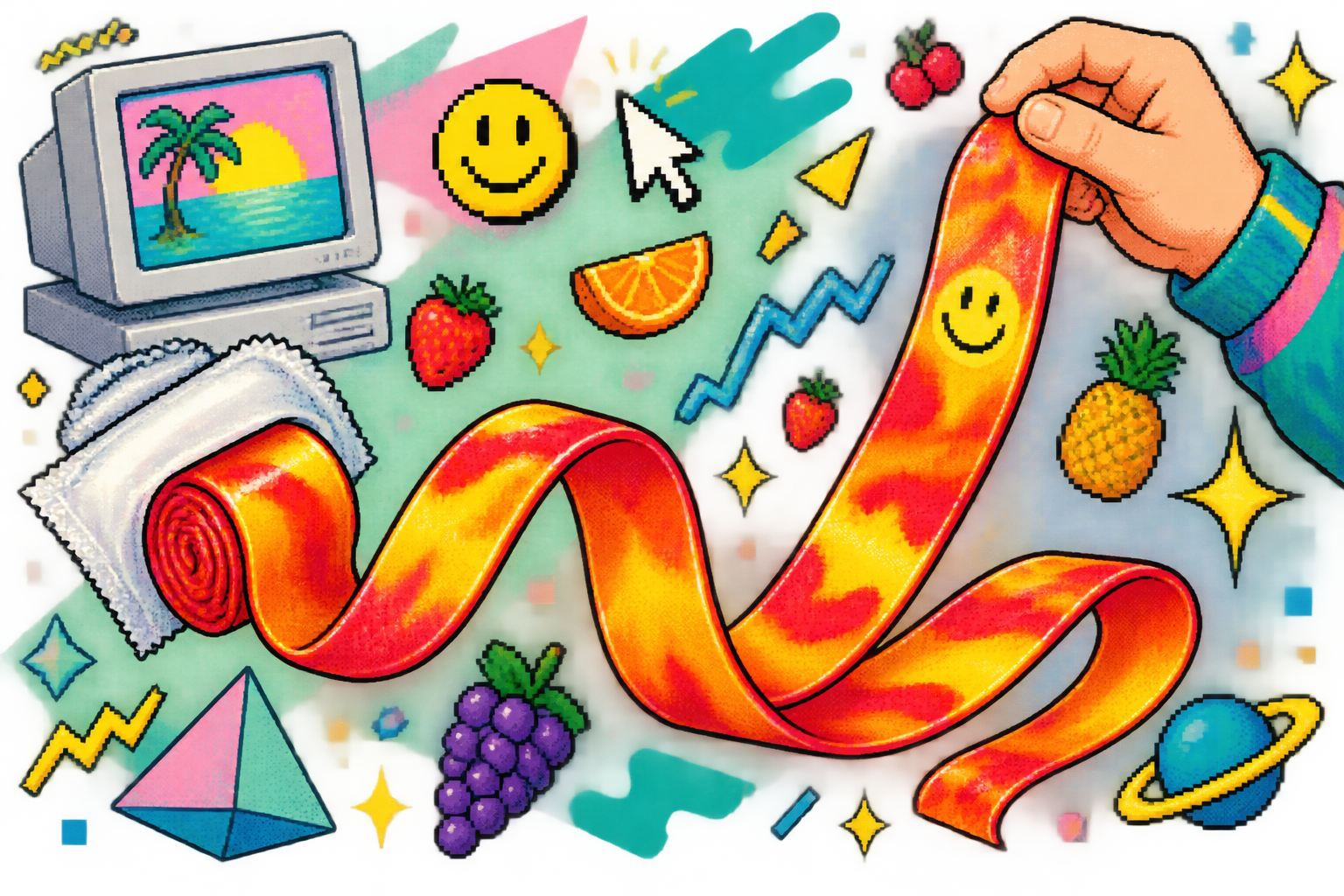
Your lunchbox had a sandwich, a Capri Sun, a small bag of Doritos, and a Fruit by the Foot. The Fruit by the Foot was in a white plastic pouch about the size of a business card. Inside the pouch was a coiled ribbon of red fruit leather. The ribbon was three feet long.
You knew it was three feet long because the box said so. The box was insistent about it. Three feet of fun. A whole yard of snack. It was, in the taxonomy of 90s foods, unreasonably long, and it came out of a pouch you could stuff into a pencil case.
You pulled it out at lunch.
The Format Was Wrong
Nothing else in the lunchbox had a length. The sandwich had a weight. The Doritos had a count, roughly. The Capri Sun had a volume. The Fruit by the Foot had inches.
That was the whole gimmick. It was food measured the way you would measure a piece of rope. You did not, at eight years old, know any other food that came in feet. You had never eaten anything in feet. The concept of eating a yard of something was, right up until General Mills invented it in 1991, not a thing.
So the first thing you did with a Fruit by the Foot was not eat it. The first thing you did was pull it all the way out. You held one end. You extended your arm. You stood up in the cafeteria and let the strip drop toward the floor and you and your friend looked at it and confirmed, empirically, that this was, in fact, a yard of fruit.
The first thing you did was pull it out to full length and confirm, with your body, that it was as long as they said it was. You did not eat any of it. You measured it.
The Ingredients Were Not Fruit
Let's be clear about what Fruit by the Foot was made of, because fruit is doing a lot of work in that sentence.
It was mostly pear concentrate. There was some corn syrup. There was a lot of maltodextrin. There was some sugar. There was some more sugar. There was xanthan gum, which is what made the whole thing flex like a piece of gasketing. There was Red 40 and Yellow 5 and Blue 1, which is what made a snack marketed as strawberry the color of a maraschino cherry that had been through legal.
The word fruit on the box was earning its keep through the pear concentrate the way cheese on a Kraft single is earning its keep through the trace of dairy that lets it use the word cheese. It was fruit adjacent. It was fruit alleged. It was fruit at the level of chemistry.
Nobody minded. Nobody was reading the box. Your mom had bought a whole box of these at the Kroger and put one in every lunch of the school week and the boxes were, at the checkout, next to the Doritos and the Squeezits, and nobody in that aisle was making health claims.
The Tongue Tattoo Was Real
Some varieties came with what the box, in a font that was already committing crimes, called a tongue tattoo.
This was not a bonus. It was not stuck on the outside. It was printed onto the strip of fruit. Somewhere in the middle of your three-foot ribbon there was a segment that had a small design on it - a smiley face, a shark, a lightning bolt - printed in edible ink, dark against the red base.
You were supposed to peel that segment out, press it to your tongue, hold it there for a few seconds while it went slightly clammy against the roof of your mouth, and then peel it off. The design would stay behind. On your tongue. In edible ink. Where you could show your friends.
You could not, in the modern year, ship this product. There would be a call. A meeting. A slide deck. Someone in legal would say let's talk about what happens when a child aspirates an edible transfer. The whole thing would die in a conference room.
In 1996 it was fine.
General Mills, a public company with a legal department and an office in Minneapolis, sold you a piece of fruit with a temporary tattoo baked into it. You put it on your tongue. Your mom bought a case at Sam's Club. Nobody had a meeting about this.
The Physics
The strip did not tear easily. That was the other thing.
You would try to bite a piece off, at length, and the whole thing would refuse. Your teeth would clamp down. The strip would elongate. Not tear. Elongate. It had the specific tensile behavior of a rubber band that had been aged in a warm car. You would pull with your hand. The strip would stretch. And then, with no warning, it would snap - not at your teeth, at some random point four inches back, releasing a whole slack loop of unsanctioned fruit into your face.
This was not a bug. This was the material. Fruit leather was engineered, in a factory in the Midwest, to be as unwilling to be eaten as an actual leather belt. The kids in your cafeteria worked around this by pinching off small segments with their fingers instead of biting, an act which was, if you thought about it, closer to how you would eat a Fruit Roll-Up than how you would eat a food.
Nobody thought about it. You pinched. You ate the pinch. You pinched again.
- A large rubber band
- A shoelace, if the shoelace were dyed with beet juice
- The gasket around a Tupperware lid
- The tag on the back of a t-shirt, if the tag were sweet
- A single unwound piece of magnetic tape, from a Talkboy cassette
- A ribbon of Wrigley's Big Red, if the Wrigley's Big Red were flat
Try It
Tear the pouch. Pull the strip. The tattoo is not at the start. Somewhere in there, a smiley is waiting.
The Whole Snack Aisle Was Like This
I want to zoom out because Fruit by the Foot did not exist alone. It was one item in a whole family of snacks that General Mills, in one specific decade, shipped as if there was no regulator on earth.
There was Fruit Roll-Ups, which was the same fruit leather, cut into palm-sized squares, sometimes with a pop-out tongue tattoo shape like a hand or a fish. There was Fruit Gushers, which was fruit leather wrapped around a small pouch of concentrated sugar syrup that ruptured in your mouth in a way that some kids found delightful and some kids found violating. There was String Thing, which was fruit leather but braided. There was Fruit Wrinkles and Shark Bites and, briefly, a thing called Berry Bears which were exactly what they sound like.
The entire aisle had lost its mind. Every brand had at least one product that was, structurally, a piece of stationery you could eat. The strategy was clear. The strategy was find a new shape. Not a new flavor. The flavor was going to be strawberry, or the flavor was going to be tropical punch, which is not a flavor. The flavor was fixed. The shape was the whole innovation.
A foot. A sheet. A wrinkle. A bear. A bag inside a wrap.
The shape was the pitch. The pitch was going in a lunchbox.
The 90s snack aisle was not competing on flavor. It was competing on geometry. Somebody sat in a meeting and said what if it was a foot long, and somebody else said yes, and neither of them was fired.
The Ritual Was The Point
Here's the thing I actually want to say about Fruit by the Foot, though.
The snack was fine. The snack was, honestly, kind of gross. If you tried to eat one right now, as an adult, you would take one bite and think this is a plastic ribbon full of sugar and Red 40, why did anyone eat this. It does not survive contact with grown-up taste buds.
But the snack was never really the point. The snack was the ritual. And the ritual was: unroll it, measure it, dangle it, marvel at it, pinch a piece off, feed a piece to your friend, try to eat the whole thing in one shot without breaking it and fail, find the tattoo, apply the tattoo, stick your tongue out, laugh, do it again tomorrow.
The snack had a choreography. It was three feet long specifically so you had something to do with it. Every other food in your lunchbox took forty seconds to eat and then you were bored. The Fruit by the Foot took the full lunch period. It kept your hands busy. It gave you a small performance to put on. It gave you something to trade a segment of, in the trading economy that ran across every cafeteria table in America.
A regular snack fed you. Fruit by the Foot entertained you.
I don't want to make this bigger than it is. It was a piece of processed sugar in a shape. It was invented to sell more snacks to eight-year-olds. It was not a good idea. It was a marketing idea that happened to also be, briefly, a small performance art piece you did with your hands during math.
But I want to notice that we don't really have this anymore. Snack food today comes in a bag. The bag has a snack in it. The snack is a chip, or a cheese cube, or a small cracker. You reach in. You eat one. You reach in again. That's the whole loop. There is no shape to it. There is no yard of anything. There is no small design printed on your food that you are supposed to press to your tongue.
Snacks have become sensible. They have become portion-controlled. The whole vibe of the modern snack aisle is this will not surprise you. Every bar has a macro breakdown on the front. Every pouch is resealable. The snacks that used to be edible novelties are now, mostly, gone or diminished. Fruit Gushers still exists but nobody talks about it. Fruit by the Foot still exists but nobody talks about it. The tongue tattoos, as far as I can tell, do not.
The category that produced them - snacks that were also small stunts, snacks that came with a bit, snacks that made you laugh before you ate them - has been quietly retired.
Snacks used to have a bit. The bit was the whole reason to eat it. The snack was the delivery vehicle for the bit. We do not have snacks with bits anymore. We have snacks with macros.
The Argument
Here is the counter-argument, which I want to give a fair hearing.
Maybe it's fine that we don't have Fruit by the Foot with a tongue tattoo anymore. Maybe printing a smiley face in edible ink onto a strip of pear concentrate and encouraging a child to stick it to their mouth was, on inspection, a category of behavior a functioning society should quietly stop doing. Maybe the modern snack aisle is a responsible snack aisle. Maybe kids today are better off with a small pouch of applesauce that has a straw and a resealable cap and a QR code that opens a recipe.
I hear that argument. I concede that argument, mostly. I would not, if I had a child, put a printed edible smiley face into their mouth and take a picture of it. That is not a hill I want to die on.
But I want to say one thing on the other side, which is that the tongue tattoo was, structurally, a joke. It was a company deciding to be silly. It was a snack food that thought about you, the kid, the person actually eating this thing, and said what if we did the funniest possible version. The answer, in 1996, was a printed image on your tongue. That's a bad answer, medically. It is, artistically, a good answer.
Modern snacks do not have jokes in them. Modern snacks have messaging. There is a difference. A joke is for you. Messaging is for the brand.
I was at a Kroger a few years ago and I walked past the box of Fruit by the Foot on the endcap. Same box. Same font. Same red base with a photo of the strip curling on it. I picked it up and turned it over.
The ingredients were about the same. The pouch was about the same. The tongue tattoo was not mentioned on the box.
I bought a box. I ate one at my kitchen table, at thirty-eight, on a Tuesday. I pulled the whole thing out. It was three feet long. I confirmed this by extending my arm and letting it dangle. It touched the linoleum. It was still, in the year of our lord whatever, three feet of fruit.
I pinched a piece off. I put it in my mouth. It was worse than I remembered. It was aggressively sweet in a way that was more of an accusation than a flavor. I ate about eight inches and then I threw the rest out.
The tongue tattoo segment was not there. I checked. It had been removed from the recipe at some point I could not identify, in a memo I did not read, by a person who was doing their job. That person was probably right. But I did want, sitting there, to press a small edible smiley to my tongue and show it to somebody. There was nobody in the kitchen. There was nothing on the strip.
The strip was three feet long. That part they kept.