The song had no name.
It had a saxophone in it. It had one of those clean electric pianos that always sounded like it was played by a session musician who had a mortgage. It had a bass line that walked, without hurry, from one C major seventh to another, and it did this for forty-five seconds and then, very politely, ended. You had heard it four hundred times. You had never once, in your life, asked what it was called. It was not the kind of song that had a name. It was the kind of song that had a purpose, and the purpose was to play under a list of the current wind speeds in Akron.
This was Local on the 8s. It came on at :08 past the hour, and :18, and :28, and :38, and :48, and :58. It ran for about a minute. It told you the current conditions in your area, the extended forecast, the observations from six nearby cities you had never been to, and then it went away, and SportsCenter or an ad for a lawyer came back on, and you would wait until :18 for it to happen again.
The Machine
The graphics were generated by a beige plastic box called the WeatherStar 4000.
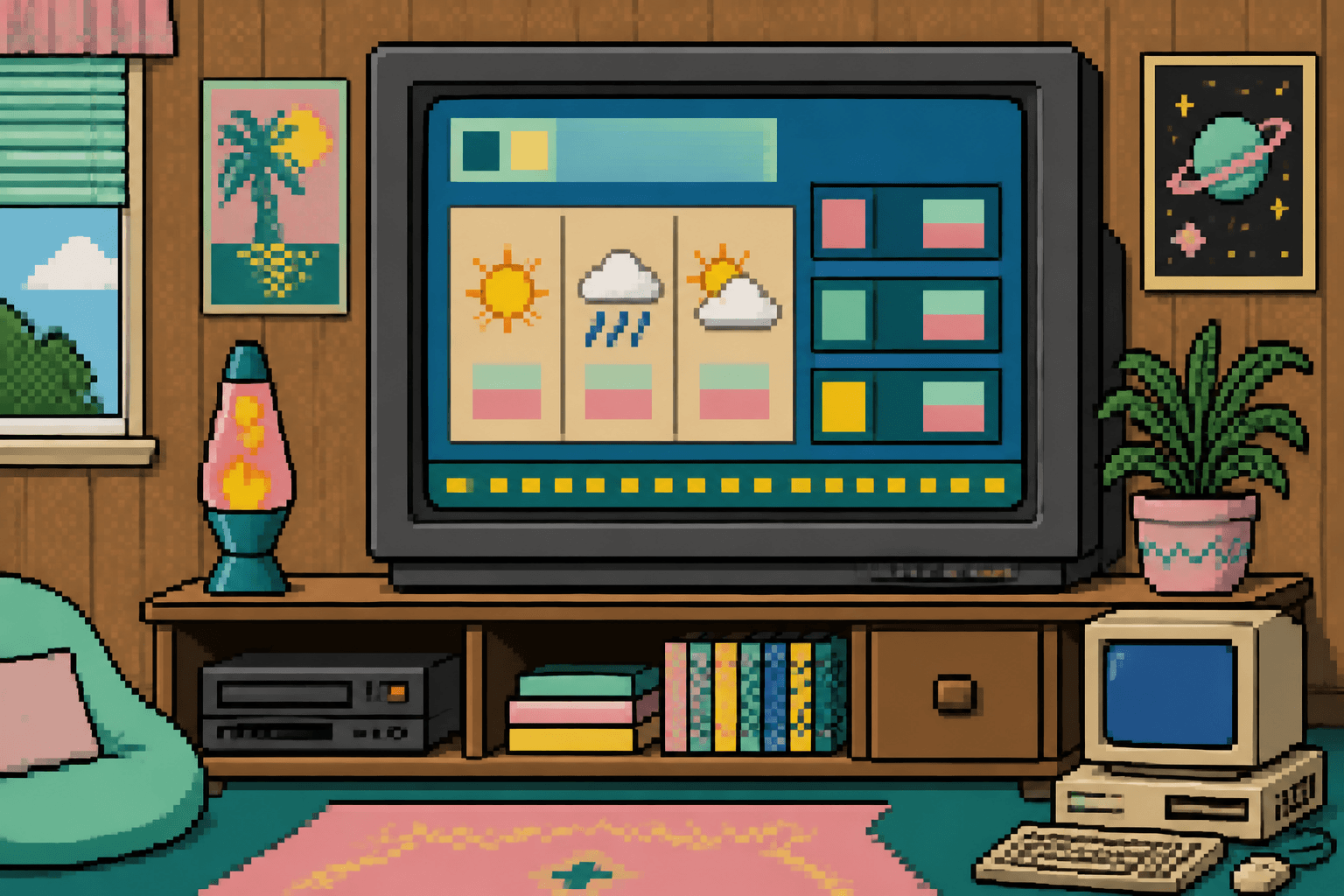
It was installed at your cable provider's headend, sometime around 1990, and it was, mechanically, one of the strangest pieces of consumer-facing computer hardware ever deployed at scale. It had 512 kilobytes of RAM. It ran on a Motorola 68000 processor, which was the same chip that powered the original Macintosh. It received its data via a satellite dish on the roof, updated a few times an hour, and it took that data - the temperature, the wind, the pressure, the six-city list - and drew it, in real time, in blocky mustard-yellow numbers on a teal blue background, over a soft loop of instrumental music that some poor engineer had licensed from a stock library in Nashville.
The WeatherStar 4000 ran on the same processor as the original Macintosh, drew big yellow numbers on a blue background, and did this in every American living room, every ten minutes, for a decade.
There was one in every cable market. Yours was probably in a strip-mall office park in a town you had never heard of, next to the local access channel and the closed-captioning box, drawing forecasts that only your ZIP code would ever see. If you moved from Ohio to Georgia the WeatherStar 4000 knew. The graphics did not change but the cities did. Yours were now Athens, Marietta, Rome. The song was the same song. The saxophone had followed you.
The Six Cities
The tri-city format, and then the six-city list, and then the extended, and then the almanac.
You never learned all the cities. Nobody did. If you lived in Akron the list was Canton, Mansfield, Youngstown, Wooster, Ashtabula. You could not, at nine years old, have found four of these on a map. You did not know anyone in Mansfield. You had never been asked to know what the temperature in Mansfield was. But every ten minutes The Weather Channel would tell you, in a font that looked like it had been drawn with a ruler, that Mansfield was 68 degrees and cloudy, and after ten years of this you knew, with a kind of pointless conviction, that Mansfield was almost always three degrees cooler than wherever you actually were. This was your Mansfield fact. You did not have any other Mansfield facts.
The extended forecast was where the real information was. Three days out. Sun, cloud, cloud with rain, cloud with a very small lightning bolt sticking out of the bottom left. The icons were drawn in the same blocky style as the numbers - flat, geometric, un-anti-aliased, the visual language of a computer that had been asked to do something it had not been designed to do and had done it anyway, out of stubbornness. The forecasts were sometimes wrong. Nobody minded. The forecast was not the point. The point was that at :08, on a Tuesday afternoon in November, you got a minute of your local area reflected back at you in soft blue and yellow, and you got a saxophone.
- The one with the walking bass and the muted trumpet
- The one that sounded like Kenny G but was, legally, not Kenny G
- The one with the acoustic guitar arpeggio and the wind chimes
- The one that was almost Careless Whisper but not enough to sue
- The synth pad one, which nobody liked but which somehow ended up under the seven-day forecast about half the time
- The one that started with a rainstick and made you inexplicably sad
The composer was a man named Trammell Starks. This is one of the great facts of the 90s. Trammell Starks, of Nashville, Tennessee, wrote hundreds of pieces of instrumental music for a stock music library, and The Weather Channel bought a big pile of them, and those pieces of music became the soundtrack to millions of American afternoons. Nobody knew his name. Everyone knew his work. You could sing three of his songs from memory if I hummed the first two bars, and you would not be able to tell me which one was which, but you would know that you had heard them, and you would know exactly where.
The Waiting
The thing you have to understand is that you waited for Local on the 8s.
If you had The Weather Channel on because a storm was coming, or because your dad had put it on and left the room, or because it was 4:30 in the afternoon and there was nothing else on cable, and something in the national forecast segment caught your attention - a big red blob over Oklahoma, a hurricane graphic, a map of school closings - you would wait for :08 to see if it applied to you. Because the national broadcast, live from Atlanta, could talk about the mid-Atlantic all it wanted, but it did not know where you lived. Only your WeatherStar 4000 knew where you lived. Only the local forecast could tell you if you personally needed a jacket.
Nobody knew Trammell Starks' name. Everyone knew his work. He scored more American afternoons than any composer in history and you have never once said his name out loud.
You would sit through six minutes of Atlanta. You would sit through an ad. You would sit through the beginning of a segment about the pollen count in the southeast. And then the graphics would change, the music would kick in, and the beige rectangle would fill with the six cities you knew from nowhere else, and there was Akron, and the temperature was 71, and it was partly cloudy, and you had, for the moment, been personally addressed by a television network.
The Argument With Itself
Here is where I am supposed to say that this was a beautiful, humane, small-scale piece of programming that respected the specificity of your life, and that we lost something when the smartphone came along and put the whole weather map in our pocket. And I sort of believe that. But I also want to say: it was a minute of yellow text on a blue background, updated every ten minutes, scored by a stock music library, and the reason we remember it fondly is not that it was good. It is that we watched a lot of it, when we were kids, and it was there, and it always came back, and it always came back with the saxophone.
The weather app on my phone is objectively better. It has the hourly forecast. It has the radar. It has the exact minute the rain will start, which is a thing the WeatherStar 4000 could not do because it did not know I was going to walk to the mailbox at 4:47 PM. The weather app has all of this and it has no song under it, because nobody in the room ever thought a weather app should have a song under it, and nobody ever will. That is a small correctness. It is also, faintly, a loss.
The Ritual
I miss the ritual, not the information.
I miss the specific fact that at exactly the same six moments of every hour, one small television channel would remember that Ohio existed, and would say so, in blocky yellow numbers, and would put a saxophone under it. I miss the way that meant somebody, somewhere, in a beige office park, was still tending the machine. I miss the way you would look up from whatever you were doing at :07 and go oh, it's almost time. Not because you needed the weather. Because the weather was going to come, and it always did, and it was the closest thing my childhood had to a call to prayer.
- Color Radar (1982). The first one. Text only. Green and orange.
- WeatherStar 3000 (1988). Rounded fonts, a few icons, the vibe starts to arrive.
- WeatherStar 4000 (1990-2000+). The canonical one. Blue background. Yellow numbers. The saxophone. This is the one you are remembering.
- WeatherStar Jr. (1993). Cheaper version for smaller cable systems. Fewer graphics. The saxophone was still there.
- WeatherStar XL (1998). More colors. More graphics. Less soul. The beginning of the end.
- IntelliStar (2003+). HD. Corporate. The saxophone died in this transition and everyone knew.
The WeatherStar 4000 units were physically removed from cable headends throughout the 2000s. Cable providers migrated to the IntelliStar, which was fine, and then eventually to nothing at all, because The Weather Channel had figured out that anyone who wanted the local forecast was going to open an app. The last WeatherStar 4000 in commercial service was reportedly shut down sometime around 2014, in a facility somewhere, quietly, without ceremony. There was no saxophone.
But the recordings survived. On YouTube, there are thousands of hours of Local on the 8s playbacks - some ripped from old VHS tapes, some produced by hobbyists running WeatherStar emulator software on their own home servers, drawing fictional temperatures for the six cities of Akron, forever, in real time, over a rotation of soft-jazz tracks that somebody licensed once and has apparently never stopped licensing. If you type local on the 8s into the search bar you will find them. There are entire channels devoted to running the loop. Nothing happens. That is the point.
I put one on, sometimes, in the background, while I work. Not the whole broadcast. Just the eight or nine minutes of local forecast, on a loop, at low volume. The saxophone plays. The temperature in Mansfield is 68. It is partly cloudy in Youngstown. The forecast for Thursday is T-STORMS LIKELY, though of course they are not, because it is 2026 and Youngstown is not experiencing weather on my exact timeline, and none of this is happening to me. It is just the machine, still running somewhere, in a way, drawing yellow numbers on a blue field for nobody. I find it enormously calming. I do not entirely know why.
Six minutes past. Sixteen past. Twenty-six past. And so on. Forever, if you wanted, and the saxophone in between.