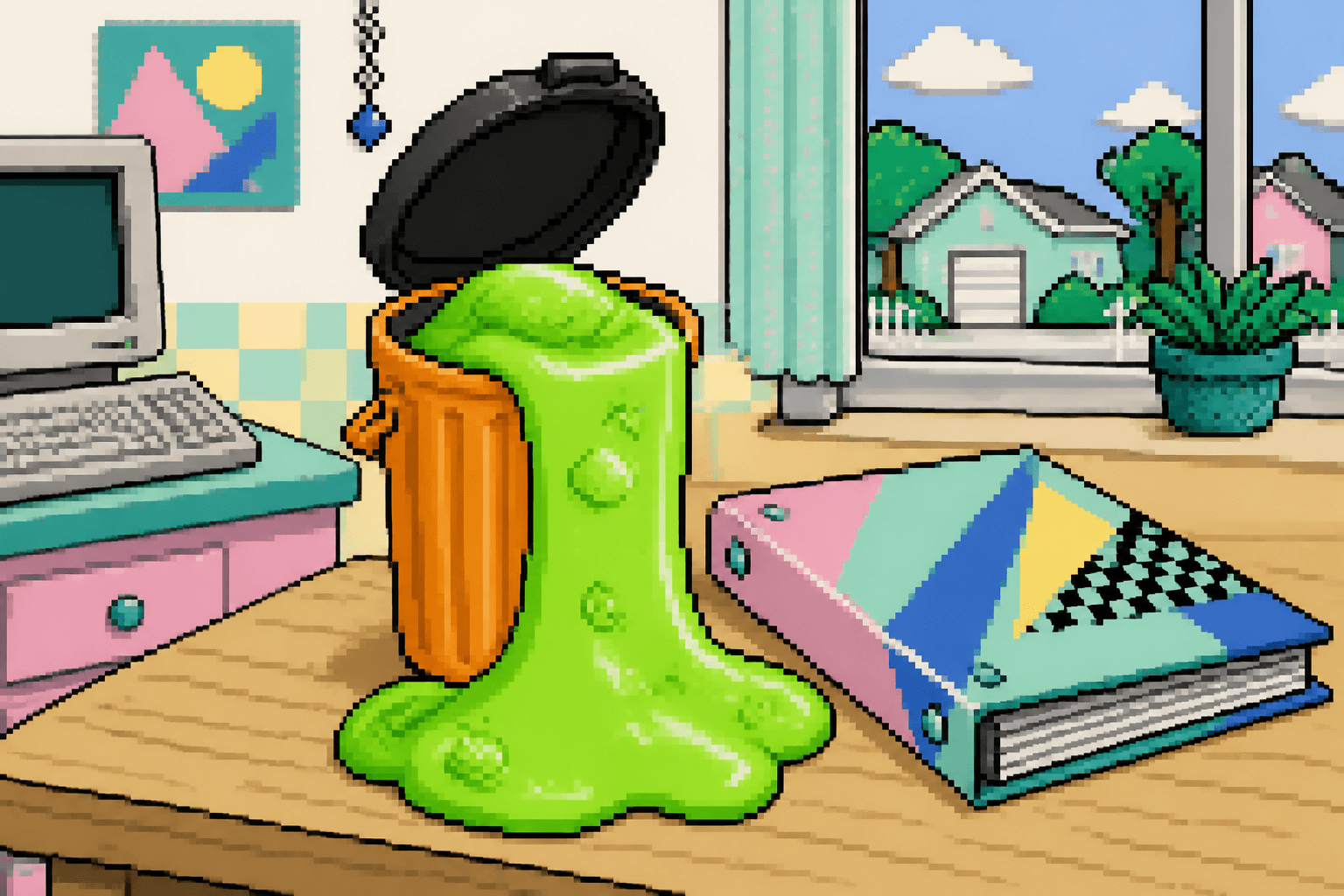
It came in a plastic trash can.
Not a jar. Not a tub. Not a resealable bag. A miniature four-inch-tall garbage can, in orange or purple or that specific 1994 Nickelodeon green, with a hinged flip-top lid and the word GAK printed on the front in a font that had been personally selected by somebody at Mattel who had recently gotten a large check. Inside the can was three ounces of neon slime that had no purpose except to be handled. And when you smooshed it back in and closed the lid, the lid made a sound.
The sound was the whole product.
The Can
The can was the marketing. This is important.
Slime, as a chemical product, is not complicated. Guar gum and water and food coloring, roughly, in a shape you can pour off a spoon. Kids had been playing with variations on slime since at least the 1970s - Mattel's original Slime came in a plastic garbage can in 1976, twenty years before Gak, in a color that made you check whether your dog was okay. The chemistry was solved. The packaging was solved. The only thing that had changed by 1992 was that Nickelodeon had figured out how to be a brand.
Gak was slime, but Gak was also Nickelodeon slime, which is a completely different product. Nickelodeon slime meant the Double Dare pit. Nickelodeon slime meant getting Marc Summers on the head at the end of a physical challenge. Nickelodeon slime meant that the color green - a very specific shade of green, the exact shade of green that no one at any of the other kids' networks had rights to - meant, in your seven-year-old brain, fun. The Splat logo. The orange and green. The idea that being covered in something wet and cold was a reward.
Nickelodeon's real product wasn't shows or slime. It was the idea that a specific green meant fun, and that being covered in something wet and cold was a reward.
Mattel bought that idea and packaged three ounces of it in a garbage can. That was the whole business plan. It worked. Gak sold, in its first eighteen months, something like a billion units, though the number has been so aggressively repeated by so many nostalgia YouTubers that I'm not going to swear to it. What I'm going to swear to is that every kid I knew had one and every kid I knew had lost it in the couch by summer.
The Sound
Okay. The sound.
The point of the can was that when you were done playing with the Gak, you had to put it back. And the specific way you had to put it back - by cramming a soft, three-ounce, room-temperature slime blob down through a four-inch opening and then closing a hinged plastic lid on top of it - generated a wet air-displacement noise that has never, in the history of consumer products, been more perfectly matched to its audience.
It sounded like a fart.
Not evocative of a fart. Not reminiscent of a fart. A fart. A slow, damp, one-sustained-note fart, delivered by the physical fact that you were pushing air out of an enclosed plastic chamber through the narrow gap between a semi-elastic slime blob and a rigid plastic wall. The physics did the joke for you. Nickelodeon and Mattel did not have to write anything on the packaging. They did not have to say makes a fart noise. They didn't have to mention it. The can made the noise, the noise made you laugh, and you told every other kid on the bus about it and they went and bought one too. This was, for a seven-year-old, viral marketing. This was word of mouth in the most literal possible sense.
You could do it on purpose. You could do it a lot. You could sit at the kitchen table while your mom was trying to write a check to the electric company and you could smoosh the gak back into the can twenty-five times in a row and every single time your mother would say stop it and you would say stop what and she would look at you and you would look at her and neither of you would say the actual word.
The Chemistry
I looked this up as an adult, because I wanted to know what I had been putting under my fingernails for a solid year of 1993.
Gak was, more or less, a polyvinyl alcohol slime with borate cross-linking. Which is: two things that make long thin molecules, mixed together, so that the long thin molecules get tangled up in a big soft blob but can still slide past each other. That's why it flowed if you left it alone but broke if you yanked it fast. That was the whole appeal - it wasn't a solid and it wasn't a liquid, it was some third thing that mostly behaved but occasionally didn't, and it was your job to figure out which it was going to be at any given moment.
You could stretch it slowly and it would stretch. You could stretch it fast and it would snap. You could lay it flat on the table and it would slowly, over about thirty seconds, spread itself out into a puddle, like a sad and slightly damp pancake that had given up. You could press it onto the newspaper and it would pick up the ink from the sports section and now you had a mirrored copy of the box score on a slime blob, and you would show your dad, and your dad would say huh, and go back to reading the paper.
It also, if you left it out for a day, developed a slight skin. This was terrifying. It suggested the slime was aging. It was not clear, at seven, whether the slime was ever not going to be aging. This was the beginning of learning that things fell apart, taught to me by three ounces of borate-cross-linked polyvinyl alcohol in a plastic garbage can.
The Colors
The original Gak came in green.
But the entire point of a viral three-dollar novelty product is line extension, and Mattel understood this deeply. Within eighteen months there was:
- Original Gak (green). The classic. The one everybody had. The fart noise standard.
- Gak Splat (multiple colors). Slightly runnier. Sold with a launcher. The launcher was a piece of plastic that you smacked and the Gak went somewhere it shouldn't. Broken by day two.
- Glow-in-the-Dark Gak (that specific sickly yellow-green). Barely glowed. You held it under a lamp for a minute and then took it under the covers and there was a small cloudy suggestion that something was there. It was enough.
- Smell My Gak (colored, scented). The smells were: strawberry, grape, root beer, cherry, and one that was called dirty socks and was aggressively marketed. Nobody's parents let them buy the socks one. Everybody bought the socks one.
- Metallic Gak (silver, gold). Suspiciously heavier. Suggested you should not eat it, which nobody had been planning to do, but now that they mentioned it.
- Gak Vac (a tube with a plunger). Sucked Gak up. Blew Gak out. Made a different fart noise, arguably a better one, arguably a worse one, entirely a matter of taste.
The colors, the smells, the vac, the splat launcher, the giant collector's-edition Gak-in-a-clear-cylinder that some kids' parents got them at FAO Schwarz and that we all resented - the entire product line was Mattel figuring out how many ways you could sell the same three ounces of borate goo. All of them worked. All of them made money. None of them were as good as the plain green one in the plain orange can.
The original made the noise. The original was enough.
The Rules
There were rules, at my house, about Gak.
Not on the carpet. Not in the car. Not near my sister. Not near the dog. Not on the couch. Not on the good couch, definitely, but also not on the bad couch, which was where you were supposed to be able to do everything, but Gak specifically had been ruled out because my mom had once found a green streak on the cushion and had, in her own words, had it.
You could play with Gak on the kitchen table. You could play with Gak on the linoleum in the mudroom. You could play with Gak on a piece of newspaper that you had spread out for the express purpose of playing with Gak on it, but you had to promise, before you started, that when you were done the Gak was going back in the can, and the can was going in the drawer, and the drawer was going to close, and you were not going to make the noise thirty times in a row while your father was on the phone with the insurance company.
The whole game was: how many times could you make the fart noise before someone with authority remembered that they had, in fact, authority.
The whole game, of course, was: how many times could you smoosh the Gak back into the can before an adult remembered that they could revoke Gak privileges. The answer was somewhere between eight and fifteen. It was worth it every time.
The Death
Gak died the way slime always dies.
It picked up carpet fibers. Then dog hair. Then a Cheerio, once, and after the Cheerio your mother threw it out without asking, because the line between this is a toy and this is a biohazard had been definitively crossed by a piece of oat cereal now permanently embedded in a green blob that was starting to smell like nothing anyone could name. You would open the drawer where you'd left it and there would just be the orange can, empty, sitting there, and you would go to your mother, and your mother would say I don't know what you're talking about, and you would go back to the drawer and stare at the empty can for a while and then you'd get out the Furby and forget about it.
I have a plastic tub of slime on my kid's craft shelf right now.
It's called Baff or Boff or Elmer's Magical Liquid or something else with a name a marketing team clearly workshopped in a conference room in 2021, and it comes in a clear tub with a screw-on lid, and it has glitter in it, which is - I want to be clear - a design decision I do not endorse. She got it as a birthday party favor. She uses it maybe once a month. She doesn't play with it, really; she watches videos of other kids playing with it, and then she takes it out and stretches it a few times and puts it back.
The lid screws on. It does not flip. It does not seal a chamber. Air passes freely between the tub and the room. There is, when you close it, no sound at all.
I mentioned this to her, once. I said - hey, when I was your age, we had this slime that came in a little plastic trash can, and when you put it back and closed the lid, it made a fart noise. Every time. Reliably. Because of the air pressure.
She looked up from the iPad. She said, why.
And I sat there and I tried to figure out how to explain the entire mid-1990s American children's-entertainment-industrial complex - the Splat logo and the Double Dare pit and Marc Summers and the way that being slimed on television was, at seven, a thing you would have paid money for - and I tried to explain that a fart noise, on purpose, in a $3.99 novelty product, was a feature, was in fact the feature, was the entire reason the thing sold - and I looked at her face and I could see that none of it was landing, because you had to be there, and she wasn't there, and the closest she was ever going to get was some dad in Brooklyn telling her about a trash can he lost in the couch in 1994.
I said - it was funny.
She said - okay.
She went back to the iPad.
The green can is somewhere in my mother's basement. I know this because I have looked. I have not found it, but I have looked. Occasionally I still open a drawer at my parents' house and expect it to be there, three ounces of borate-cross-linked polyvinyl alcohol under an orange lid, waiting to be pressed back down just one more time so that the air, escaping between the goo and the plastic, could make one last small unrepeatable noise into a room that was very briefly, again, mine.