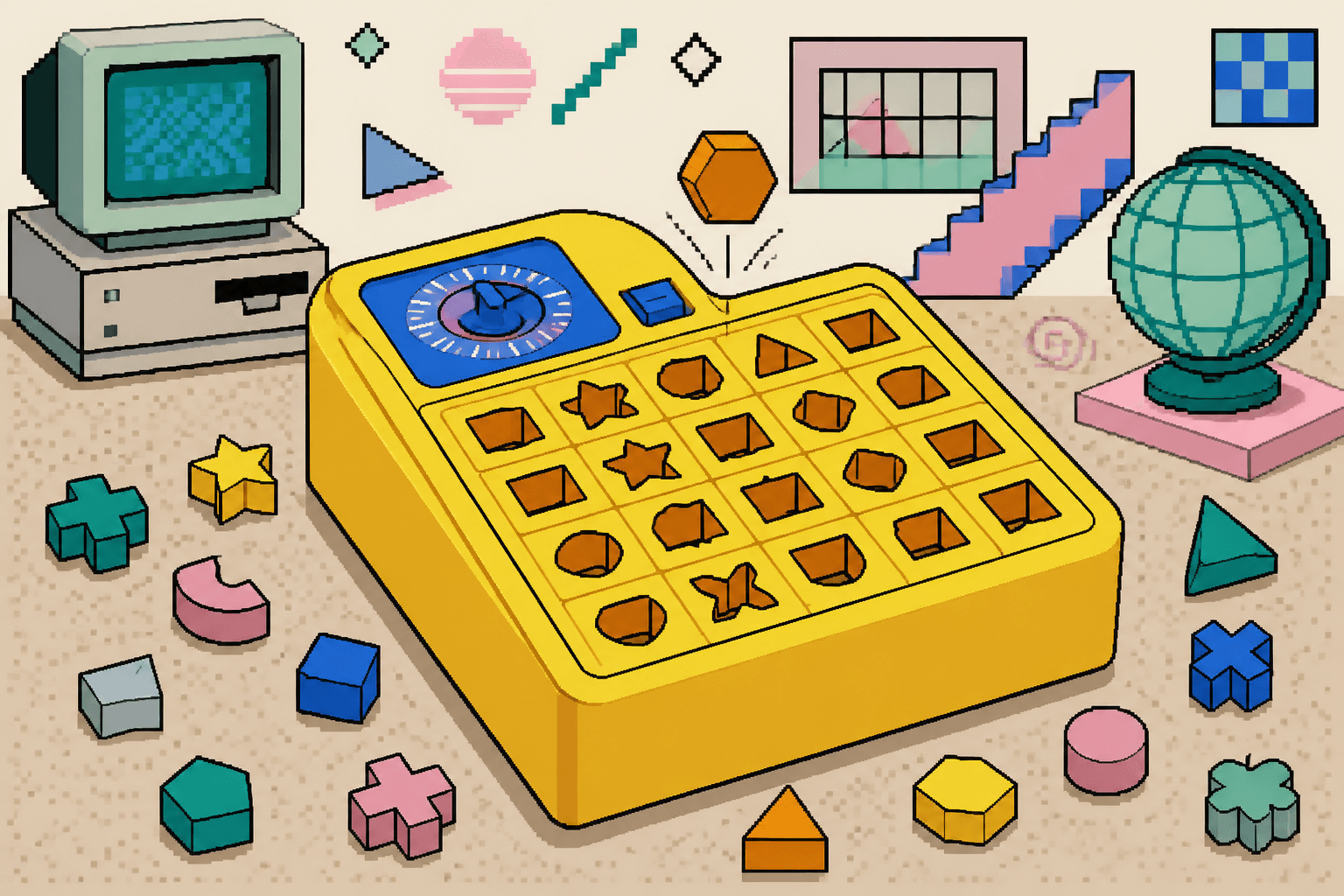
You pressed the tray down until it clicked. You heard the little spring engage under the plastic and lock into place. You picked up the timer knob on the corner and you wound it - one full clockwise turn - and you let go, and the toy began to count. Tick. Tick. Tick. Twenty-five shapes were spread across the carpet. You had sixty seconds. You did not have sixty seconds.
The first piece was the square. Everybody started with the square. The square was the biggest hole and the easiest to see and it was the confidence piece - the piece that let you say, one second in, okay, I've got this. You dropped it into the slot. It sat there. The tray stayed down. Twenty-four to go.
Somewhere around piece nine you started to sweat.
The Tray
Perfection was a shallow yellow-orange rectangle about the size of a dinner plate. It was thick plastic, injection-molded, and it weighed roughly what a bag of flour weighs, which is a lot for a toy. It sat on the carpet like it had been forgotten there by a much larger organization.
The top surface was a grid of shape-shaped holes. Twenty-five of them. Circles, squares, triangles, plus signs, hexagons, stars, weird trapezoidal wedges that no other toy in your house acknowledged. Some of them were similar enough that you could not tell them apart without picking them up. The trapezoid and the parallelogram, for example, were basically the same shape wearing different hats, and if you tried to force one into the other's hole in year two of ownership, when the pieces had softened a little at the edges, you could get it in there far enough to fool yourself but not far enough to make the tray behave.
Under the grid was a mechanism. You did not know what the mechanism was. You did not need to. The mechanism was where the badness lived. The mechanism was going to do something to you.
The Wind-Up
The knob was on the corner. Bright red or bright yellow, depending on the year. You turned it clockwise until it stopped. It resisted you the whole way, in a slow, mean, spring-loading kind of resistance that gave you time to reconsider. You did not reconsider.
When you let go, the knob started to rotate back on its own, and the sound it made was one of the defining sounds of the 1990s. Ticka-ticka-ticka-ticka-ticka. Not clean. Not clock-like. A dry, plastic, industrial ticking that meant the mechanism is running and it does not care what you are doing right now.
The ticking got louder in your head as it went. This was not the ticking's fault. This was your brain, doing what your brain does under a countdown, dropping the volume of everything in the room except the one sound that was going to end you.
The ticking got louder in your head as it went. Not the ticking's fault. Your brain, doing what your brain does under a countdown, dropping the volume of everything in the room except the one sound that was going to end you.
The Pieces
There were twenty-five pieces. They were the same yellow-orange as the tray but slightly darker, in the shade of plastic that looks like it should smell like something and does not. They sat in a shallow well next to the board when the game was over, and they scattered across the carpet the moment you needed them.
The shapes were technically all different. In practice, half of them were conceptually the same and just rotated. The rectangle and the long rectangle. The hexagon and the pentagon. The star and the star. There was one that was a very slight arch, like a small hill, and there was another one that was also a very slight arch, and they went in different holes, and you knew this in your bones by the third game, but you could never articulate it out loud.
Every piece had a top and a bottom. The bottom was slightly narrower than the top so it could actually seat in the tray. This meant every piece had to be right-side up when you dropped it in, and if you tried to place one upside-down under time pressure, it would sit above the hole like a piece of cereal on top of a bowl and refuse to descend, and you would jab at it in a panic while the tray ticked, and eventually you would realize the problem, flip it, and drop it, and by then two seconds had gone.
Two seconds mattered. Two seconds was a shape.
The Countdown
The ticking did not accelerate. That was one of the ugly things about Perfection. Most games with a timer speed up as the timer runs down - the Jeopardy! riff, the pinball warning tone, the bomb in every action movie ever. Perfection did not. Perfection just ticked at the same steady rate for the whole minute, and the horror was purely internal. You provided the acceleration. The mechanism provided the metronome. You supplied the panic, and it supplied the pulse, and the two of you together made the game work.
Around the thirty-second mark you started making small physical mistakes. You reached for the star and picked up the plus. You dropped the triangle on the way to its hole. You tried to force the hexagon into the pentagon slot, because you were nine and time was running out and both of those shapes had six sides in your head at that moment.
Around the fifteen-second mark you stopped trying to be efficient. You just grabbed the nearest piece and looked for its hole and dropped it in, and when you were wrong you moved on. There were maybe eight pieces left. You were pretty sure you could do eight.
Around the five-second mark your hand started to shake.
- :45 left. Cocky. Placing pieces one at a time. Making conversation.
- :30 left. Focused. Not making conversation. Two pieces mid-air.
- :15 left. Grabbing wildly. Six pieces left. Sweat on the upper lip.
- :05 left. Silent. Eyes locked. Three pieces left. Universe reduced to shape and hole.
- :00. KLONK.
The Pop
KLONK.
The mechanism released. The whole tray flew up on its spring by about an inch and a half, all at once, with a sound that was equal parts thud and snap and betrayal. Every piece that was in the tray was airborne. The pieces that had been in wrong hollows went up. The pieces that had been correctly seated went up too. The whole game exploded straight into your face.
You flinched. Every time. It did not matter that you knew it was coming. It did not matter that you had wound the timer yourself, personally, with your own hand, less than a minute ago. When the spring popped, you jumped, and one of the pieces landed on your leg, and two of them landed in the shag carpet where you would find them next Thursday under a couch cushion.
The pop was the point. The pop was the payoff. Perfection was not, if you thought about it, a game with a win state that mattered. Almost nobody won Perfection. Almost every game of Perfection ended with the tray popping and the pieces flying and everybody at the sleepover shrieking a little bit, and this was the outcome the toy was designed for. The rules said finish before the timer runs out. The mechanism said you will not. The mechanism was right almost every time.
That is a smaller and slower version. Real Perfection had twenty-five holes and one minute. Real Perfection punished your specific style of small-motor coordination in a way that this browser cannot recreate. But if you play it once and feel your shoulders come up around your ears at about the fifteen-second mark, you have accurately remembered the game.
The Argument For
Perfection was, secretly, a really well-designed toy.
It had one clear rule. Everybody, of every age, understood the game in one sentence: put the shapes in the holes before it pops. There was no reading. There was no setup beyond winding the knob. There was no maintenance. It didn't need batteries, ever, at any point, and this alone put it in a category with maybe fifteen toys from the whole decade. A pure mechanical loop. Wind it, play it, flinch, reset, do it again.
And it exercised something real. Perfection was a live test of shape-recognition speed and fine-motor precision under stress, and if you played it enough you did get faster - not dramatically, not in a way that would matter in adult life, but measurably, in the way that any repeated puzzle you do for a summer will start to feel a little easier by the end. You built a small mental catalog of the pieces. You learned which slot was in the third row on the left. You knew, without looking, that the arrow points up in its home position. You developed a small piece of expertise that had no application outside of this one toy and never would.
That was fine. Not every skill needs an application. Some skills are just for the summer of 1994.
The Argument Against
Perfection was, also, a device engineered to give small children a small dose of adrenaline at a specific moment they could not control.
There is a real bodily response to the pop. Your body cannot help it. Even when you know it is coming, even when you are ten and this is your fortieth game of the day and you have made a small science of the countdown, you still flinch when the tray goes off. This is because your brain, on some low level, does not care that you know. Your brain has decided that a loud sudden noise from a machine you are holding is worth an interrupt, and the interrupt is going to fire, and your shoulders are going to jump, and there is nothing your prefrontal cortex can do to override the reflex.
Milton Bradley, in the 1970s, decided that this was fun. Milton Bradley was, on balance, correct. Millions of kids agreed. But we should probably be honest that Perfection was, at some level, a jump-scare toy. It was Five Nights at Freddy's for kids in the era of shag carpet and one earth-toned corded phone in the hallway. Nobody framed it that way. Everybody would have played it anyway.
Milton Bradley, in the 1970s, decided that this was fun. Milton Bradley was, on balance, correct.
The Sleepover Configuration
At sleepovers, Perfection turned into a small performance.
One kid played. Everybody else sat around the tray on the shag carpet, at a respectful two-foot distance, watching. Nobody helped. Helping was against a rule that had never been written down. If you coached the kid at the tray - hexagon is bottom left, hexagon is bottom left - the other kids would look at you, in that patient way nine-year-olds have, and say nooo, come on, and you would shut up. The point of the game was that the kid at the tray was alone, in a small controlled panic, in front of witnesses. Coaching diluted the panic. Panic was the deliverable.
The pop, when it came, was a group event. Everybody flinched. Everybody laughed. The pieces went everywhere. Somebody's older brother, who had been standing in the doorway pretending not to be interested, would drift in and pick up a piece from the carpet and drop it into the tray and say bet I could get all of them and then he would try, and he would get to twelve, and the timer would pop on him too, and the older brother would say this game is rigged and walk away, and this was, culturally, the highest possible honor for Perfection to receive.
The Cleanup
The pieces went into a small compartment on the underside of the board, held shut by a plastic door with one Phillips screw and no hinge. The door fell off within a month. The pieces then lived in a Ziploc bag, or in the tray itself, or in the corner of the toy box, or under the couch. Perfection was the toy most likely, in your entire toy collection, to be missing exactly one piece.
The missing piece was almost always the small oval. Nobody knows why. Every Perfection I have ever seen in a thrift store is missing exactly the same small oval. The small oval is out there somewhere, in the collective sofas of the world, in the collective vacuum bags. A whole planet of small ovals.
I found a Perfection in the back of a closet at my parents' house a couple of years ago. My nieces were over, ages seven and nine, and they had never seen one. I set it up on the coffee table. I loaded the pieces around it. I let them look at the board for a minute so they understood what they were up against. I wound the knob.
The older one, the seven-year-old, sat down and played first. She was calm and methodical about it. She placed nine pieces cleanly. She hit fifteen seconds and I saw her look at the timer and her hand steadied instead of shaking, which was, honestly, a little disturbing. She got to nineteen pieces when the tray popped, and she jumped roughly two feet, and she said oh very softly, and she immediately picked up the pieces and asked me to wind it again.
The nine-year-old refused to play. She watched her sister play four more games in a row, from the doorway, arms folded, saying I don't like that sound every time the tray went. On the fifth game she came over and knelt next to the coffee table and said let me try and she placed twelve pieces and then she froze, and the tray popped, and she jumped harder than her sister had, and she laughed, and she said do it again.
They played until the batteries would have been dead if it took batteries.
The small oval was missing. I still don't know where it went.