The click was the whole thing.
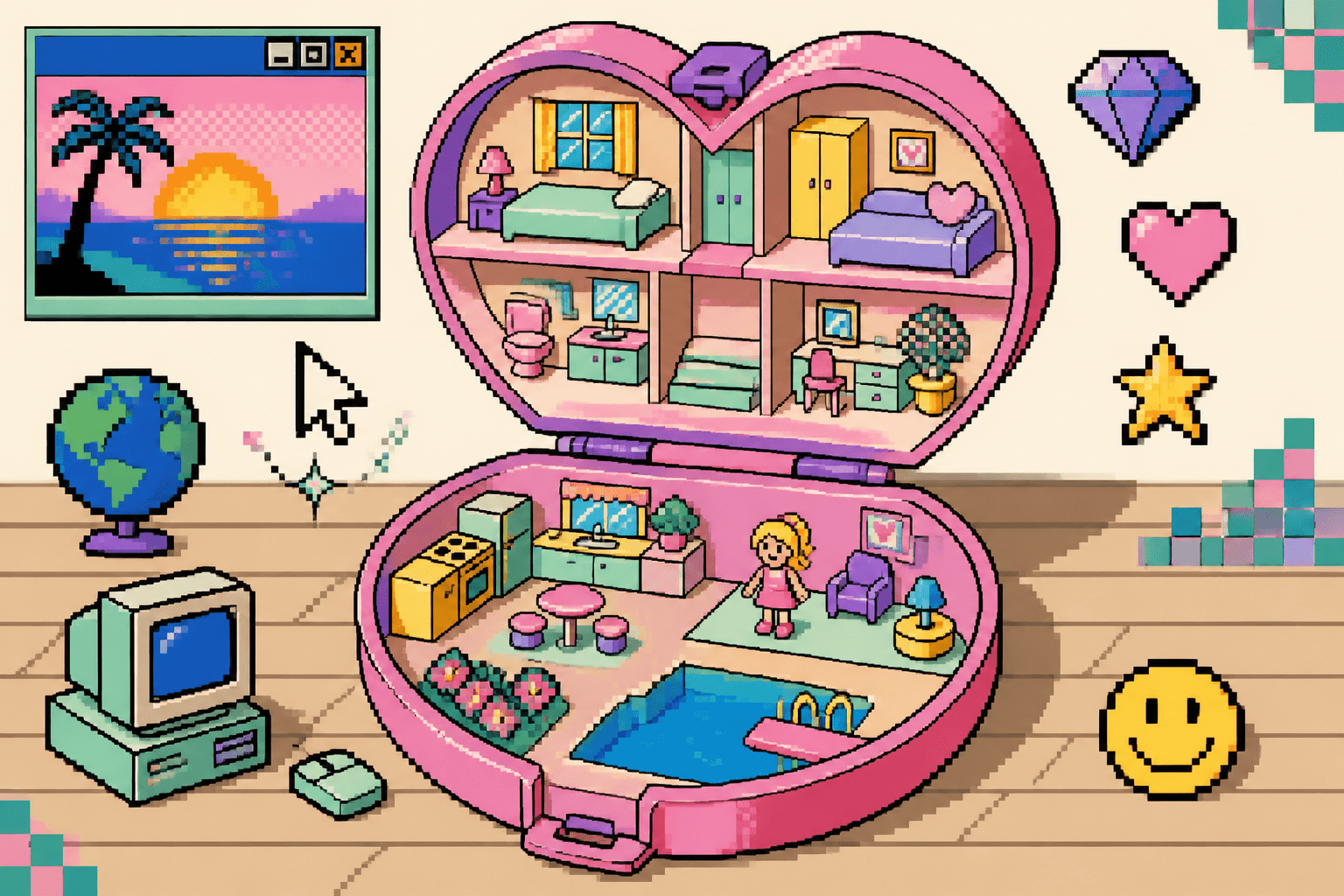
You opened the heart with your thumbnail. The little plastic catch made a sound that was somewhere between a click and a snap, a tiny mechanical commitment that the lid had agreed to open. Inside, behind that two-inch shell, was a house. Two floors. A kitchen with a stove painted on the wall. A pool with a slide. A swing on a hinge that actually swung. A bedroom with a bed the size of your pinky fingernail. And a woman, an entire woman, about the height of an aspirin, with a permanently molded ponytail and feet that did not move.
You snapped it shut. You opened it. You snapped it shut. You opened it. For ten minutes, the whole toy was just the hinge.
The Scale
A Polly Pocket compact, the original Bluebird one from before everything got ruined, was about the size of a clamshell makeup compact. Two inches across. Pink, mostly. Sometimes purple. Sometimes a baffling shade of pearl-green like the inside of an oyster shell. Always shaped like a heart, or a star, or a flower, or a tiny suitcase with a handle.
Inside was an entire architectural rendering at 1:48 scale. There were rooms. There were levels. There was a tiny ladder painted onto the wall that suggested a tiny ladder existed, even though it did not. There was a kitchen sink the size of a Tic Tac with a tiny faucet curled over it that you could not interact with in any way, but which you stared at, often, because how had anyone made a faucet that small.
The whole product was the secret of it. The fact that an entire world was being kept inside a plastic heart in your front pocket, and nobody knew.
The molding was the miracle. Polly's house had nine separate textures: brickwork on the chimney, shingles on the roof, tile on the bathroom floor, wood grain on the staircase, a flower pattern on the bedspread, a checkerboard on the kitchen, water ripples in the pool, a starburst on the rug, and tiny circles where the burners were on the stove. All of it cast in a single piece of plastic, no bigger than a sugar packet, painted with what must have been a needle.
The Polly
The figure herself was barely a figure.
She was about half an inch tall. Her hair was molded into her head in one chunk - a swept-back blonde wedge, or a ponytail, or two pigtails, identical on every doll. Her arms were down at her sides. Her legs were together. She was wearing a dress that was painted on. She had no joints, no posability, no expression beyond the two dots that were her eyes and the tiny line that was her mouth. She was a peg.
Her one functional feature was a small notch on the bottom of her feet. The notch fit into a corresponding slot on the floor of the compact - usually in the kitchen, sometimes by the pool, occasionally in the middle of the staircase, which made no architectural sense. You'd press her into the slot and she would stand. You'd tilt the compact and she would not fall, because she was wedged in. Then you'd pull her out, hold her between your thumb and forefinger like a contact lens, and walk her over to the swing.
- Bend any limb
- Change her clothes
- Sit down properly
- Hold an object
- Be picked up without dropping her at least twice
- Survive the dryer if she went through the dryer
- Be distinguished from the other Polly from the other compact your friend brought over
- Be reliably located in carpet
You loved her anyway. You gave her a name that was usually not Polly. She lived in a house that had no doors but did have a piano. She had a sister, sometimes, if the compact came with two figures, in which case the sister was also Polly, which you had to mentally rename mid-play.
The Click
The hinge was the product.
A Polly Pocket compact was, mechanically, two pieces of injection-molded plastic and one small spring-loaded catch. The catch was the entire user interface. You pressed the little tab on the front with your thumb, the heart popped open about a quarter inch on its own, and then you pulled the rest of the way with your other hand. To close it, you pressed the two halves together until you heard the snap, which meant the world was sealed.
The snap was the whole experience. The snap meant the world had been put away. The snap meant nobody could see your tiny house. The snap meant you could put the heart back in your pocket and walk around school with a secret cosmos riding against your hip.
That was the marketing copy and that was also the actual physics. The toy was named after the pocket. Polly was in your pocket. The whole product was the secret of it. The fact that an entire world was being kept inside a plastic heart in your front pocket, and nobody knew, and it weighed nothing, and it made a sound when you opened it.
The Pocket
She lived where the toy said she lived.
A Polly Pocket compact was small enough to fit in the front pocket of jeans, which was the actual unique selling proposition and which the brand name was not subtle about. Other toys lived in toy boxes. Other toys lived on shelves. Polly lived in you. You took her to school. You took her to your grandma's house. You took her to church and opened the heart very slowly during the sermon so the click wouldn't carry.
Then she fell out.
The thing about a half-inch plastic figure is that it weighs less than a fingernail clipping. You'd open the compact in the back of the car, pop the Polly out of her slot, drop her once on the seat, find her again, put her back, drive home, take the compact upstairs, and at some point between the car and your room you would lose her, permanently. Not because you'd been careless. Because she was the size of a grain of rice with feet.
Polly fell into:
- The crevice between the couch cushion and the armrest
- The narrow space along the floorboard of the back seat of the Camry
- The lawn
- The carpet, specifically the section of carpet directly beside your bed, where she would remain visible for six months as a small pink dot until she vanished
- The vacuum cleaner, audibly
- Your friend's pocket, by accident, never to be returned
You always lost the Polly first. The compact you kept. You'd open the compact later, look at the empty slot in the kitchen floor where she used to stand, and feel a specific small grief that nobody else in the house would understand. The house was still there. The woman was gone. It was a sealed plastic ghost story.
The Other Polly
Then you'd find a Polly from a different compact.
This Polly had blue hair, or green eyes, or a painted-on bathing suit instead of a dress. She did not belong in the kitchen of the heart-shaped house. She belonged in a starfish compact you had given to your cousin two birthdays ago. But she fit. The notch was standardized. Any Polly went in any slot.
So you used her. You wedged her into the kitchen. You told yourself this was now her house. She lived here now. The first Polly was somewhere in the upholstery. The new Polly was in the kitchen, dressed for swimming, and that was just the new continuity. You did not question it. You were eight.
The compact you kept. The Polly you lost. The Polly you found was someone else's, dressed wrong, slotted into a kitchen that wasn't hers.
The toy industry calls this figure interoperability and considers it good design. We just called it finding a Polly. It happened the way money happens. Somebody had lost a Polly, and now you had one, and tomorrow you would also lose her, and another kid would have her, and the population of Pollies in the world remained roughly constant while individual Pollies cycled through ownership like coins.
The Mattel Era
Then Mattel bought the brand and made everything four times bigger.
This was 1998. Bluebird Toys, the British company that had been making Polly Pocket the right size since 1989, got acquired. Mattel kept the name. Then Mattel decided, reasonably, that a half-inch figure was a choking hazard for a toy aimed at small children. The new Pollies were three inches tall. They had bendable limbs. They had real clothes you could take off. The new compacts were the size of a paperback. They had a sticker sheet. They had accessories. They had a brand strategy.
They were also, fundamentally, a different toy.
The original Polly Pocket was a secret. The point was that the whole house was small enough to hide. The point was the click. The point was the fact that this thing was sized for you, the kid, not for the giant world of adults. A three-inch Polly with removable shoes was just a small Barbie. A two-inch heart you could keep in your pocket was a portal.
The original was discontinued. The kind of compact where the figures were the size of a baby tooth and the kitchen sink was the size of a freckle - that thing is not for sale anymore, except on eBay, where someone has them in a Ziploc bag for forty-five dollars including the Pollies, which is a lie, because the Pollies have been lost since 1996 and the seller does not know yet that the Ziploc bag has only the compact.
The Argument
I want to be sentimental about this and I am not going to let myself.
The original Polly Pocket was a choking hazard. The recall data is real. There are good reasons that Mattel made the figures bigger, and the good reasons involve toddlers in emergency rooms, and any honest accounting of the toy has to include that the original design was, by modern safety standards, dangerous.
It is also true that the original was a better toy. Not because small things are inherently better than big things. Because the smallness was the idea. The brand was named Polly Pocket. The whole brief was small enough to fit in your pocket. When you take that away, you have a small Barbie, which is fine, but is not what the box on the shelf at Toys R Us in 1993 was selling. The box was selling secrecy. The box was selling the click.
A three-inch Polly with removable shoes is a small Barbie. A two-inch heart you can keep in your pocket is a portal.
Both things are true. The toy was unsafe. The toy was perfect. These do not cancel out. They sit next to each other on the same shelf, the way the compact and the lost Polly sat next to each other in the carpet, for years, before the Polly went somewhere and the compact stayed.
The End
I have one. It is on my desk. It is shaped like a starfish. It is missing its Polly.
I opened it last week and looked at the tiny molded kitchen and the tiny molded bed and the tiny empty slot where someone named Jessica used to stand, in 1994, before she fell into the back seat of a Ford Taurus and was vacuumed up by a dealership detailer in Ohio. I do not know any of this is true. It is just the most likely chain of events. Pollies do not stay. The compacts do.
I closed it. The click was still good. The click was the whole toy. The click meant the world was sealed.
You can buy them again now. Mattel is making them again, in collector sizes, with adult buyers in mind, with the original 1989 dimensions and a price tag of forty dollars. They come in collector boxes. They come with a Polly who is glued into her slot so she cannot be lost. They come with a card that says original size. They are very nice.
They are not the same thing.
The original Polly Pocket was a piece of injection-molded plastic that fit in your pocket and contained an entire architectural rendering of a house with a swimming pool and a tiny molded woman who lived there until you took her out of the kitchen and put her on the back seat and then she was gone forever, and you walked around with an empty compact in your pocket for three more years, opening it occasionally to look at the kitchen, and the kitchen was always still there.
The kitchen is always still there. That is the whole product. That was always the whole product. Polly was just borrowing it.