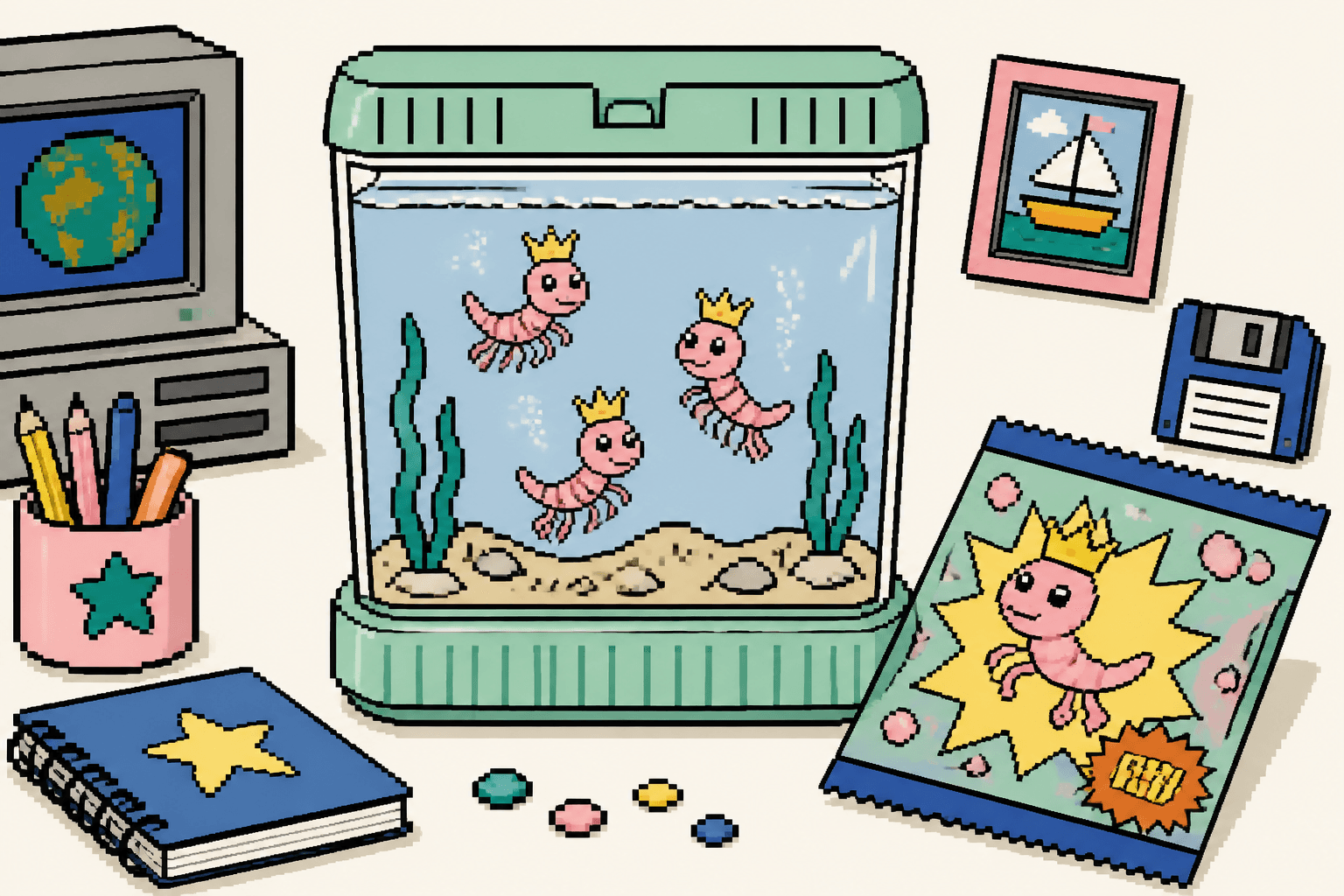
The ad was on the inside back cover of a comic book. You were holding a Spider-Man on the rug at your friend's house and you turned to the last page and there they were. A cartoon family. Pink, naked, smiling. The dad had a tail. The mom had eyelashes. Both of them, and the two kids, were wearing tiny gold crowns. The dad was waving. The whole family appeared to be standing upright underwater, in a glass castle, looking at you.
The text said INSTANT LIFE - JUST ADD WATER. It said They love attention! It said Order yours today, only $1.25 plus shipping.
You were eight. You filled out the order form in pencil. You found an envelope. You put $1.25 of birthday money in the envelope, plus the shipping, which you had to ask your mom about. You stuck a stamp on it. You walked it down to the mailbox at the end of the driveway and lifted the red flag.
Then you waited.
The Wait
Six to eight weeks, the ad said. SIX TO EIGHT WEEKS. You did not know how long that was. You found out.
You checked the mailbox every day after school. The dog walked with you. The mailbox had a magazine, or a bill, or a flyer for siding. Then, eventually, on a Wednesday, there was a small padded envelope with your name on it and a postmark from someplace in New York. You ran inside. You tore it open at the kitchen table while your mom was making spaghetti.
Inside the envelope was: a plastic tank the size of a deck of cards, three foil packets, and a sheet of paper folded in quarters with instructions in two languages. That was it. The packets were the size of duck sauce packets from a Chinese restaurant. You held the empty tank up to the light and looked through it.
It was, technically, a tank. It was also, technically, a small acrylic box from a factory in Long Island.
You held the empty tank up to the light. It was a small acrylic box from a factory in Long Island. It was also, technically, a tank.
The Packets
There were three of them and the order mattered.
Packet #1 was the Water Purifier. You filled the tank with tap water - your mom let you do it at the sink, which felt official - and you tore open the first packet and dumped the powder in. It dissolved. The water turned faintly blue. You stirred it with the little plastic spoon that came in the kit, or with a chopstick, or with your finger. The instructions said to wait 24 hours.
You waited 24 hours, sort of. You went to bed. You checked it before school. You checked it after school. The water looked exactly the same. You said is something supposed to happen yet, and your mom said that's the next packet, honey.
Packet #2 was Instant Life. This was the magic packet. It contained the eggs.
You tore it open over the tank. A puff of dust came out. You poured the rest in. The instructions said to wait no more than five minutes, and you will see them swim.
You stared at the tank. The dust settled toward the bottom. You stared harder. After about four minutes, you saw something. A speck. The speck moved. It was not the dust. It was a Sea-Monkey. You had created life. You ran to get your mom.
Packet #3 was Growth Food. You were supposed to feed them every few days, a tiny pinch at a time. The food was a different dust, browner. You tapped a little in. The specks ate it, presumably. They got slightly bigger over the next few weeks. They eventually got, at their absolute peak, about a quarter of an inch long.
A quarter of an inch.
The Tank
Press the button. Add the water. Add the life. They are extremely small. You may have to squint.
I'll note that the toggle is a lie, mostly. The cartoon family - the crowned ones, with the smiles and the eyelashes - was an illustration by Joe Orlando, drawn for the back of comic books in 1962 because Harold von Braunhut, who had patented the brine shrimp cyst process two years earlier, needed something to put on the ad. The illustration was the product. The cysts were what they shipped. Those two things were not the same product. We sort of knew that. We sort of did not care.
The Science
The Sea-Monkey was Artemia salina, a species of brine shrimp that has been in the saltwater pools of dry inland deserts for about 100 million years. Its trick is that its eggs - more properly, its cysts - can survive complete dehydration for decades. You can put them in a jar on a shelf for ten years and then add salt water and they hatch.
That is genuinely incredible. A tiny crustacean evolved a way to suspend life indefinitely, get folded into a foil packet, sit in a warehouse in Yonkers for two years, get mailed to a third-grader in Indiana, and resume existing.
The packet you got contained brine shrimp cysts and a sodium chloride buffer that made tap water salty enough to hatch them. That was all "Instant Life" meant. It meant we already started this process, we just paused it, which is a kind of magic but not the kind the comic book ad was selling.
The trick was that brine shrimp eggs can survive complete dehydration for decades. That's genuinely incredible. That's just not what the cartoon family was doing.
The shrimp did not wear crowns. They did not have eyelashes. They were not a family. They were, taxonomically, closer to a barnacle than to anything in the comic book. They lived for a few weeks, swam in jerky little arcs, and died one at a time over the next month, sinking to the bottom of the tank, where they joined the residue from Packet #1 and Packet #3 in a fine sediment that you did not, at age eight, want to look at too closely.
The Ad
The ad was the actual product.
Harold von Braunhut, who also invented X-Ray Specs and the Invisible Goldfish, understood mail-order. He understood that what he was selling was not a brine shrimp. He was selling the gap between the comic book illustration and the foil packet. You were paying $1.25 for the right to spend six weeks imagining a glass castle full of crowned aquatic people, and then a few minutes watching what arrived, and then the slow conversion of one image into the other.
- "Instant Life!" - cysts in a foil packet
- "They love attention!" - they will not perceive you in any way
- "Train them to do tricks!" - they will not do tricks
- "A bowlful of happiness!" - a quarter inch of brine shrimp
- "Eager to please!" - extremely small
- "World famous!" - sold via comic books
- "Live longer than goldfish!" - in some specific cases
- "Just add water!" - this part is true
This is, I think, the model for a lot of things that came later. The thing you ordered was not the thing you saw. The thing you saw was the thing that existed to get you to order. The product was the wait, and then the small confrontation with reality, and then the choice you made about whether to keep loving it anyway.
A lot of kids kept loving it anyway. That is the whole story of the Sea-Monkey.
The Argument
I want to be careful here, because there is a version of this essay that is just kids today are too cynical, we used to believe in things, and I am not writing that essay. We were not less cynical. We were just younger, and the ad was very good.
There is also a version of this essay that is the Sea-Monkey was a scam, this taught us not to trust capitalism, and I am not writing that one either. The Sea-Monkey was not a scam. You ordered brine shrimp eggs and you received brine shrimp eggs and the brine shrimp hatched and you watched them. That is what you paid for. The misunderstanding about what they would look like was, technically, on you, although the comic book did its level best to set up the misunderstanding.
What I do want to say is something about the gap. The gap between the cartoon family with the crowns and the small jerky speck. That gap was the thing we actually bought.
We did not know, at eight, that you could buy a gap. We thought you bought a thing. The Sea-Monkey was the first time some of us learned that the marketing image and the actual object could exist as two separate products. The marketing was for free. The object cost $1.25 plus shipping. You got both. You had to do the work of reconciling them yourself.
A lot of subsequent purchases were just this. The vacation in the brochure versus the vacation. The car in the commercial versus the car. The job in the offer letter versus the job. The Sea-Monkey was a training round.
The Sea-Monkey was the first time some of us learned that the marketing image and the actual object could exist as two separate products. You got both. You had to reconcile them yourself.
The Tank on the Dresser
Mine sat on my dresser for about three months. I fed them. I named two of them, even though I could not really tell them apart and even though the population kept changing as some died and the survivors laid eggs that hatched into new ones. The named ones were Greg and Sandra. Greg and Sandra were definitely not the same shrimp over time. I knew this. I called them Greg and Sandra anyway.
Eventually the water got cloudy. Eventually my mom said we have to clean this or get rid of it, and I said clean it, and she said I am not cleaning it. The tank went outside, behind the garage, with the water still in it. Some of the Sea-Monkeys were still alive when it went out there. Some of them were probably alive for a few more days. Some of them, almost certainly, were not.
I do not know what happened to the tank. I think my dad threw it out. I think we did not talk about it. The remaining cysts on the dry parts of the tank, freeze-dried into the corners, are possibly still viable somewhere in a landfill in Pennsylvania. You could, in theory, add water to that landfill and get a Sea-Monkey out of it. That fact is just sitting there. I am sharing it with you. Do with it what you will.
The End
I looked them up recently. The Sea-Monkey brand still exists. You can buy a kit at Walmart for about ten dollars. The tank is bigger now, and clear acrylic, and the packets are the same. The ad on the back of the box still uses Joe Orlando's cartoon family. The crowns. The smiles. The eyelashes. The whole impossible aquatic civilization. They have not updated the illustration in sixty years. They do not need to. The illustration is the product. Always has been.
There's a kid out there right now, somewhere, holding a Spider-Man comic - except it's a Spider-Man movie tie-in book from Walmart, and the ad is for a tablet game, and the Sea-Monkey kit is in a shrink-wrapped clamshell three aisles over. The pipeline is shorter. The wait is shorter. The illustration is still the illustration.
The shrimp are still brine shrimp. They still live for a few weeks. They are still about a quarter inch long.
They are still, technically, not wearing crowns.