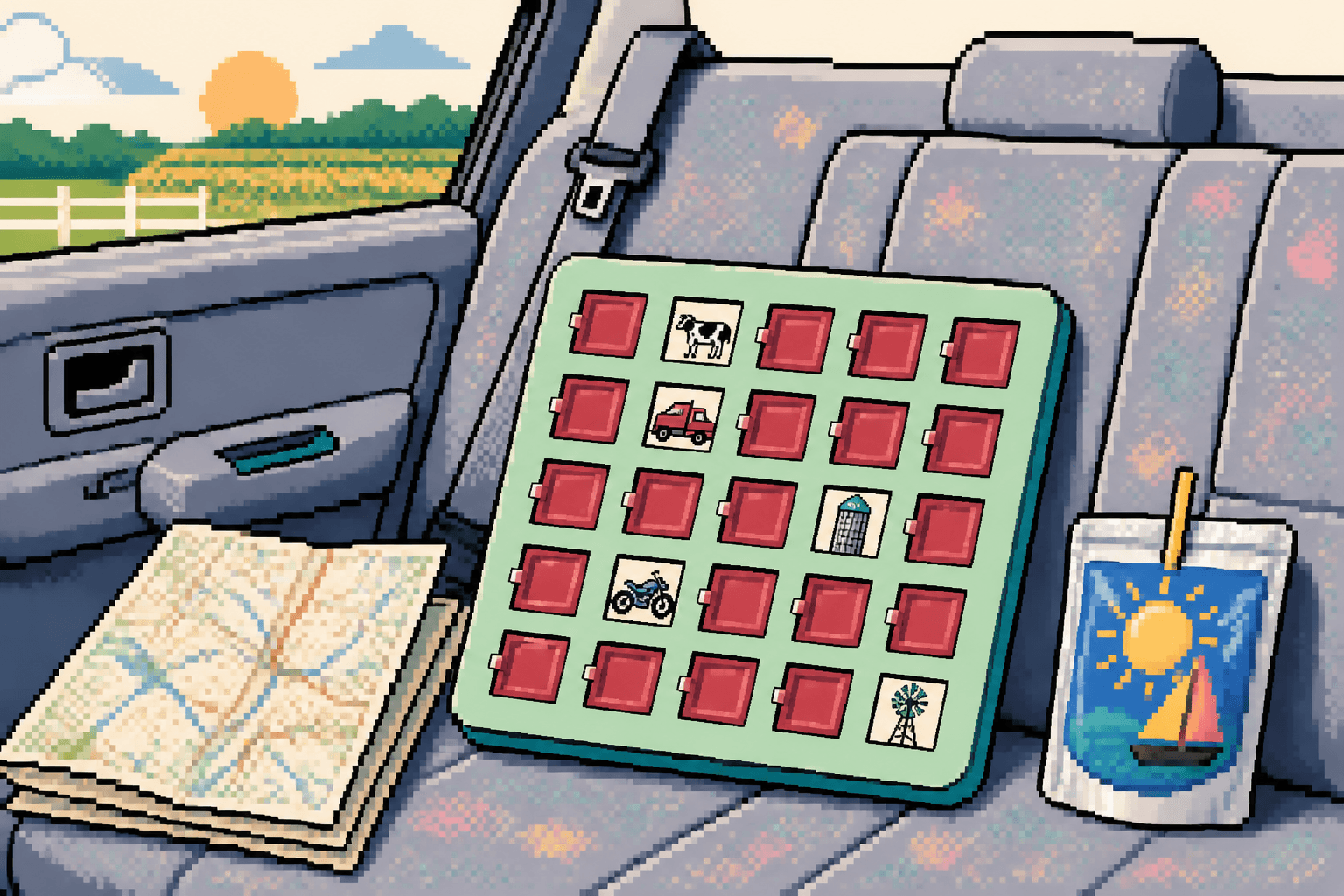
The card lived in the seat pocket. It had been there when you got in the car three states ago and it would be there when you got out three states later, wedged between the atlas and the manila envelope of insurance documents your mother had put in there in 1997 and never looked at again. You didn't need to ask for it. You reached forward, felt cardboard through the mesh, and pulled it out. Auto Bingo. Twenty-four little red plastic shutters and a printed FREE square in the middle, five across and five down on a cardboard rectangle the size of a paperback. The whole thing rattled softly if you tilted it, which was the first thing you did.
You tilted it now.
The Card
Regal Games made these, though nobody knew that. They came in a plastic sleeve at gas stations in Pennsylvania, in the checkout aisle at the Cracker Barrel outside Nashville, in the wire spinning rack at a Stuckey's off some exit in Georgia. Two dollars, maybe three. The cardboard was thick enough to feel like a real object but not so thick that the shutters didn't clatter when you shook it. Each shutter was a small rectangle of translucent red plastic, held onto the card by two little tabs that let it slide up and down inside a printed frame. Under the shutter, when it was up, was a picture. Cow. Silo. Red barn. Motorcycle. School bus. Windmill. Pickup truck. Semi. Out-of-state license plate. Church. Water tower. Deer. Mailbox with the flag up. Road sign with a state name on it. Brown horse. Tractor.
The pictures were tiny line drawings. The kind of art you make when you have one guy and a printer and eight hours. They looked like they had been drawn by someone who had once had a cow described to them over the phone.
Nobody cared. You knew what they meant.
The pictures looked like they had been drawn by someone who had once had a cow described to them over the phone.
The Shutter
The shutter was the mechanism, and the mechanism was the game.
You'd spot a cow. You'd reach down, put your thumbnail under the shutter over the cow, and slide it - up, or down, depending on which way the card had rotated in your lap. There was a small mechanical click as the shutter passed through a detent halfway along the track and settled at the end. A yes. A clean, specific, tactile yes. That click, for a kid on a highway with nothing else to do, was as satisfying as almost anything else a kid on a highway could get.
The problem was that the shutters didn't want to stay shut.
The plastic was too soft, the track was too shallow, and the car was in constant slow vibration. A highway seam. A tar strip. A pothole in Delaware. Your father drifting the tires off the lane marker and back on. Any of these could pop a shutter halfway open, and once one had popped, you had a decision. You could reset it, in which case you were now doing bookkeeping. You could pretend it was still closed, which was cheating. Or you could grimly re-slide it and hope the next bump held off for thirty seconds.
The card was, in a real sense, a machine for creating tiny road-trip crises.
What Counted
Half the game was the arguing.
Was that a pickup or was that an SUV with an open bed? Did a semi need a trailer, or did a bobtail count? What about a school bus that was clearly, from the paint scheme, a church bus? Did a windmill count if it was one of those little three-foot decorative ones in someone's yard? Did a brown horse count when you were doing seventy and it was really more of a shape in a distant field? Was a state trooper's cruiser a car, or did cop cars get their own square that this card didn't have, in which case did they count or not count?
- Convertibles counted as sports cars if the top was down. If the top was up, they were sedans, which was not a square.
- A minivan was a van. A cargo van was a van. A Vanagon was not a van and my brother could not explain why.
- An out-of-state license plate had to be genuinely other. Delaware plates in Pennsylvania didn't feel other enough. New Mexico did.
- A dog counted only if you actually saw the dog. A silhouette of a dog in someone's back window did not.
- A silo in a magazine advertisement on a billboard did not count. This came up.
The rules on the back of the card, printed in something like six-point type, said that a neutral party should confirm each spotting. Your neutral party was the person driving. Your neutral party had not looked at you in an hour and was actively trying to merge. Which meant the game had no oracle. It was pure honor system between two children in a moving vehicle, which is to say it was whatever your older brother could argue you into.
I once got bingo on a stretch of I-84 and my brother told me the third square in row two, school bus, didn't count because the bus we had passed had been yellow but was clearly, from context, a church bus. He was seven. I was ten. I un-shuttered it.
The Freebies and the Impossibles
Some squares were nearly free. Cow was a freebie once you crossed any state line. Motorcycle was a freebie in summer. Semi was a freebie the moment you got on an interstate. Red truck was midlist. Pickup was easy. Van was easy. Bus was medium. Church was medium and depended on whether your parents were the kind of parents who took the exits with the picturesque steeples.
Some squares were monstrously hard.
Deer was a Northern-tier square that meant nothing to a kid driving to Orlando. Windmill was for people who were, apparently, expected to be driving through Kansas. Silo was for the same person. Water tower was easier than you'd think because every small town has one, but you had to actually be looking up, and the whole game was designed for a child who was looking at a card. Brown horse was cruel. Brown horse was, in most parts of the country, brown-horse-with-a-hedgerow-in-front-of-it or brown-horse-at-half-a-mile.
And the hitchhiker square, on the older versions of the card that a lot of you didn't have but that your uncle definitely did, was a completely different problem.
The Moment
The moment was the point of the game and it was almost never worth the game.
You'd get a row. You'd realize you were one square from a row. And then every window of the car became a possible source, and you were staring so hard at the passing landscape that your eyes got that specific highway ache, the one where you had been focused-not-focused for too long and everything past the guardrail looked like water. You'd will an out-of-state plate into existence. You'd try to promote a station wagon into a van. You'd count a semi you had seen ninety miles ago just in case nobody was checking.
And then it would happen. The last square. Sometimes it was the silo, in Iowa, at hour six. Sometimes it was the church, in South Carolina, at hour eleven. You'd slide the shutter down, the small mechanical yes would arrive, and you would yell BINGO into the front seat.
And your father would say what.
And your mother would say not so loud.
And the car would keep moving toward Cocoa Beach.
You'd yell BINGO into the front seat and your father would say what and your mother would say not so loud and the car would keep moving toward Cocoa Beach.
The Reset
You had won something no one else in the car had understood the terms of. And now, having won it, you had to unwin it, because the only way to play again was to reset all twenty-four shutters, and the only way to reset the shutters was to flip the card over and push them back up from the other side, one by one, with a little plastic sound that was the exact reverse of the click.
Undoing them took as long as spotting them. This is the part of the game they don't advertise. You'd sit there for four minutes sliding red plastic upward in a card that was already curling at the corners from your sweaty hands, while your brother watched you with the same expression a federal auditor probably has, waiting for his turn. Which he would then win, at which point you had to reset the card again.
By hour eight, the card had been reset seven times. Two shutters had come off. One had fallen between the seats and would be found next spring under a French fry. The cardboard was soft at the edges where you had been gripping it. The little printed cow in the upper left had a permanent thumbprint on him.
You looked out the window. You saw a cow. You didn't do anything about it.
What It Was Really For
Here is the thing about Auto Bingo. Nobody was actually keeping score.
The card was a device your parents had bought at a truck stop so that you would be doing something instead of asking about lunch. You did not know this at the time, and neither did they, not consciously, but the parent-child transaction was clear. Your parents got forty-five minutes of quiet. You got a shutter that clicked. Everybody won.
I found one, of course. In a shoebox in my mother's garage last April. Not the exact one from that summer - or, who knows, maybe it was - but a Regal Games Auto Bingo card, five across, five down, twenty-four little red plastic shutters and a printed FREE square in the middle, some of them still slid closed from the last time some version of me had spotted a cow.
The cardboard was soft. Two of the shutters were missing. The one in the upper left, where the cow lived, had that thumbprint. I ran my nail along the track of the semi truck square and slid the shutter down. It clicked. Actual, mechanical, faint, but it clicked. Thirty years old and the detent was still there.
I sat on the floor of the garage and did the whole card. Twenty-two shutters, in a house where I was thirty years too old to be doing it. Every one of them clicked. Two of them fell back open when I set the card down on the concrete, because the concrete had a vibration to it I couldn't feel but the plastic could.
I picked the card up. I re-slid the two shutters. I set the card down. They fell open again.
I laughed at nobody in particular. And then I put the card back in the shoebox and slid the shoebox back on the shelf, and I closed the garage, and I got in my car - which has heated seats and a screen that plays anything my kid asks for and a rearview camera that shows her back there strapped in with a tablet in her lap and headphones on - and I drove home.
She didn't tilt anything.