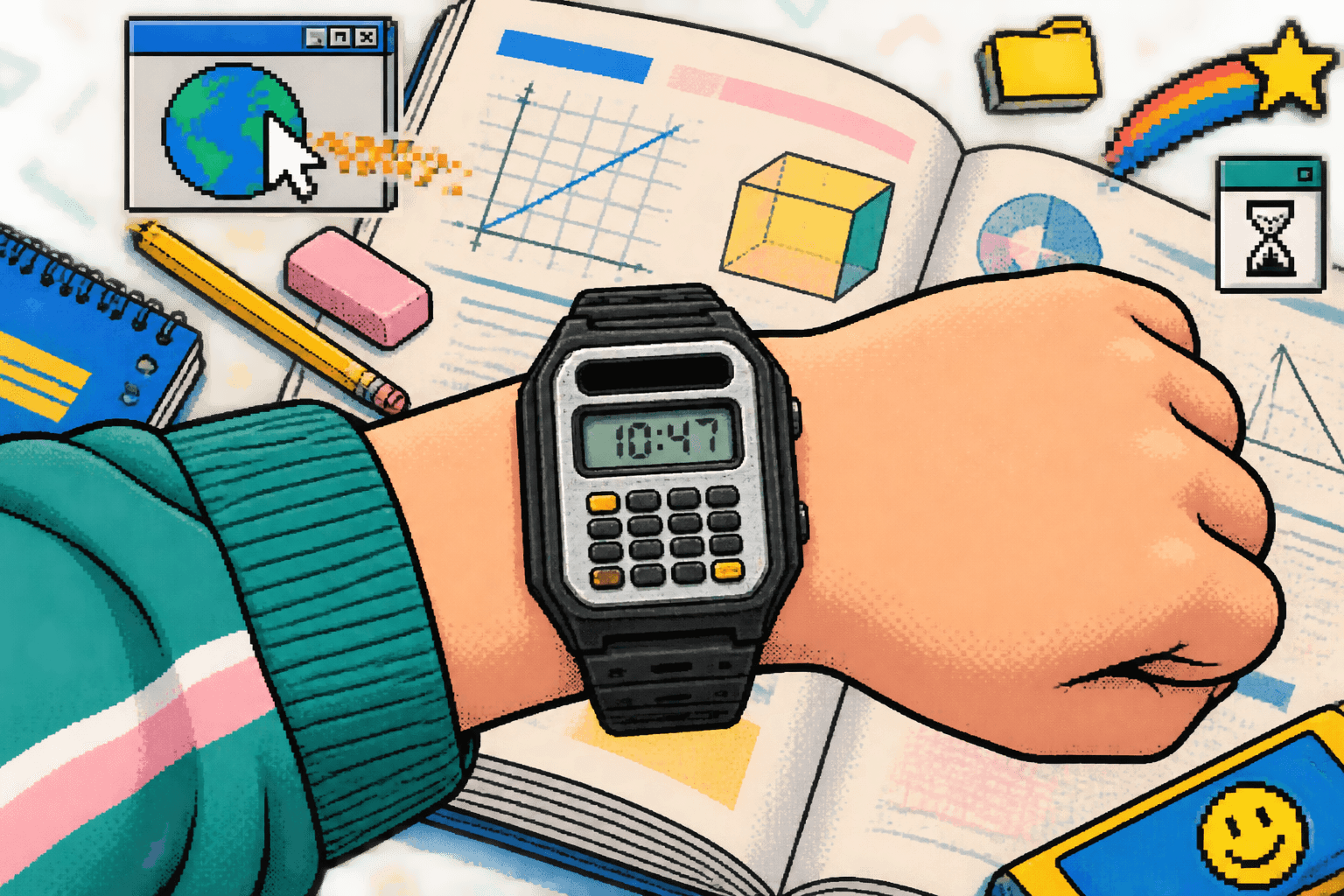
You checked the time. You did not need to check the time. You already knew the time - the classroom clock was six feet away and you had been staring at it. You checked the time because you wanted an excuse to look at your wrist for four seconds, because your wrist had a calculator on it.
The watch was black plastic and the width of two fingers. It had a rectangular LCD in the middle, a silver bezel around it, and, below the screen, four rows of tiny raised bumps that were, technically, buttons. There were about thirty-seven of them. Or forty. You never counted, because to count them you'd have to touch each one, and touching them was a whole thing.
The Buttons
The buttons were the size of a poppy seed.
They were arranged in a grid, laid out like a full QWERTY keyboard on some models and a calculator numpad on others, and every single one of them was flush with the surface of the watch face, or slightly below it. There was no tactile feedback. There was no click. To press a button, you needed a small hard tip - a mechanical pencil, a compass point, a straightened paperclip. Your fingernail sort of worked if you had one. Your fingertip did not work at all. Your fingertip pressed roughly nine buttons at once, or, more accurately, one button that was different from the one you intended.
You were eleven and you had eleven-year-old fingers, which were smaller than adult fingers, and even your fingers did not fit. This was not a design flaw the manufacturer had somehow overlooked. This was a watch built for a person who did not exist. The instructions specifically recommended using a "pointed object." You carried a mechanical pencil to school every day partly, if you were honest with yourself, so that you would have a pointed object at all times.
The watch was built for a person who did not exist. The instructions specifically recommended using a "pointed object." You carried a pencil to school partly so you would have one at all times.
The Calculator
The point of the watch was that it had a calculator in it. This was the feature. This was what was printed on the packaging in a red starburst. This was what got you to spend forty-two dollars of birthday money at Service Merchandise instead of buying a normal watch for twelve.
You never used the calculator for math.
You could not use it for math. The screen was maybe a centimeter tall. The digits were small enough that you had to bring the watch to your face, which meant you had to twist your wrist toward you, which meant that in any actual math class the teacher would see you doing it and think you were cheating. You were not cheating. You could not have cheated if you had wanted to. It took you about twenty seconds to enter a two-digit multiplication problem with a pencil tip, and by then the teacher was standing next to your desk.
What you did use the calculator for:
- Typing
55378008and turning your wrist upside down so it spelled BOOBLESS. - Typing
5318008and turning it upside down so it spelled BOOBIES. This was funnier when you were eleven. - Typing
07734for hELLO, which required you to explain the h to your friend, who said that's an h though and you said yeah I know and he said so it's hello, not HELLO and you said fine and it took the joke apart. - Adding 2 and 2, hitting the equals sign, and watching it come back with 4, to prove you could.
- Adding two very large numbers slowly, one digit at a time, over the course of a whole class period, to see if the total was what you expected. It usually was. This was a way of doing homework you did not have.
That was about the extent of it. A forty-dollar computational device deployed exclusively for the numerical spelling of the word BOOBS.
The Alarm
The alarm was where the watch got you into actual trouble.
Every calculator watch had at least one alarm. The good ones had five. You set the alarm by cycling to alarm mode, then holding a button, then pressing arrows, then pressing another button, then setting the hour, then setting the minute, then confirming. Somewhere in this sequence you would misclick and set the hour ahead by three. You would fix it. You would misclick and set the minute back by eight. You would fix that. You would eventually get 8:47 on the screen, hit set, and forget which mode you were in, so you would then re-cycle out of alarm mode by pressing MODE four times, which would put you back in time mode showing the wrong time by six minutes because you had accidentally set the clock to 8:47 instead of the alarm.
Fine. You fixed it. It was correct now.
The alarm went off at 8:47 the next morning, which was in the middle of second-period English.
The alarm was a specific eight-note song. Not a beep. A song. Casio had programmed a little melody into it, tinny and repetitive and unmistakable - bee-bee-bee-BEEP, bee-bee-bee-BEEP - and it played for thirty seconds and it did not have a snooze button and to stop it you had to press any button, which you could not do, because your fingers were still too big for the buttons and now you were panicking and there were thirty-two other kids looking at you and the teacher had stopped talking.
You ended up smacking your entire wrist against the edge of the desk to stop it, which pressed enough buttons at once that it silenced. Also it now said E on the display in three places and you had no idea why.
You did this once. You then, forever after, disabled every alarm on the watch, which took nine minutes to do because each alarm required six button presses to disable. You accepted this.
- TIME. The default. Showed the time. What most watches did with less effort.
- CALC. The calculator. Used for spelling BOOBS.
- ALARM. Where you spent nine minutes disabling five alarms after the incident.
- STOPWATCH. For timing your friend running to the fence, and later for timing silences at the dinner table.
- DATA BANK. On the fancier models. See below.
- DUAL TIME. For knowing what time it was in London, which you did not need.
The Backlight
The backlight was the coolest thing about the watch. It was, honestly, the whole reason.
You pressed a specific button on the top-right of the bezel, and the screen glowed a faint radioactive green. It was the color of a broken glow stick. It made the numbers look like they were floating. It lit up your entire wrist and part of your sleeve.
You did this at sleepovers. You did this in the back seat of the car on a night drive, holding your wrist up to the window. You did this in bed with the covers over your head, checking the time you did not need to check, feeling for a second like a person on a submarine or in the cockpit of something. The backlight lasted about a second and a half, then faded. You pressed the button again. Another second and a half. The battery was, allegedly, being depleted by this. You did it anyway.
There was a specific tsk sound the watch made when the backlight came on. Or you thought there was. There was not. But you remember one.
The Data Bank
The high-end model was the Data Bank. It could store, depending on which version, between twenty-five and one hundred and fifty phone numbers, and had a full alphabetic keypad printed on the face.
Except: to enter a letter, you did not type it. You pressed a directional arrow to scroll to it. A was one press. B was two. Z was twenty-six. To enter your friend Zack, you pressed the arrow twenty-six times, then advanced a space, then pressed the arrow one time for A, then advanced, then pressed the arrow eleven times for K. That was one name. It had taken you two full minutes and you had not yet entered the phone number, which was seven digits, which was another thirty seconds. And you had two hundred and forty-nine remaining slots.
Nobody entered any names.
You had, in the data bank, on the day you eventually took the battery out three years later, exactly two entries:
HOMEand your home phone number, entered by your dad at the store because he was excited about the watch and wanted to see it work.TESTand the number1234567, entered by you to confirm you knew how, entered once, on the day you bought it, never referenced again.
The data bank was, in practice, an empty database with a lock on it. You were the sole administrator and you had never onboarded a user.
The data bank was an empty database with a lock on it. You were the sole administrator and you had never onboarded a user.
The Stopwatch
The stopwatch, on the other hand, ruled.
The stopwatch was the actually good feature nobody advertised. You hit a button. The seconds started counting up on the screen in hundredths, flashing so fast the last two digits were an unreadable blur. You could pause it. You could reset it. You could hit lap. It measured things in a way that made ordinary events feel like sports.
You timed your friend running to the fence. You timed how long you could hold your breath. You timed how long the teacher took to notice you were not doing your worksheet. You timed a whole silence, one time, at a family dinner - the specific quiet that fell after your uncle said something wrong about your mom - and you stared at your wrist and watched the hundredths flick past and thought this is nineteen seconds long and nobody is saying anything.
The stopwatch did not care what you were timing. It measured. That was its whole job. It was the one feature of the watch that treated you like an adult, and you loved it for that, and you used it on stupid things.
Try one
Press MODE to cycle through. The alarm plays the song. The backlight glows. The buttons are too small, on purpose. Try adding two numbers with your finger.
The Argument
The calculator watch was, plainly, a bad watch and a worse calculator.
It could not tell time as well as a $9 Timex, because the LCD was cluttered with mode indicators and tiny icons. It could not do math as well as a $3 calculator, because you could not press the buttons. Its alarm humiliated you. Its data bank required a graduate seminar to use. Its whole reason for existing was to be a computer on your wrist, and the entire computer part of it was, functionally, a novelty.
But there was a specific moment, in 1996, in the pre-dawn dark of a Sunday morning, when I was ten and could not sleep, and I lay in my bed and held my wrist up in front of my face and pressed the backlight button, and the screen glowed, and I saw, in radioactive green, the numbers 4:12, and I felt, for the first time in my life, like I was in contact with something. Some system. Some larger network of time and information that reached all the way from Tokyo, where the watch had been made, through Sears, where my mom had bought it, into my dark bedroom in Ohio, and told me, with authority, that it was four twelve in the morning.
It was, of course, four twelve in the morning on the classroom clock too. And on the microwave. And on the VCR that was blinking 12:00 because nobody ever set it.
But the watch had told me on my wrist. In green.
I have a phone now. It tells me the time, and also the weather in Tokyo, and also who is calling, and also how many steps I have taken today, and also whether I have any unread messages, and it does all of this without me pressing anything, because it is always on, and it fits in my hand, and its buttons are the right size for my fingers.
I look at it a hundred times a day. It has never once, when I looked at it, made me feel the way that green four-twelve made me feel.
I think about that sometimes. I don't have a lesson about it. I just think that it was a stupid watch, and it was a stupid calculator, and the buttons were too small, and I loved it, and I have not felt exactly that specific kind of thrilled-by-a-device feeling since, and I am not sure if that is a fact about the device or a fact about me.
Probably both. It was probably always going to be both.