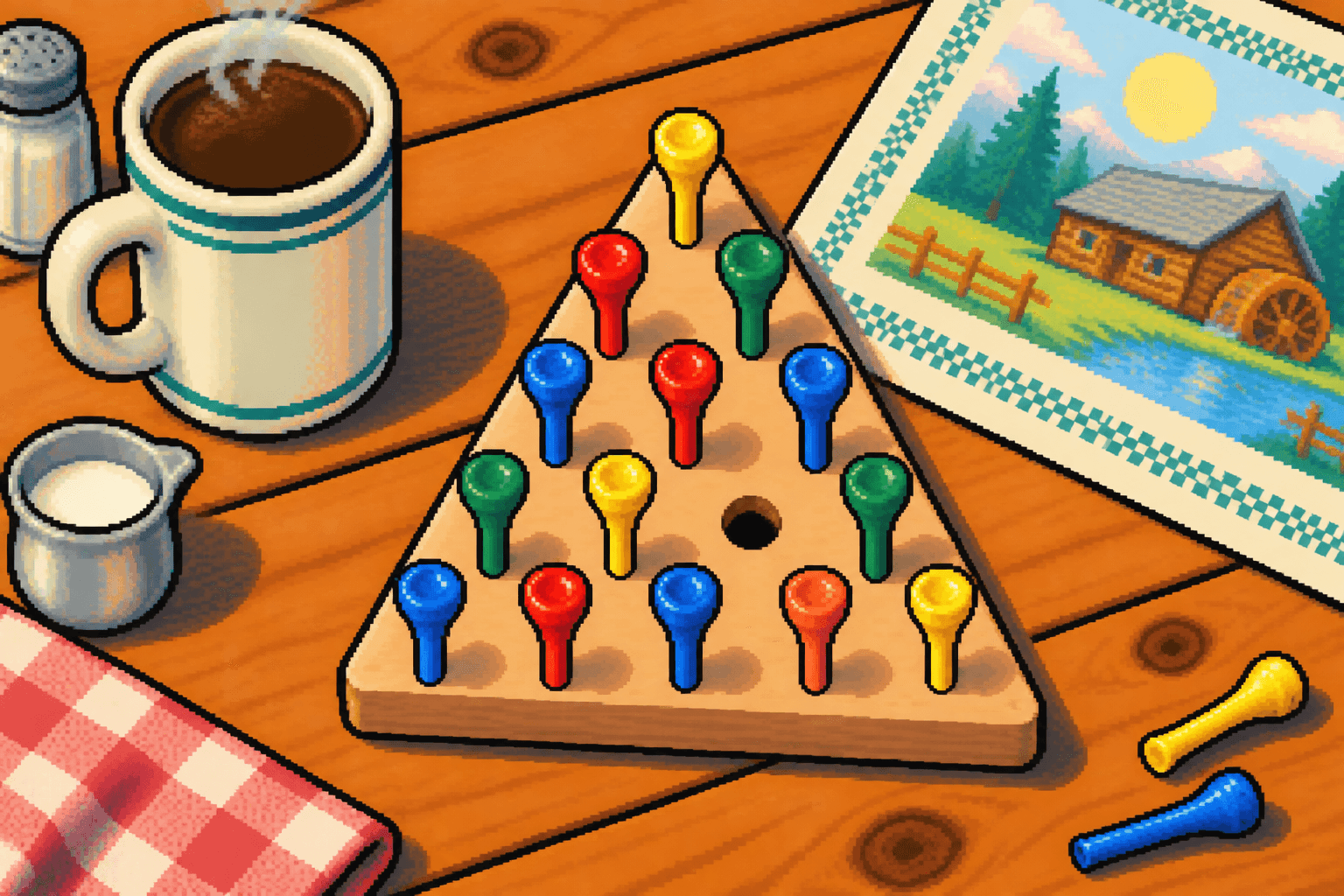
Your family was in the vinyl booth by the fireplace. The waitress had brought waters and a basket of cornbread and had disappeared to put in the order, which was going to take twenty-two minutes because it always did. Your parents were talking to each other about mileage. Your brother was quietly disassembling the sugar caddy. And in the middle of the table, next to a small bottle of maple syrup and a laminated card advertising the peg game as a gift shop item, was the peg game itself.
A wooden triangle. Fifteen holes in it. Fourteen colored golf tees standing upright in the holes. One hole empty.
You pulled it toward you.
The Object
The board was actual wood - a triangle of pine or something like it, maybe five inches on a side, sanded smooth on top and rougher on the bottom, with a slight burn-mark ring around the edge that made it look old on purpose. The three corners each had a small round burn-brand, like it had been pressed with a cattle iron. The holes were drilled in a neat triangle: one, two, three, four, five, going down. Fifteen total.
The tees were the exact same tees a golfer used. Red, yellow, blue, green, one or two of each color, translucent plastic that had gone slightly cloudy from ten thousand small hands. They were sharp on the bottom, blunt on top, and they fit their holes exactly the way a golf tee fits an inch of soft ground, which is to say snugly, with a little give.
The whole thing was branded, on the flat side, with a sign written in a country-fair font. It said:
JUMP ALL BUT ONE Leave only 1 - you're GEE-NIUS Leave 2 - you're purty smart Leave 3 - you're just plain dumb Leave 4 or more'n - you're EG-NO-RA-MOOSE
That was the whole instruction card. That was also the whole grading rubric. The board was scoring you before you'd made your first move.
The board was scoring you before you'd made your first move. Somewhere between the waters and the biscuits, a piece of wood was preparing to call you an EG-NO-RA-MOOSE.
The Rules Nobody Read
Nobody read the rules. Nobody had to. Every kid figured out the rules within thirty seconds by picking up a tee and trying things.
- One hole starts empty.
- A move is: pick a tee, jump it over an adjacent tee into an empty hole beyond, remove the jumped tee.
- You keep going until you can't move.
- The goal is to leave one tee.
That was it. Four bullet points. You did not need the little laminated card. The board taught you by rejecting bad moves - if you tried to lift a tee straight out because you didn't like where it was, it just sat back down in the hole and refused to participate. The board only understood one verb, and the verb was jump.
You would jump one tee. Then you would jump another. Within five moves your board had six or seven tees left and you would look up, momentarily proud, and realize you had no legal jumps left. Nothing was next to anything else that had an empty hole beyond it. You had painted yourself into a corner in a game you were pretty sure was mostly for children.
You would check the sign.
The sign said EG-NO-RA-MOOSE.
The First Ten Attempts Were Bad
You did not solve it on your first attempt. You did not solve it on your fifth. You did not solve it on your tenth.
You would leave nine tees. You would leave seven. You would leave five. Once, in a moment of near-solve, you left three - just plain dumb - and you thought maybe you were about to break through. You told your mom. Your mom said good job, honey without looking up from the menu. Your mom did not understand that the sign was, in your mind at that moment, a real authority figure who had ranked you, in front of the whole family, as just plain dumb.
The strategy - what you thought was the strategy - was to jump greedily. Take every jump. Clear the board. But the more you jumped, the more you scattered the remaining tees to positions where they could not reach each other, until you had four lonely tees at four separate corners of the triangle, staring at each other across empty holes with no bridges between them. The board was full of empty. The tees were islands. The game was over. You were EG-NO-RA-MOOSE.
The tees became islands. Islands cannot jump each other. The game was full of empty space and you had put it there.
The Kid At The Next Table
There was, at some Cracker Barrel, on some Sunday, a kid at the next table who solved it in front of everybody.
He was maybe eight. He was wearing a Braves t-shirt. He picked up the board, moved four tees, put it down, and there was one tee left in the middle of the triangle. He did not celebrate. His father high-fived him. He shrugged. He went back to coloring a placemat.
You stared at him from your booth. He had done in twenty seconds a thing you had been failing at for the entire wait for chicken and dumplings. You wanted to walk over and ask him how. You did not walk over. You were nine and he was eight and there was, in that moment, a real gap between you that you did not want to acknowledge.
You went back to your board. You played it again. You left five tees. Just plain dumb, plus two.
- It's rigged. (It is not rigged.)
- Only certain starting positions can be solved. (No: any starting empty hole has a solve.)
- The corner start is easier than the top. (The top corner is famously the hardest starting position.)
- You have to start from the middle. (You can start from anywhere. There is a solve for every start.)
- My dad can do it in his head. (Your dad usually could not do it in his head.)
- The waitress knows how. (The waitress had seen it done a thousand times and had never played it once.)
The Reveal
Somewhere between the ages of ten and twelve, if you were the kind of kid who kept picking up the board every time your family stopped at a Cracker Barrel, you started to see it.
You saw that certain configurations of three tees in a row were fuel. You could burn them, one long jump at a time, and they'd keep feeding you moves. You saw that leaving a tee in the very center was almost always fatal. You saw that the last move needed to be into the middle, not out of it, which meant you had to save the middle hole for the last tee to jump into, which meant your entire strategy had to work backwards from a solved endgame you were only sort of visualizing.
You saw, in other words, that the game was actually a puzzle, and the puzzle had solutions, and the solutions required you to plan.
That was different from anything else at Cracker Barrel. Nothing else at Cracker Barrel asked you to plan. The rocking chairs on the porch did not ask. The old-timey candy in the gift shop did not ask. The pancakes on the menu, twenty-two minutes away, did not ask. The peg game was the one thing in the building that had decided to have standards.
The peg game was the only thing at Cracker Barrel that had standards. Everything else was there to soothe you. The peg game was there to grade you.
Try It
Start with the top hole empty. Tap a peg. The board will show you which jumps are legal. Keep going until you can't. Report yourself to the sign at the end.
There is a solution. There is more than one.
The Argument
There is a whole argument you can make about Cracker Barrel and what it was and what it wasn't - the porch, the old license plates on the wall, the cast-iron everything, the fact that the whole place was a national chain pretending to be your grandma's living room. That's not a small argument. It's not one I want to have. I ate a lot of dumplings there as a child and I do not have neutral feelings about the building.
But I want to say a thing about the peg game.
Every restaurant chain in the 90s tried to keep kids busy at the table. Applebee's had crayons and a maze. Denny's had a paper menu with a word search. Bob Evans had a coloring page. Chili's had a small pack of Play-Doh sometimes. The move was: give the kid a small piece of consumable paper, print a bad joke on it, hand them a broken crayon, and the kid will be quiet for eight to eleven minutes while the adults eat.
Cracker Barrel's move was different. Cracker Barrel put a problem on the table. Not a maze - a maze has one path, and any kid can trace it. Not a word search - a word search only asks you to recognize what's already there. A real, actual puzzle. A puzzle with a solution space. A puzzle that most adults could not solve on the first try. A puzzle that would, if you failed it, use a piece of hand-lettered font to publicly call you an EG-NO-RA-MOOSE in front of your family.
And every kid I ever met, in every Cracker Barrel booth I ever sat in, picked it up and tried.
Every kid picked it up. Every kid tried. It did not have a screen. It did not need a battery. It was a piece of wood with holes in it, and it was harder than anything else in the building, and the kids all played it anyway.
I don't know why this feels like the point to me now, but it does.
We spend a lot of time these days trying to figure out how to make things engaging for kids. There are whole industries. There are apps. There are consultants. There are think-pieces about screen time and attention spans and how to make math into a video game and how to make reading into a video game and how to make a video game into a video game. The answer is always: more feedback, more colors, more animations, more little chimes when you do the thing right, more little sad noises when you do the thing wrong.
The peg game did none of that. The peg game gave you: a triangle, fourteen tees, and a sign that would insult you. And every kid in America, at least once in the 90s, sat down and did the whole thing. Voluntarily. In a restaurant. While waiting for pancakes.
I don't know what to do with that fact except to notice it. I don't want to make a bigger claim than the game deserves. It was a small wooden puzzle from a country-themed chain restaurant, and I am not going to pretend it was some kind of prelapsarian miracle of unmediated attention. Cracker Barrel is a company. The peg game was sold in the gift shop for twelve dollars. There was a whole cynical apparatus around it.
But the puzzle itself did not care about any of that. The puzzle was just a puzzle. The tees jumped or they didn't. The board ended up empty or it didn't. The sign called you what it called you, without pity, in a font that looked like a cattle brand. And you, a nine-year-old with nothing to do for the next fifteen minutes, tried again.
I have played the peg game as an adult, exactly once, in a Cracker Barrel outside Knoxville, four years ago. I sat down. My food had not come. There was no phone service in the parking lot, or I would not have picked it up.
I solved it in about six minutes. I left one tee. The sign said GEE-NIUS. Nobody was watching. There was no father there to high-five me. There was no eight-year-old at the next table to be quietly beaten by. I set the board back in the middle of the table where I had found it. The chicken and dumplings came. They were the same chicken and dumplings.
I don't know if I actually solved it, in the sense of understanding what I did. I think I might have just remembered, somewhere in my hands, from all those Sunday afternoons in booths in every state on I-40 and I-75 and I-95, how it was supposed to go. My hands did it while I was looking at my water glass. That's a real thing, I think. Some puzzles you solve in your brain. Some puzzles you solve, later in life, in the same body that failed them the first two hundred times.
The board doesn't care which one it is.
The board just wants to know how many tees are left.