You opened the freezer with both hands, because at eight years old the freezer door had more suction than gravity, and you pulled hard enough to make the ice trays clatter.
You reached past the frozen peas. You reached past the ziploc bag of freezer-burned hamburger meat that had been there since March. You reached, at the very back of the top shelf, into the cardboard box, and you pulled out a long clear plastic tube of frozen blue sugar water, and you held it flat against your palm, and it felt exactly like holding a small piece of pipe.
That was the freezer pop.
The Object
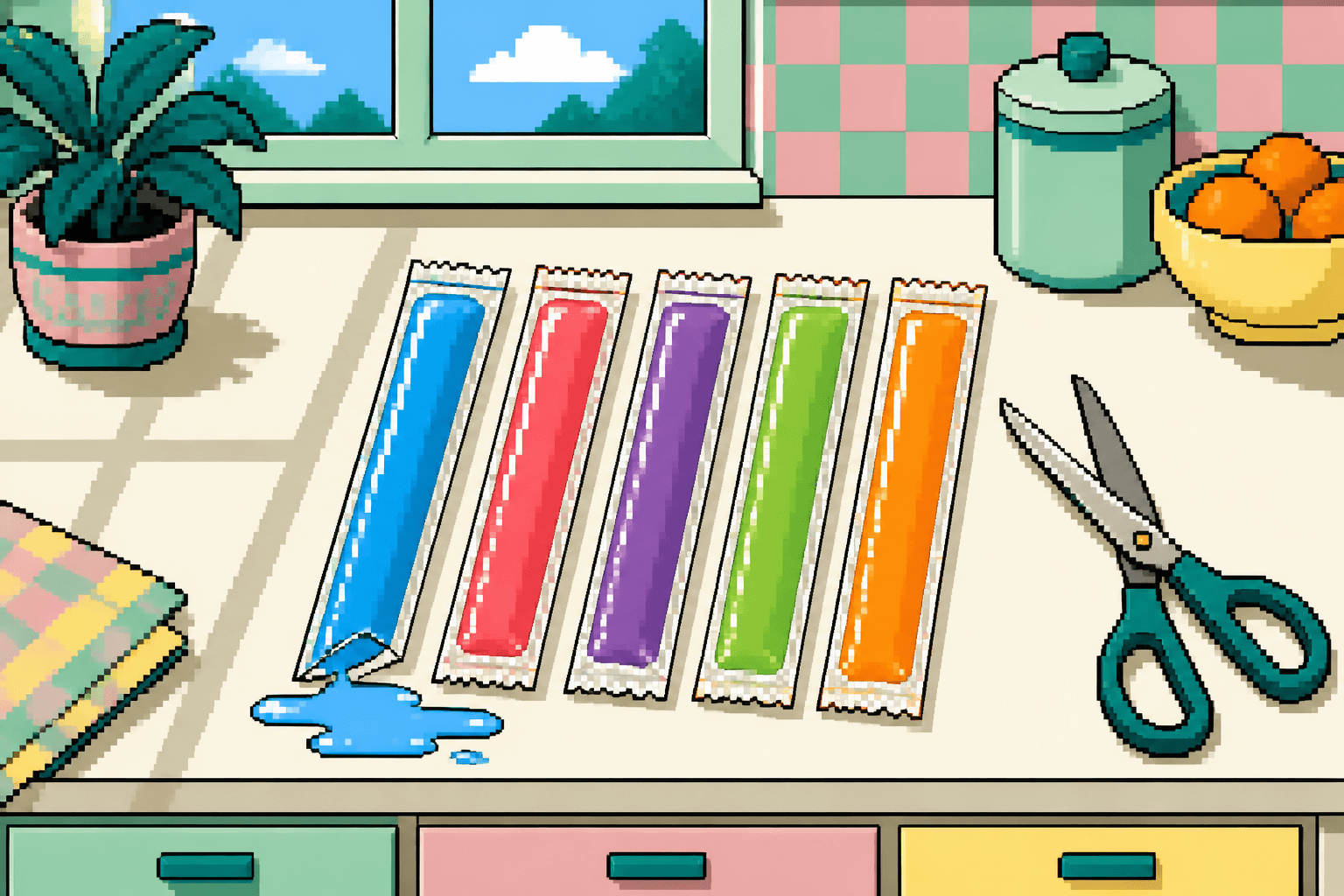
It was a plastic sleeve, about seven inches long, an inch and a half wide, sealed at both ends by a flat crimped strip of the same plastic. Inside was frozen colored syrup. The plastic was slightly cloudy so you couldn't see through it clearly, but you could see the color - blue, red, purple, green, orange - and you could feel that the whole thing was one solid rod of ice, and you were not going to bite through it, and you were not going to open it with your fingers.
You had to open it with scissors.
The freezer pop was, as a food product, unique in that it was fully weaponized against the consumer. It could not be eaten out of the package it came in. The package was a fortress. The fortress had been designed by adults who understood, correctly, that a child who could open the tube on their own would eat six of them in an afternoon.
The freezer pop was, as a food product, unique in that it was fully weaponized against the consumer.
They came in a box of ninety-six. The box lived in the deep freeze in the garage or on the top shelf of the freezer inside, past the vegetables. The box said OTTER POPS or FLA-VOR-ICE or, if your family was economical, it said GREAT VALUE and had a cartoon iceberg on it. The tubes inside were all mixed up. You couldn't get the blue one on purpose. You had to reach in and take what you got, unless you were willing to unbox the whole thing on the kitchen floor to find the blue one, in which case, obviously, you did that.
The Scissors
You took the tube into the kitchen. You held it up. You said mom.
Mom was on the phone. Mom said just a second, and she meant four minutes. You stood in the doorway of the kitchen, holding a frozen tube of sugar water, watching it start to sweat onto your hand. The condensation was already dripping. A single drop of water rolled off the seam and hit the linoleum.
Eventually she came over. Eventually she went to the drawer.
The drawer was the drawer next to the sink. Every mother in America had this drawer. It contained: three pens that didn't work, one pen that did, a rubber band, a takeout menu from a Chinese restaurant that had closed in 1996, a roll of Scotch tape, a small hammer for no reason, and the kitchen scissors. The kitchen scissors were black-handled Fiskars, and they had been used to cut chicken, hair, coupons, and freezer pops, in that order, and they had never been washed.
She snipped the corner of the plastic tube at a diagonal, about a quarter inch in, and she handed it back to you, and she went back to the phone.
Sometimes she cut too much. Sometimes she cut the whole top off, and now you had an open-mouthed tube of syrup that was going to leak out the top the second the ice softened, and you had to hold it upright like a little popsicle beaker, and there was nothing you could do about it.
You did not complain. She had scissors. You had teeth. It was fine.
The Method
There was a method to eating a freezer pop and it involved both hands and time.
You held the tube vertically. You put your mouth on the snipped corner. You sucked. Nothing came out. It was still solid ice. The suck was mostly performative, an act of hope. You lowered the tube. You squeezed the middle of the plastic sleeve, gently, between your thumb and finger, like you were trying to feel a bruise. If the middle was still hard, you kept waiting. If the middle had softened a millimeter, you started pushing the syrup toward the top.
You had two options.
Option one, the squeeze up from the bottom method, was the one your dad used. You pushed the ice column upward from the bottom of the tube, milking it, forcing the melted syrup through the frozen part and out the corner. This was efficient. This was the correct grownup way. This got you the whole popsicle in about seven minutes with no injuries. Nobody ever taught you this, and you rarely did it.
Option two, the just chew through it and drink the slush method, was the one you actually did. You bit down softly on the tube, right below the snipped corner. You felt the ice crack under your teeth. You sucked. A rush of half-melted sugar syrup, colder than anything else in the house, hit your tongue at once, and you flinched, and you swallowed, and you did it again. You worked your way down the tube, one inch at a time, biting and sucking, and the plastic went slack behind your bite marks, and your fingers got sticky, and your tongue started to change color.
- Blue. Called raspberry on the box. Was not raspberry. Was blue. The best one. Everyone wanted it.
- Red. Cherry. Fine. Turned your mouth the same color as the syrup.
- Purple. Grape, allegedly. Tasted like Dimetapp. Some people were into this.
- Orange. The compromise flavor. Selected only when all other options were gone.
- Green. Lime. Nobody picked green first. Nobody. Green was structural. Green existed to make the box look full.
Try one
Pick a color from the box. Snip the corner. Sip until the tube is empty. If you go too fast, the plastic edge will get the corner of your mouth, and there is nothing you can do about it, because the edge is the deal.
The Colors
The blue one turned your whole mouth blue for about forty minutes. Your tongue. Your teeth. The inside of your bottom lip. There was a photograph in every family album from the summer of 1997 in which a kid was smiling wide with a mouth that looked like it belonged on a Halloween costume, and the mom who took the photo made you close your mouth for the next five pictures, and you didn't.
The red one turned your mouth red, which was less funny, because red was the color of every other food you ate. If you'd had spaghetti for dinner and a red freezer pop for dessert, nobody could tell the difference.
The purple one was where things got strange. Purple looked wrong. Purple mouth is not a color the human face is used to. When your friend across the table had a purple mouth, you looked at him like he was a puppet.
The green one - if anyone had actually eaten the green one, which nobody did - turned your mouth a sort of pond color. It was not a compliment.
Nobody picked green first. Nobody. Green was structural. Green existed to make the box look full.
The Cut
There was, in the design of the freezer pop, a small betrayal.
The plastic sleeve, when snipped at a diagonal, produced a corner that was flat and sharp. Not razor-sharp. Not dangerous, exactly. But sharp enough that if you were sucking hard, and if you were sliding the tube in and out of your mouth to speed up the melt, and if you were nine years old and did not yet have full control over your face, the plastic edge would, at some point, catch the corner of your mouth.
It was always the corner. Never the front.
The cut was small. It was the same kind of cut you got from an envelope, or from turning a page too fast, or from the underside of a Trapper Keeper flap. But it was on your lip, and once you had it, every subsequent sip found it, and the sugar syrup got into it, and it stung, and you kept going anyway.
You looked at yourself in the reflection off the freezer door on the way to throw the empty tube away. You had a blue tongue, a blue mouth, sticky fingers, and a small red line at the corner of your smile. It looked, roughly, like you had been in a fight with a Smurf, and lost.
You went back to the freezer and got another one.
The Argument
Every essay about a specific childhood snack, eventually, wants to argue that the snack was good, or that it represented something, or that the specific inefficiency of it - the scissors, the wait for mom, the cut on your lip - was a lesson in patience or family or delayed gratification.
I want to make that argument. I don't think I'm going to.
The freezer pop was not a good snack. It was sugar water in a plastic tube. It cost, at wholesale, less than a penny per unit. It was the exact category of thing that gets flagged in modern parenting essays as what we used to feed children before we knew any better, and by any measure you can name - nutrition, cost per calorie, environmental impact, structural safety, dental science - it did not clear the bar.
But it was a summer object. It only existed in July. You couldn't eat one in November. It required specific conditions - heat, a garage freezer, a mom with scissors, forty minutes of nothing to do - and inside those conditions it was, briefly, the most important thing in the kitchen. It was the reward for being outside all day. It was the thing you had after you came in from the sprinkler. It was the first sugar of the afternoon, and the plastic sleeve, and the wait, and the color, and the cut on the lip, were all parts of a small ritual that happened three thousand times a summer and was never once explained.
It was a summer object. It only existed in July.
Kids still eat these. They still exist. The box hasn't changed. The scissors are still in the drawer, though now they're in your drawer, because you're the one with the drawer.
But the ritual has thinned out. There are Popsicles that come in molds you fill yourself, from silicone, with real fruit. There are ice pops with electrolytes. There are frozen yogurt tubes with less sugar and a peel-off top and no scissors required. The freezer pop is no longer the only game in the freezer. It's one of many. It's not a summer object anymore. It's just a thing.
The Empty Tube
The empty tube was longer than you expected. When you got the last drop of syrup out, you held it up, and you were surprised at how much plastic was involved in the whole enterprise. There was a full seven inches of clear crimped plastic, sticky on the inside, with a diagonal snip at the bottom and your bite marks all down the front, and this thing had been full, an hour ago, and now it was garbage.
You threw it in the kitchen trash. You didn't wash it. Nobody washed it. Two months later, in the fall, someone finally cleaned out the deep freeze in the garage, and there was one lone freezer pop rolling around in the bottom of the box, and it was green, and it stayed green until March.
What It Left
I bought a box last summer. My kid is six. She is exactly the right age for this.
I put the box in the top shelf of the freezer, past the vegetables. I did not tell her they were there. On the third day of an eighty-nine-degree afternoon, she was standing in the kitchen sweating and I said hey, look in the freezer.
She opened it. She stared. She said what.
I said the tubes. I said pick one.
She pulled out a blue one. She held it in both hands. She said how do you open it, and I went to the drawer, and I got the scissors - the same Fiskars scissors, which somehow followed me through three apartments and a marriage - and I snipped the corner off at a diagonal, about a quarter inch in, and I handed it back to her.
She sat on the kitchen floor. She sucked on the corner. Nothing came out. She sucked harder. She said it's still ice. I said give it a minute. I said squeeze the middle.
She squeezed the middle. She sucked. A little blue syrup made it into her mouth. She lit up. She said whoa.
She spent forty minutes on it. She got syrup on her shirt. She got it on the tile. She got a small blue smear on the cabinet, which I found the next morning and did not clean off. Her tongue turned exactly the color mine used to. She did not cut her lip. She was more careful than I was. She had better hand-eye coordination than I did at that age, which is a thing I have accepted only because she is objectively better at Mario Kart than I am.
When she was done, she held up the empty tube. She said can I have another one.
I said sure.
I said it in the same voice my mother used, which is the voice that means yes, but you know we're going to have this conversation again in twenty minutes.
She did not know the voice yet. She just heard yes.
She went back to the freezer.