You picked it up wrong.
Not because you did it wrong. Because there was no right way. The Nintendo 64 controller had three prongs, and you had two hands, and the negotiation of which prong you were going to leave alone was, on some level, the game before the game. You held the left prong and the center. You held the center and the right. One time, at your friend's house, you tried to hold all three at once, and your friend said what are you doing, and you did not have an answer.
You settled on center-and-right. Everyone did.
That was the whole story.
The Object
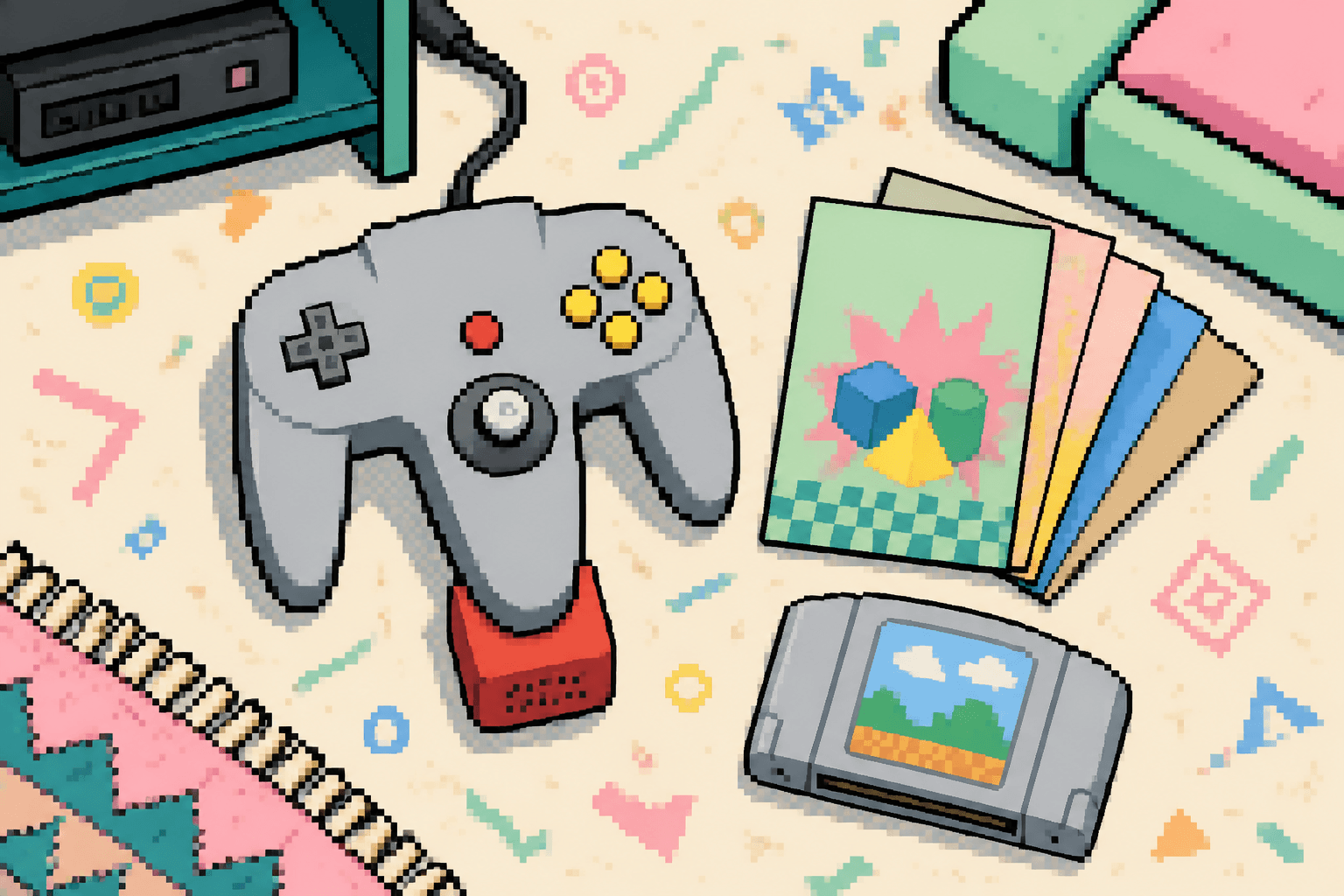
The N64 controller was gray. Or it was blue. Or purple, or green, or, if your uncle bought yours at a garage sale in 2001, it was yellow and had a splash of what you hoped was Sunny D on the analog stick. It weighed slightly more than the SNES controller had. It had six colored buttons on the face, a D-pad on the left, an analog stick in the middle, a couple of triggers up top, and it fanned out at the bottom into three separate hand-grips, each about the length of your palm.
The three-prong shape was, at the time, the strangest thing that had ever come out of a Nintendo box. Every controller in the history of controllers had been a rectangle you cradled in two hands. The N64 controller was not a rectangle. The N64 controller was a creature. It looked like something that would walk sideways across a table if you took your eyes off it.
But you plugged it in. It had a very long thin gray cable and a small plug that went into a slot on the console with the confidence of a thing that would only ever accept one specific shape. And then the little bootup jingle played, and you looked down at the controller in your hands, and you had to make a choice.
The Three Prongs
There were three prongs, six trigger buttons, one analog stick, one D-pad, and one hand short. This math did not work out.
The left prong had the D-pad on top. It also had the top of the L trigger. If you held this prong, your left thumb rested on the D-pad, and your left index finger reached over the top for L.
The center prong, the forward one, the strange one, had the analog stick. The analog stick was gray, textured, and it sat inside a small circular well like an arcade joystick that had been shrunk down and set into the plastic. It was Nintendo's first analog stick. It was the reason the controller existed. There was also a small trigger on the underside of the center prong, labeled Z, that you pulled with your index finger like the trigger on a rifle.
The right prong had the six colored buttons. A was blue. B was green. The four C-buttons were yellow, clustered like a second D-pad. R sat on top.
You had two hands. You had to pick two prongs. Nintendo did not tell you which two.
Nintendo did not tell you which two.
The Wrong Question
The wrong question was how am I supposed to hold this.
Nobody at Nintendo had an answer. The manual did not show a hand holding the controller. The box had a picture of it, from above, floating over a background of stars, as if it had appeared from another planet and you were supposed to figure it out from context. The commercials showed kids gripping it in ways a chiropractor would flag.
The right question was which grip does this game want.
Because the answer changed. Every game answered differently. Mario 64 wanted center-and-right, so your left thumb lived on the analog stick and your right thumb lived on the C-buttons, and you could run and jump and kick a Bob-omb across a hill without ever touching the D-pad. GoldenEye also wanted center-and-right, but it wanted you to use the C-buttons like a second thumbstick, and if you had never held a controller with two thumbsticks before, which you hadn't, because two thumbsticks weren't invented yet, then you learned to look with your right thumb and walk with your left thumb inside of one afternoon, and it changed your brain permanently.
Mario Kart wanted center-and-right. You drifted with R.
Zelda: Ocarina of Time wanted center-and-right, and it had specific finger choreography where you held Z down with your right index finger while pressing A with your right thumb while moving the analog stick with your left thumb, and this was called Z-targeting, and the fact that a small child could do it says something about children.
Star Fox 64. Center-and-right.
Perfect Dark. Center-and-right.
Diddy Kong Racing. Center-and-right.
The left prong, which contained the D-pad, sat there. Alone. Unheld.
The D-Pad Ghost
The D-pad on the N64 controller was there because someone at Nintendo felt bad.
There were, at the time, older Nintendo instincts that couldn't be shipped a device without a D-pad. There were emulator hopes. There was the occasional 2D minigame. The D-pad had to be somewhere, and Nintendo put it on the left prong, and the left prong was designed to be held in a third configuration - left-and-right, no center, D-pad in one hand and the buttons in the other, as if you were playing a Super Nintendo game on the world's worst Super Nintendo controller.
You could hold it this way. You could play a few Mario Party D-pad minigames this way. If you did, your hands were separated by the entire width of the controller, and the center prong stuck out toward you like an untouched tongue, and if you leaned forward you would knock the analog stick with your stomach, and Mario would immediately start walking toward the pit.
Almost nobody held it that way. Nobody wanted to. The D-pad on the N64 controller lived a very quiet retirement, being nudged by a stray thumb during a menu transition once every eighteen hours of play, and otherwise being ignored by the entire industry, including the company that put it there.
- Left prong. D-pad on top, L trigger up front. Held in maybe 5% of the games you owned. Held for about 10% of the time you spent on those games. Was clean because your thumb didn't live there.
- Center prong. Analog stick on top, Z trigger underneath, Start button. Held in every game you owned. Was slightly greasy at the base.
- Right prong. A, B, four yellow C-buttons, R trigger. Held in every game. Was very greasy. The A button was the shiniest because it had been pressed the most.
Try holding it
Left thumb on the analog stick. Right thumb bouncing between A, B, and the four C-buttons. Right index finger under the center prong on Z. Every 3D game wanted you to hold it this way. Every 3D game was every game.
- Super Mario 64
- GoldenEye 007
- Zelda: Ocarina of Time
- Mario Kart 64
- Star Fox 64
- Perfect Dark
Pick a grip. The controller will glow at the two prongs your hands are supposed to be on. If you pick the ghost grip, which is left-and-right, you'll find out why nobody used it. If you pick center-and-right, you'll find out why everyone did. If you pick all three, you'll find out that you do not have enough hands, and you will have to make peace with this.
The Analog Stick
The analog stick on the N64 controller was the reason the controller existed. It was the first mass-market analog thumbstick in a home console. It was the thing that let you tilt a character's movement instead of just eight-directioning them. It was the thing that made Mario 64 possible. It was the thing that made 3D gaming, as a category, possible. It was, unironically, one of the more important pieces of plastic in the history of the medium.
It was also junk.
The analog stick was a small hard plastic knob mounted on a spring-loaded gimbal, and the gimbal was made of small plastic gears, and the small plastic gears were made of plastic. Over the course of about eight months of playing Mario Party, the gears wore down against the housing, and the stick started to feel loose, and then it started to drift, and eventually Mario walked slowly toward the pit even when you weren't touching anything.
The fix was to twist the stick in a circle, hard, thirty times, to redistribute the plastic dust inside the housing. This worked. This was a solution that a friend told you at recess. It was in the manual, in a way, if the manual had been written by that friend at recess. You did it. Everyone did.
The fix was to twist the stick in a circle, hard, thirty times, to redistribute the plastic dust inside the housing.
Some of us are still doing this.
The Rumble Pak
There was a slot on the back of the controller.
The slot took an accessory called the Rumble Pak. The Rumble Pak was a small gray brick that clicked into the back of the controller and made the entire thing shake, using a small motor that spun an off-balance weight, whenever the game told it to. It shipped with Star Fox 64. The first time you got hit by a laser and the controller vibrated in your hands, you dropped it, because things in your hands weren't supposed to move on their own.
The Rumble Pak required two AAA batteries. You had to keep them in the controller. When they died, which they always did, the controller stopped rumbling, and if you didn't have any AAAs in the house, which you didn't, you played Star Fox in dead silence like a game of chess.
There was also a Controller Pak, which was a memory card, and it went in the same slot. You could only use one at a time. If you wanted to save your Mario Kart times, you had to take the Rumble Pak out and put the Controller Pak in, and if you wanted to save your Mario Kart times and feel the rumble, you were out of luck until the Expansion Pak came out and Nintendo shrugged.
Every three months you dug into the slot with a butter knife, popped one accessory out, popped the other in, and lost the small plastic door in the couch. The door was the first thing to go. Nobody has ever seen a Rumble Pak door on the correct Rumble Pak. They are all in the couch. They are all in there together.
The Argument
Every essay about a specific piece of gaming hardware, eventually, wants to argue that the weird thing was actually right. That the three prongs were foresight. That Nintendo, alone in a world of rectangles, saw the future - two thumbsticks, four shoulder buttons, one central hub - and the N64 controller was the messy first draft of what everyone else would eventually copy.
I want to make that argument. It's mostly wrong.
The three-prong controller was a mistake. It was a design that solved a problem Nintendo had - how do we ship an analog stick without alienating people who still expect a D-pad - by shipping both, in different positions, held in different hand configurations, and letting the games choose. It was hedged. It was a compromise. The very next Nintendo console, the GameCube, went back to a rectangle, with the analog stick moved to the natural left-thumb position that every other console adopted, and the D-pad shrunk into a vestigial nub that even Nintendo had stopped pretending anyone would use.
The N64 controller lost. The rectangle won. Every controller you have held in the last twenty years is a descendant of the SNES pad with an analog stick bolted on. The three-prong shape is dead. It is not coming back. Even Nintendo doesn't want it back.
The N64 controller lost. The rectangle won.
But something happened, in that window.
We learned that a controller could be strange. That a company could put an analog stick in the middle of a device instead of on the left, and we would just figure out how to hold it, because we wanted to play the game. We learned that our hands were more flexible than the industry had assumed. We learned, in a small way, that hardware could ask us to change how we sat on the couch, and we would.
That was worth something. Not enough to justify the third prong. But something.
The Prong That Nobody Held
I dug my old controller out of a shoebox last year. My kid was over. She is nine.
She picked it up. She turned it over. She said why is it like this. I said I don't know. She said am I supposed to hold this part? She was holding the left prong. She was pointing at the center prong. I said no, that part has the joystick. You hold that one and the right one.
She said why are there three, then.
I said for the D-pad.
She said what's a D-pad.
I plugged the controller into a small HDMI adapter I had bought online for a reason I could no longer remember. I loaded Mario 64. She sat on the floor. She held the controller center-and-right, exactly the way we had all held it, and she moved Mario around the castle grounds and she jumped and she wall-kicked and she said this feels weird, and she meant the plastic, the shape, the object in her hands, not the game.
The analog stick was, of course, drifting. Mario walked slowly to the left when she wasn't touching anything. She looked at it. She said is it broken.
I said no. You just have to twist it thirty times.
She said what.
I twisted it in a circle, thirty times, hard, until the plastic dust inside made a small dry sound. I handed it back. Mario stood still. She played for an hour. She did not touch the D-pad. Nobody has, since 1998.
I put the controller back in the shoebox. I put the shoebox back on the shelf. It weighs the same as it did in 1997, which is the same as a small book, and the left prong, if you turn it over, has a small chip in it from the time you dropped it on the driveway, which I remember, because I was the one who dropped it.
You get to keep the driveway. You get to keep the chip. The prong is still there, still empty, still waiting for a hand that isn't coming.