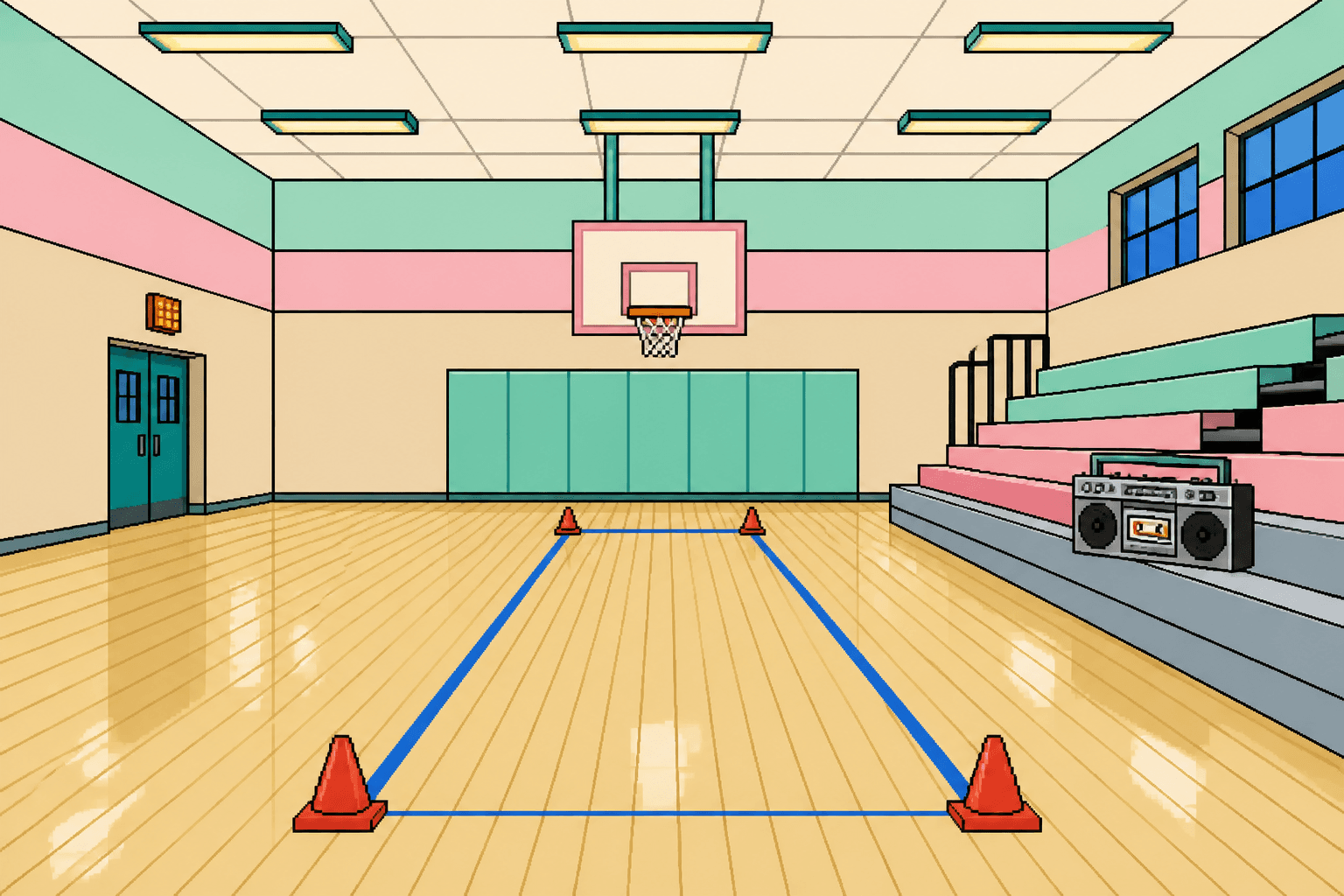
The gym teacher wheeled the cart in. On the cart was a boom box. In the boom box was a cassette, and later a CD, and later, if your school was on the newer side of things, one of those grey plastic FitnessGram binders with a disc in a plastic sleeve inside. The teacher pressed play. A polite adult voice, with the specific flatness of someone reading from a laminated card, explained that the test was progressive, that the beep was going to get faster, and that the point was to run from this line to that line before the beep sounded. If you missed the beep twice in a row you were out. The narrator did not use the word out. The narrator said your test will be complete.
Then a whistle. Then a beep. And then thirty of you started running.
The Setup
The gym had two lines. One at the near wall, one twenty meters away at the far wall. Twenty meters is not far. Twenty meters is the length of a school bus and half of another school bus. You could walk it in fifteen seconds. In the first minute of the beep test, you could walk it and still be fine.
That was the trap.
The lines were made of duct tape, or hockey tape, or the black rubber base that runs along the bottom of the wall, or, in the schools where nobody had bothered, they were the seam where two tiles met. Everybody agreed on which seam. Nobody had to say it. The line was the line.
You stood at your line. The kid to your left was also at their line. The kid to their left was at theirs. In a class of twenty-eight, this meant a jagged human row across the whole gym, everybody in the same white gym shirt with the school's name across the chest in an iron-on font that had already started to peel.
The narrator counted down. The test will begin in five, four, three, two, one.
Then the beep.
The Beep
The beep was not a beep. It was a tone. Specifically it was a sine wave at around 1000 Hz, held for about a half second, generated by a person in a fitness lab in the late seventies who never once anticipated that their tone would become an internet meme in the year 2015 played over ironic edits of anime characters running.
The tone had a specific quality that made it worse than it should have been. It was clean. It was polite. It did not distort. It did not sound like a starting gun or a whistle or any of the other noises that told you something was starting. It sounded like a microwave. It sounded like a truck backing up in the parking lot. It sounded like the second-most important sound in the room, which is exactly why the room bent around it.
Between beeps was the ambient sound of the gym. Sneakers squeaking. Somebody wheezing. The teacher on the bleachers with a clipboard, saying nothing. The narrator, patiently silent, waiting to come back at the top of every minute to tell you the level had changed and it was going to get faster now.
The tone sounded like a microwave. It sounded like a truck backing up in the parking lot. It sounded like the second-most important sound in the room, which is exactly why the room bent around it.
The Levels
Level one was walking pace. This was on purpose. It was a warm-up. The kid who was going to sit down at level three was, at level one, feeling pretty good, actually. They were casual. They were joking to their friend at the next line. They looked like a person who was going to be fine.
Level two: a light jog. Now the joking was quieter. The kid who was going to sit down at level three now understood, at the base of their throat, that they had made an error. They had not budgeted correctly. They had used their level-one lung capacity to talk to their friend, and now the level-two lung capacity was arriving with the previous debt attached.
Level three: real running. Not sprinting. Not yet. Just the pace of someone who is being chased at a moderate but not urgent speed. The first casualties started here. A kid stopped running, walked to the wall, sat down against the padded blue mat under the basketball hoop, and did not look up. That kid was fine. That kid had gotten it over with.
Level four: sprinting. Level five: sprinting with a small internal panic. Level six: the kid at the far end of the row was now the fastest kid in fourth grade, and everybody knew it, because they were still standing on their line while you were on your knees.
The Line
The rule was: your foot must be on the line before the beep sounds. Not near the line. Not close to the line. On the line.
This was the mechanism. This was the whole thing.
You could feel yourself getting close to the line. You could see the line. You knew, in the last three steps, whether you were going to make it. If you were going to miss it, you had two options. You could keep running and touch the line late, which counted as one miss but let you keep going. Or you could lean, and dive, and get the tip of your sneaker onto the tape a quarter second before the beep, and then eat a full breath and turn around and run back.
The kids who leaned were the kids who were going to last. The kids who kept a nice steady pace and hoped for the best were the kids who missed by half a foot, and then missed again on the way back, and then heard the words your test will be complete from the narrator's calm voice, which had not calmed anyone in the history of the test.
The Sitting Down
When you missed twice, you sat down.
You did not walk out. You did not go get water. You sat down against the wall, in your gym uniform, and you watched the rest of the class continue to run.
This was the part nobody prepared you for. In every other event in gym class, when you failed you were done. Kickball: you struck out and went back to the dugout with everyone else. Dodgeball: you got hit and went to the wall to wait for the next round. Everyone was in the same rotation. Everyone was hidden by the group.
The Pacer test had no group. The Pacer test had a rank order. If you were the third kid to sit down, that was public data. Everybody saw. Everybody remembered. The kid who sat down at level two had a piece of information attached to them for the rest of the semester, and they would have to hand it to the next unit's group at the next school if they moved districts, because their transcript said Level 12, PACER.
You sat there for six more minutes while the kid who was going to reach level eighteen kept running. You watched them lap the empty gym. You watched their gym shirt get a dark V of sweat down the back. You watched them not talk to anyone, not look at anyone, not do anything except run to the line and turn and run back and turn and run back, and you thought, how are they doing that.
- The volunteer: sits down at level three, on purpose, to get it over with.
- The overreacher: goes hard at level one, dies at level five.
- The steady jog: makes it to level nine every time, never higher.
- The leaner: lasts one full level past their actual fitness by cheating the line.
- The kid with an inhaler: is not doing this at all today, and the teacher knows.
- The final kid: is not human. Is a small piston. Runs until the narrator herself sounds impressed.
The Music
At some point somebody at the FitnessGram company decided that the beep test needed music between the beeps.
This was a mistake.
The music was a synthesizer track, thin and generic, the kind of loop that a mid-nineties educational CD-ROM would play behind a menu screen. It was chirpy. It was upbeat. It had no relationship to the rate at which your heart was beating. It was cheerful in a way that felt almost cruel by level twelve, when your vision was going a little blurry at the edges and this tinny synthesizer was still going do do do do under the beeps like everyone was having a great time.
There is a specific horror to failing a physical test set to do do do do. An entire generation of kids sitting on gym mats, chests heaving, watching the last three runners in the class, listening to a synth beat that a person in an office in 1988 had thought would be encouraging.
The Argument For
The Pacer test was fair.
It did not care how tall you were, or how big your family was, or whether your dad was the football coach, or whether you had good hair. It did not care about the kids who were popular at recess. It did not care about the kids who were good at math. It cared about one thing, which was: can you run to that line before this beep. Every kid, in every school, in every district, was doing the exact same test, at the exact same speed, and the number that came out at the end was the same number. There was no argument. There was no scoring bias. There was no charm exemption.
It also did what gym class rarely did, which was give you a piece of information about your body. Not a shape opinion. Not a look opinion. A piece of measurable data about a specific thing your body could or could not currently do. And it gave you the piece of data whether you wanted it or not.
That was legitimately useful. A kid who could not run to level five learned that they could not run to level five, and could then, if they wanted, decide to do something about it. A kid who reached level eighteen learned they were fast, and that was a fact worth knowing about yourself when you were eleven.
The Argument Against
The Pacer test was public.
Nobody needed thirty other kids to know how many laps they could run. The information could have been collected in private. It could have been done in groups of two. It could have been done outside, in a spread-out format, where nobody was ranked against the kid running next to them. It was not. It was done in a single line across the width of the gym, so that everybody could watch everybody else fail.
There was also the problem that the test was not, at nine years old, actually measuring what it claimed to measure. Aerobic capacity in a nine-year-old body is highly variable. It depends on whether you hit a growth spurt. It depends on whether you had strep last month. It depends on whether you ate lunch. The Pacer test treated all of these variables as noise around a signal that was clean and simple and eternal, and the number you got at the end was pinned to a chart of healthy versus needs improvement, and if you got the wrong number the chart's official position was that you needed to change.
Which is a lot of certainty for a test that involved a synthesizer, some tape on the floor, and a beep.
And there were the kids who were already having a hard time. The kid who was heavier than the other kids. The kid who moved a little slower. The kid whose asthma inhaler was in a Ziploc bag in their backpack in the locker room, which they were about to need. The Pacer test made no accommodation for the fact that being the second person to sit down, in front of the entire fourth grade, was going to stay with a kid in a way that a number on a chart could not undo.
Nobody needed thirty other kids to know how many laps they could run. The information could have been collected in private. It was not. It was done in a single line across the width of the gym, so that everybody could watch everybody else fail.
The Kids Who Went Forever
Every gym class had one.
The kid who did not stop. Level ten. Level twelve. Level fifteen. Level eighteen. Level twenty, which was where the tape ran out and the narrator said something like you have completed the test and the teacher looked over at their clipboard and wrote a small number that was, for the class, the same as saying this one is a different kind of animal.
The kid was not always the fittest looking kid. It was not always the kid who was going to make the JV soccer team. Sometimes it was the tall skinny kid who read paperbacks at recess and whose lungs, for reasons nobody could explain, were just enormous. Sometimes it was the small quiet kid who nobody noticed until the fourth minute of the test, when they were still going, and everybody looked at each other and thought huh.
That kid became famous in the class for one afternoon. They got a little bit of protection from the social order for about a week. Then everybody went back to being nine, and the kid who could run forever went back to being the kid who could run forever, and nobody thought about it again until the following semester, when the boom box came out on the cart, and they did it all over again.
The After
The Pacer test still exists. FitnessGram is still a program. Kids are still doing this in gyms across America, in some schools, right now, with the exact same beep, because the audio has never needed to be updated. The tone is a tone. It works.
But the audio has had a second life on the internet. The specific opening narration, the FitnessGram Pacer Test is a multi-stage aerobic capacity test that progressively gets more difficult as it continues, has been played over a million meme videos. Kids born after 2005 know the narrator's voice as well as I do, and they know it without ever having stood on a line, because YouTube handed it to them.
Which is a strange fate for a piece of educational audio. To be preserved forever, not as itself, but as a joke. To be the soundtrack of failure, decades after the test itself has stopped being the standard.
I ran into an old classmate at a wedding a few years ago. He was the kid who used to go to level nineteen. Everybody in fifth grade knew this about him. He is now a lawyer who lives in a suburb and, by his own admission, cannot run a mile.
I asked him if he remembered the Pacer test. He said God, yes. I asked him if he remembered going to nineteen. He said he remembered it exactly. He said he remembered the specific feeling of turning at the far line and knowing, in his lungs, that he was going to hit twenty. He said it was the last time in his life he was measurably the best at something in front of other people.
Then he said the thing that made me put my drink down.
He said, do you know that I still hear that beep in my sleep sometimes.
I said no. I asked him what he meant. He shrugged. He said he did not know what he meant. He said he had not thought about it in years, and then somebody at his firm had made a joke about the beep, and he had heard the tone in his head the exact way it sounded on the boom box in the corner of the gym, and now sometimes when he was trying to fall asleep he heard it, and he was on the line, and he was nine, and he was doing it again.
I told him that was probably not healthy.
He said no. He said it wasn't. He said it also wasn't unpleasant.
We stood there for a minute. Then we did not talk about it anymore, because we were adults at a wedding, and the DJ was playing do do do do, and everybody in the room who was our age had heard that sound before, and we all knew what it meant, and none of us were going to say so out loud.