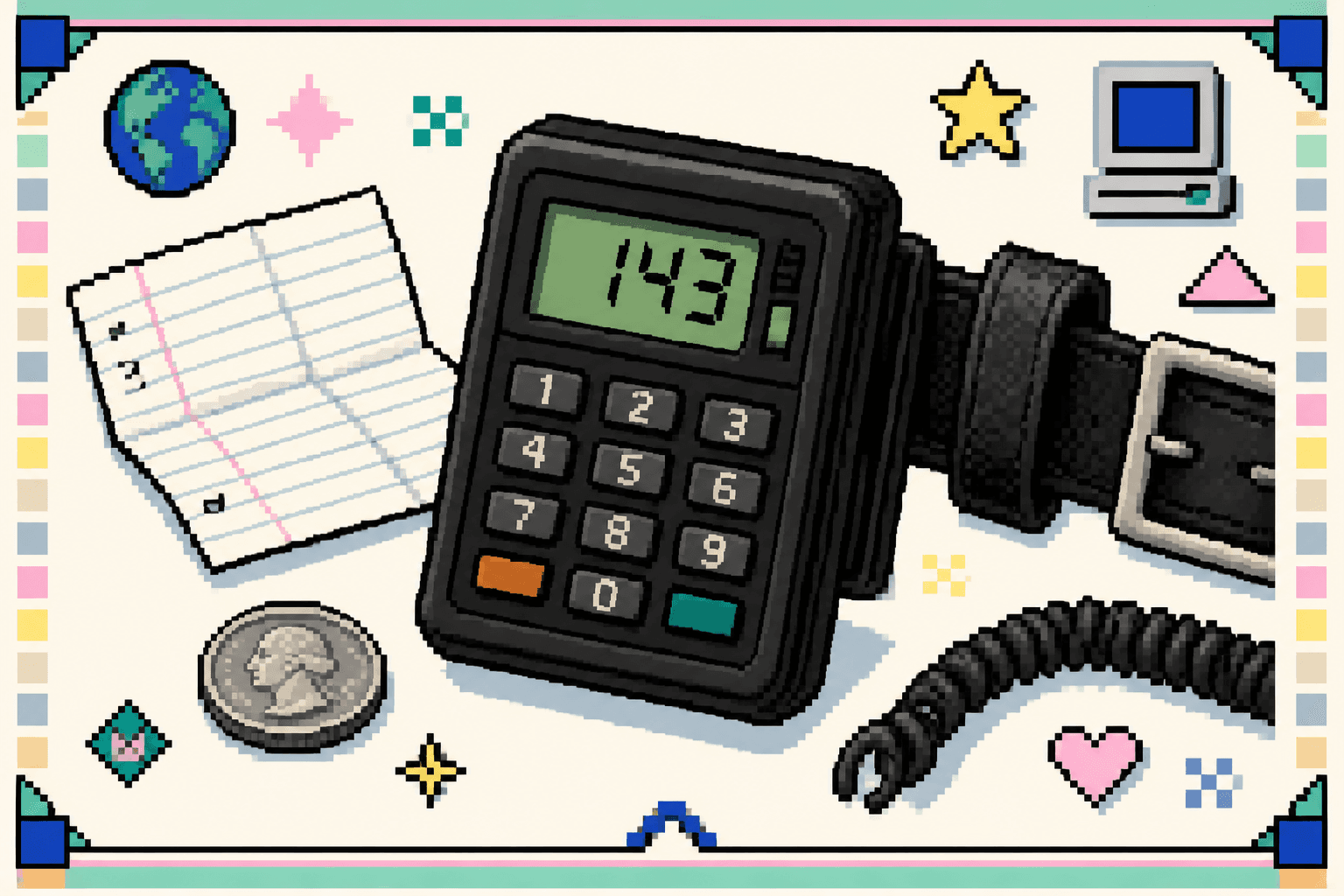
You wore it on your belt.
Right above the pocket, on the side of your jeans, clipped through a belt loop, at a slight angle so the screen faced up when you looked down at it. It was black. It was about the size of a bar of hotel soap. It had a small gray-green LCD screen and one or two buttons and a plastic clip on the back that had scuffed the paint off itself where it rubbed. It weighed almost nothing, and you were aware of it, at every moment, constantly.
It buzzed against your hip in seventh-period math. Everyone in a two-desk radius heard it. Mrs. Patterson looked up from the overhead projector. You did not look at her. You looked, under the desk, in your lap, at a very small angle, and it said 555-1487, which was your friend Andy's home number, which you knew by heart. And then it said 143.
143 was I love you.
You did not tell Mrs. Patterson.
The Beeper
Pagers had about a fifteen-minute window in which they were the coolest object a person could own, and that window was roughly 1996 to 1999, and if you missed it, you missed it. Before that, they were carried by doctors and drug dealers and the guy from your dad's office who was on call. After that, everyone had a Nokia 5110 and the pager went in the drawer with the calculator and the AOL disks.
But inside the window, if you were fourteen, and your parents had bought you one because they were tired of not knowing where you were, you carried it like a badge of office. The pager meant you had people. The pager meant somebody, somewhere, might page you at any moment, and you would have to stop whatever you were doing, and go find an actual phone, and call them back.
The pager did not make calls. The pager did not receive calls. The pager did nothing except display a phone number, sometimes a little code after the phone number, and then buzz.
That was the entire product.
The Screen
The screen held twelve characters. Some pagers held sixteen. A few of the fancy ones, the ones with alphanumeric keyboards you had to press with a fingernail, held whole sentences. Nobody had those. Those were for stockbrokers. Yours was numeric only.
Twelve characters. In practice: ten for the phone number, counting the dash, and two left over for whatever else you wanted to say.
Two digits. To say something. To an actual person.
This is where the language came from.
The Codes
Everyone knew 143. Everyone. It came up at some point in the summer of 1996, and by the time school started nobody had to be taught what it meant. One letter I. Four letters L-O-V-E. Three letters Y-O-U. That was the whole grammar. If you paged someone 143, they knew, at once, without ambiguity, what you meant, and if you paged them from the payphone at the food court to say it, they knew you had walked out of the food court to say it, and this was itself part of the message.
One letter I. Four letters L-O-V-E. Three letters Y-O-U. That was the whole grammar.
There were others.
911 meant call me right now. Not urgent in the emergency-room sense, though sometimes. Urgent in the sense of I have news or this cannot wait or, if a girl sent it, sit down before you call me.
411 meant give me the info, which was the number you dialed for directory assistance before Google existed. If your friend paged you 411, they were asking what was happening that night, and the correct response was to call them back and tell them what was happening that night.
831 was also I love you, but the compressed formal version. Eight letters. Three words. One meaning. If somebody paged you 143 five times, they would eventually page you 831, because it was the same thing said in a slightly more grown-up handwriting.
121 meant one on one. Talk to me alone. Away from Kevin, who is definitely on the three-way. This never worked, because Kevin was always on the three-way, and Kevin knew what 121 meant too.
And 07734 meant hello.
Not because of the digits. Because of the shape. If you flipped the pager upside down, and if you were the right kind of nine-year-old, and if the LCD was rendering its digits in the correct segmented boxy way that all of them did, the 0 became an O, the 7 became an L, the 3 became an E, the second 7 became an L, the second 0 became an O, and you had said hello to somebody using math.
- 143 - I love you. Universal. Unambiguous.
- 831 - I love you, but with more math.
- 911 - call me right now, from wherever you are.
- 411 - give me the details, what's up tonight.
- 121 - one on one, get off the three-way.
- 1134 - hEll. Upside down. Not a message. Just a middle-school thing to do.
- 07734 - hELLO. See above.
- 5537 - LESS upside down. For no reason.
- 10 - I'm bored.
- 100 - perfect. Also: you look great.
- 101 - call me back when you get this.
- 07734.0 - hELLO. With a period. Because you were fancy.
Try one
Type digits. Hit send. The pager will buzz. Hit flip and the display will read as if you'd turned the whole thing upside down, and if you did it right, some of the numbers will become letters, and you'll have written a whole message using a device that could only display twelve digits at a time, which was, in 1997, sort of a big deal.
The Payphone
You needed a payphone to answer a page.
The payphone was, on average, forty feet from wherever you were when the pager went off, and it took a quarter, and if you did not have a quarter, you asked the guy behind the counter at the Amoco if he could break a dollar for you, and if he said no, you were done. You walked home. You returned the page from the kitchen. It was six hours later. The moment was over.
If you did have a quarter, you fed it into the slot, and you dialed the number, and the phone at the other end rang, and if the person who paged you was still there, they picked up, and you had a conversation, and it was fine. If they weren't there, their mom answered, and you had to ask if they were home, and their mom said hold on, and shouted their name up a staircase somewhere in a house you had never seen, and you stood at the payphone at the Amoco, holding a receiver that had been coughed on by four hundred strangers, listening to a woman shout her child's name into an unfamiliar living room, and this was normal.
Sometimes the payphone was at the mall. Sometimes it was at the bowling alley. Sometimes it was in the hallway outside the boys' bathroom at school, and you had to skip lunch to use it, because that was the only quiet payphone in the building, and Mr. Delvecchio, who taught shop, could see you from his office door.
You did not use the pager to send a message. You used the pager to receive one, and then you found a phone. That was the loop. You lived in service to the loop.
You did not use the pager to send a message. You used the pager to receive one, and then you found a phone. That was the loop.
The Argument
Every essay about a specific piece of pre-internet technology, eventually, wants to argue that the constraint made it good. That being limited to twelve digits taught us to write. That being unable to say more than 143 forced us to actually mean it. That the specific inefficiency of the pager - the beep, the search for a phone, the quarter, the mom shouting up a staircase - was what made the messages count.
I want to make that argument. I don't think I'm going to.
The pager was fine. It was not better than a phone. It was not more romantic than a text message. It was a slightly worse version of a phone attached to a hunt for a real phone, and it was mostly good because we were fourteen and any object with a battery in it that beeped at us was thrilling. The kids who had one felt important. The kids who didn't have one felt like they were missing something. The kids who did have one and had never been paged in their lives - and there were a lot of us, and I was one of us - checked the screen every eleven minutes anyway, because what if.
But something did happen, in that window.
We wrote in numbers. We took a device that could display ten symbols and we built a whole vocabulary out of it, on the fly, and everybody figured it out at the same time, without any adult teaching it to us, and by the time the adults found out that 143 meant I love you, we had moved on to 831, and by the time they found out that 831 meant the same thing, we had a flip phone and were writing ily in T9 with our thumbs.
That is not proof that scarcity is holy. That is not a lesson about constraint. That is just what happens when you give a group of teenagers a limited tool, a lot of unstructured time, and a person they want to talk to. They will invent a language. They always do. The pager was one of many. There will be more.
The Beep
The one thing I do remember, clearly, is the beep.
The beep of a pager was not the beep of a phone. It was not the beep of a microwave. It was a specific two-tone chirp, high then low, or high then higher, depending on the model, and it lasted maybe half a second, and it was designed to be heard through a jacket pocket and felt through a waistband, and it did both.
When somebody else's pager went off in the school hallway, everyone with a pager grabbed for theirs. You did this without thinking. You did it the way you now check your phone when somebody else's phone chimes. It was the first draft of that reflex. The first time the general population had a small object that told you, at unpredictable times, in a public place, that someone was thinking about you.
We would eventually get better versions of this. We would get the same thing in a phone, and then in a smaller phone, and then in a phone on our wrist. We would get push notifications, which are the same thing again, at scale, from strangers. We would get, eventually, the constant low-grade background hum of being paged by the entire world at once, forever.
But the first time it happened - the first time you were sitting on the floor of a friend's basement and your hip buzzed and you pulled out a small black object and it said 555-1487, and then it said 143, and you looked up and everyone in the room saw you smile at nothing - the first time was different.
I found my old pager last year, in a shoebox at my mom's house, next to a broken Discman and a Blockbuster card. It didn't turn on. The battery had leaked. I held it in my hand for a minute, at roughly the weight and shape of a phone, and I flipped it over, and the clip on the back had scuffed the paint off in the same place it always had.
I did not really want it to work. If it had worked, and if it had beeped, and if somebody had paged me 143, I would have been standing in a bedroom at my mother's house at forty years old, holding a broken beeper, looking for a payphone. There is no payphone. There is no Andy. There is no seventh-period math class.
But the number would still mean the same thing.
It's still a good code.