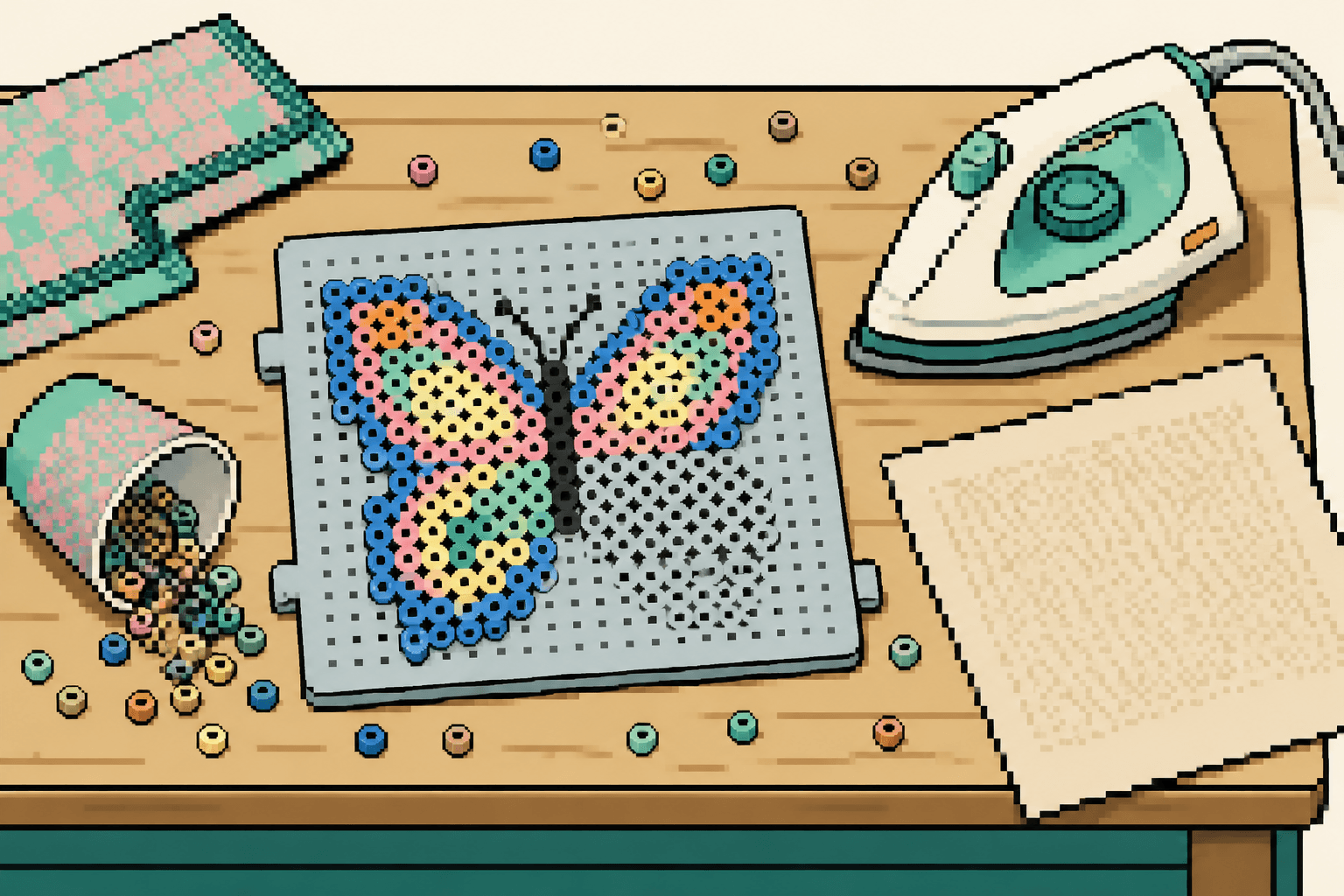
You had the pegboard on a piece of newspaper on the coffee table. You had a paper Dixie cup of yellow beads, a paper Dixie cup of black beads, and a small pile of one specific shade of pink you'd been mining out of the big bucket for twenty minutes.
You had, on the pegboard, most of a butterfly. One wing was done. The other wing was three rows in. You were placing beads with the tip of your finger, one at a time, and each one made a tiny plastic tick as it landed on its peg, and you were doing this so carefully that you had stopped breathing through your nose.
Your brother came through the living room. He was not doing anything wrong. He was just walking. But he kicked the leg of the coffee table with the toe of his sneaker, casually, the way an eight-year-old kicks anything at knee height, and the pegboard moved about a quarter of an inch.
A quarter of an inch was all it took.
The Beads
They were tiny plastic cylinders. Each one was about the size of a pencil eraser, sliced very thin, with a hole in the middle. They came in a plastic bucket the size of a coffee canister, mixed together in every color the plastics industry could produce, and pouring them from the bucket into your hand sounded exactly like pouring pebbles onto a snare drum, which was a sound that would bring your mom into the room within about eight seconds.
You didn't buy them by the color. You couldn't. You bought them in the rainbow bucket or in the pastel bucket or in the neon bucket and you got what you got, and if you wanted seventy yellow beads for a sun, you sat on the carpet and picked yellow beads out of the bucket, one at a time, and you built up a small yellow economy in a Dixie cup, and this took about forty minutes, and it was not what you were supposed to be doing but it was, in fact, most of what Perler beads were for.
The beads had a smell. It wasn't a bad smell. It was the smell of new plastic - not the smell of a car dashboard on a hot day, but a lower, quieter smell, the smell of a bin at a craft store, or of a fresh bag of Legos. You could stick your face into a full bucket of Perler beads and inhale, and if you did that in front of your mom, she would say what are you doing, and the correct answer was I don't know, because you didn't.
The Pegboard
The pegboard was clear plastic, about the size of a coaster or, if you were the ambitious kind, about the size of a paperback book. It was a flat sheet with hundreds of small pegs sticking straight up out of it, like a bed of nails scaled down for very small angels.
Each peg was exactly wide enough to hold one bead. The bead sat on the peg like a doughnut on a finger. There was nothing keeping it there except gravity and friendship. If you nudged the pegboard, the bead moved. If you nudged it harder, the bead fell off, and now it was on the coffee table, and now it was on the carpet, and now it was gone forever.
The pegboards came in shapes. There was the big square, which was the honest one. There was the round one, which you used exactly once, for a Christmas ornament, and then you never used it again. There was the heart-shaped one, which was a trap, because you couldn't do anything on it except a heart, and even the heart looked like a lump. And there was the giant hexagonal one, which had come with your kit, and which was too big to finish, because filling a hexagon takes about nine hundred beads, and you didn't have nine hundred of anything.
Most kids only ever finished the small square.
Each peg was exactly wide enough to hold one bead. The bead sat on the peg like a doughnut on a finger. There was nothing keeping it there except gravity and friendship.
The Design
You could make anything you wanted, in theory. You could make a heart. You could make a butterfly. You could make a flower. You could, if you were really committed, make a rainbow, but rainbows required a lot of specific colors in a specific order, and by the time you got to purple you were tired and out of purple.
In practice, everybody made the same six things. A heart. A butterfly. A flower with five petals. A star. A smiley face. A rectangle that was going to become something and then didn't.
Later, if you were the right age at the right time, you made Pokemon. You made a Pikachu. Everyone made a Pikachu. Pikachu was yellow and had a black tail and a red circle on each cheek, and if you owned the pastel bucket, you did not have any red, so your Pikachu had two pink circles on its cheeks, and it looked, faintly, embarrassed about that.
The design lived in your head or on a piece of graph paper. Some kits came with a booklet of patterns, and the booklet was mostly Christmas trees and Easter eggs. Some kids made their own patterns first, on graph paper, with colored pencils, one square per bead, and those kids ended up with much better butterflies. Everyone else guessed as they went, and their butterflies had one wing bigger than the other, and they accepted this.
- A heart. The default. Two colors. Done in seven minutes. Fine.
- A butterfly. Ambitious. Four colors. Fifty-fifty odds one wing came out crooked.
- A flower. Simple in theory. Petals never lined up. Always got a stem you didn't plan for.
- A rainbow. You did not have all the colors. You would substitute pink for red. It looked wrong.
- A star. Deceptively hard. The points were always uneven.
- A Pikachu. Not until 1998 or so. Everyone made one.
- Your initial. Very cool for about eleven seconds.
- A dinosaur. Only the kids who drew a lot at recess even tried this.
- A gun. Somebody's older brother, once. Confiscated.
Try one
Pick a color from the palette. Click a peg. Fill in a butterfly, or a heart, or, more likely, a rectangle that was going to become something and then didn't. When you're ready, hit Iron It. The beads will fuse and get a little shine on them. Sometimes it comes out fine. Sometimes the middle goes brown.
There is also a Sneeze button, which you should press only once, and only when you have committed enough time to something that pressing it will actually cost you.
The Iron
At some point, when the design was done, you had to fuse the beads together, and you could not do this yourself, because it required the iron.
The iron was your mom's iron. The iron lived on top of the dryer, or on a shelf in the laundry room, or, in the houses of children whose parents ironed shirts on weekends, on a special little board that folded out of the wall like a Murphy bed. The iron was hot. The iron was heavy. The iron was, in the hierarchy of household objects a nine-year-old was allowed to touch, at approximately the same level as the stove, which meant no.
So you carried the pegboard, in both hands, at the speed of someone carrying a bowl of soup, from the coffee table to the kitchen. You did not breathe. You went around the cat. You stepped very carefully over the transition strip between the carpet and the tile. You held the pegboard perfectly level, because a five-degree tilt would send half the beads sliding into a corner, and any tilt at all would send at least one bead flying off, and that bead was gone. It rolled under the fridge. It's still there.
You set the pegboard on the kitchen counter. You told your mom. Your mom said just a second, and she meant twenty minutes, and you waited, standing next to the pegboard like a security guard, because if the dog got up on the counter, you would kill the dog with your hands.
Then your mom came in and got out the iron. She plugged it in. She got a piece of wax paper off a roll in the drawer. She laid the wax paper over your pegboard. She set the iron down. She started moving it in slow circles.
You held the pegboard perfectly level, because a five-degree tilt would send half the beads sliding into a corner. Any tilt at all would send at least one bead flying off, and that bead was gone. It rolled under the fridge. It's still there.
The Fuse
There was a window, and the window was maybe ten seconds wide, and if your mom stopped ironing before the window opened, the beads didn't fuse, and if your mom stopped ironing after the window closed, the middle of your butterfly turned brown.
Nobody knew where the window was. Your mom didn't know. The kit didn't say. The kit said ask an adult to iron for 15 to 30 seconds until the beads have fused together, which was, as a set of instructions, roughly find the exit velocity of a rocket. Ask a grown-up.
So your mom did her best. Sometimes she ironed for eight seconds and lifted the wax paper and half the beads came up with it because they weren't fused yet, and she put the wax paper back and ironed some more, and now those beads were fine but the ones underneath had been ironed twice and were starting to go flat. Sometimes she ironed for forty seconds and the middle of your butterfly, which had been the yellow body, was now a small brown puddle, and the wings were fine, and the body looked like the butterfly had, in flight, been hit by a very small meteor.
You couldn't fix it. You could not un-melt a bead. You could try to pick out the melted bead with a fingernail, but it was fused to the beads next to it now, and if you pulled it out, you took three friends with it, and now your butterfly had a hole in its stomach and looked, briefly, like a crime scene.
You accepted the melted body. You told yourself the meteor was a pattern. You held the ironed butterfly up in the kitchen light, and half of it was shiny, and half of it was still matte, and it was slightly warped where the iron had gone over too many times on one side, and it was yours.
The Peel
The wax paper had to come off. You did this yourself. This was the fun part.
You peeled it slowly, from one corner, and the wax paper came away from the beads with a faint sticky sound, because the beads had melted just enough to grip it, and if the beads were properly fused, the paper came away clean, and if the beads weren't properly fused, one or two of them came with the paper, and you peeled the bead off the paper with your fingernail and tried to figure out where it had gone, and you never quite got it right.
You flipped the butterfly over and did the other side.
Then you held it up. It was flat. It was warm. It had a very faint plastic smell that lingered for about a day.
You showed it to your mom. Your mom said very nice, honey in the voice she used for things she had already ironed. You went and put it on your dresser, next to the other three you had made, and then you went and got a new pegboard, and you started over, because the whole point was to make another one.
The Argument
Every essay about a craft toy from childhood, eventually, wants to say the craft toy taught you patience, or fine motor skills, or the value of finishing a thing you started. Perler beads are especially vulnerable to this argument, because they take a long time to do and they involve carefully placing very small objects, and if you squint, you can make them look like a lesson.
I want to make that argument. I don't think I'm going to.
Perler beads did not teach patience. Perler beads exposed the exact amount of patience you already had, which for most kids was about eleven minutes, at which point the pegboard got kicked. Perler beads did not teach you fine motor skills. Perler beads punished you for the fine motor skills you didn't yet have, and rewarded you for the ones you did, which is not teaching, that's just testing. Perler beads did not teach you the value of finishing a thing you started, because 90% of the pegboards we started did not get finished. They got left, half-done, on the coffee table, and the cat sat on them, and the beads went everywhere, and your mom found a red one in the vacuum bag six weeks later and held it up at dinner and said what is this from and you said I don't know and you knew.
Perler beads did not teach patience. Perler beads exposed the exact amount of patience you already had, which for most kids was about eleven minutes.
But something happened, during the eleven minutes.
You picked up a bead. You put it on a peg. You picked up another bead. You put it on the next peg. Your hand learned how much pressure to use so the bead sat down without knocking the neighboring beads off. You learned how to hold your breath while your hand hovered over the board. You learned that if you sneezed, or coughed, or laughed, you were going to have to start over, and that this was a fact about the world, not a punishment. You learned that some objects are more delicate than they look, and that the only correct response to a delicate object is to slow all the way down and pay attention.
I don't know if you use that skill now. I don't know if any of the mid-90s craft economy was, in the aggregate, worth the plastic. But you sat on the carpet for four hours, over a summer, and you made a butterfly out of little plastic tubes, and your brother almost ruined it, and you didn't cry, and your mom didn't melt the middle, and you put it on your dresser, and you kept it.
I saw a bucket of Perler beads at a Michaels last month. I have a daughter. She is six. She is exactly the wrong age for this, which is to say the right age. I bought the bucket. I bought a small square pegboard. I bought a roll of wax paper that we already had.
We sat on the kitchen floor because the coffee table had a puzzle on it. I poured a small pile of pastel-heavy beads onto a paper plate. I said you can make anything you want. She looked at the beads. She looked at the pegboard. She said what did you make.
I said butterflies, mostly. I did not say because the wings hid the fact that you couldn't do anything harder.
She started placing beads. She started, correctly, with a heart. She did the outline in pink. She filled it in in pink. She did it very fast and did not seem particularly interested in the outcome. She got about halfway through and stopped and asked if she could go watch her show. I said sure. I said we would iron it later.
I sat on the kitchen floor with a half-finished pink heart and a bucket of tiny plastic cylinders, and I picked up a red bead, and I put it on a peg, and I picked up another red bead, and I put it on the peg next to it, and I did this for about twenty minutes, because I was going to finish her heart if it killed me, and when I brought it into the living room she looked up from the TV and said cool, and I ironed it later, and the middle went a little brown, and I put it on the fridge.
It's still there.