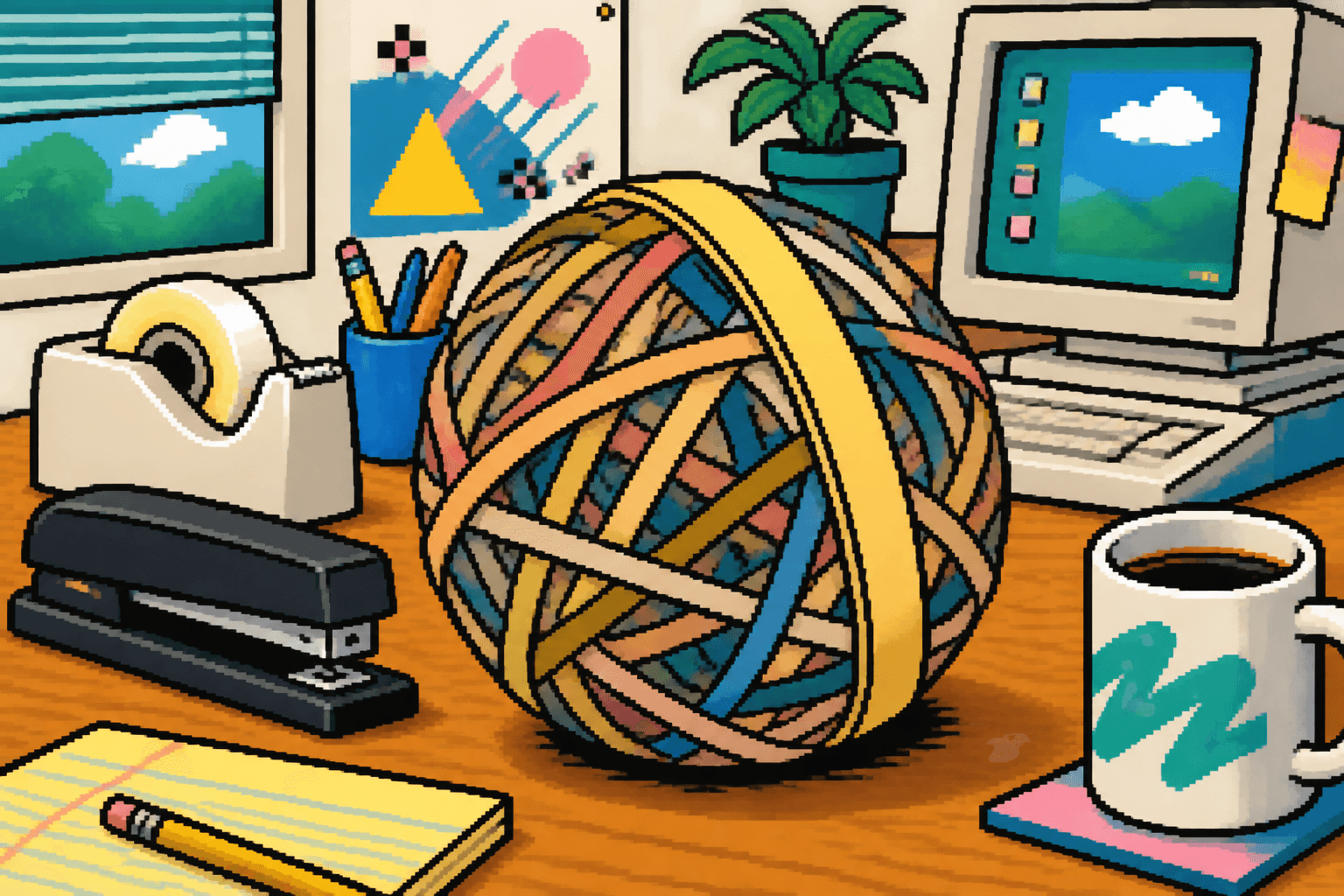
Your dad had a desk in the corner of the dining room. Or a desk in a room the family called The Office, which was really the third bedroom with a filing cabinet in it. On the desk was a black stapler, a beige tape dispenser weighted like an anvil, a mug full of pens that had all stopped working in 1994, and a rubber band ball.
The rubber band ball was the size of a plum.
You were not allowed to touch it.
Where It Came From
Nobody knew where it came from. You could ask your dad. He would say what, the rubber band ball in the tone of a man who had never once, in his entire life, considered the question. Then he would say I don't know, I've had it forever, which was a lie, because he had not always had it. It had started somewhere. There had been a first rubber band. There had, at some point, been no rubber band ball. But nobody could point to the day.
That was the first weird thing about it. Every other object in the house had a story. The couch was from your grandma. The lamp came from a garage sale. The little pewter figurine of a golfer had been a bad Father's Day present in 1991 and had been slowly demoted, year by year, from the mantel to the shelf to the desk. But the rubber band ball had no origin. It had accumulated.
Nobody remembered the first rubber band. There had been one. Somebody had folded it back on itself. The whole physical object descended from that single act. Nobody could point to it.
The Physics Were Wrong
You knew, intellectually, that it should bounce. It was a ball. It was made of rubber. It was reasonably spherical. Every diagram of a ball in your Weekly Reader indicated that a ball, when dropped, would rebound off the floor and return to somewhere near your hand.
The rubber band ball did not do this.
The rubber band ball, if dropped, would hit the linoleum with a soft, dense thpp and then roll off in a direction you had not sanctioned. It bounced maybe two inches. It bounced unevenly. One side of it was fatter than the other because your dad, in a hurry, had put on three enormous post-office bands one afternoon in 1996 and it had never fully recovered its geometry.
It looked like a ball. It weighed like a ball. It refused to behave like a ball.
The Taxonomy of Bands
The bands were not uniform. They were an archive.
There was the standard beige office band - the one that came around a cardboard box of copy paper. There was the fat, red, aggressively rectangular post-office band that had been wrapped around a stack of catalogs from Sears. There was the small, brown, waxy band that had been holding six spears of asparagus together at the Kroger. There was the wide green rubber band that came around the newspaper on Sundays and was, all by itself, roughly twelve percent of the entire ball. There was the pale pink one from god knows where. Nobody had a hypothesis.
- One brown asparagus band, folded back on itself
- Two beige office standards from a copy-paper box
- The mystery pink one
- Four thin browns, the kind that came around broccoli
- A single wide green Sunday newspaper band that changed the shape of the whole enterprise
- Three post-office reds, done in one afternoon, absolutely dominating the west side of the ball
- Roughly forty beiges, over the course of two years, whenever mail came
- One yellow one you added when he wasn't looking
The bands were also from different decades. That was the disorienting part. The band at the center of your dad's ball had been holding produce together in the Reagan administration. The band on the outside had come off a UPS package last Thursday. The ball was a stratified geological record of every rubber band that had ever passed within four feet of your father's dominant hand.
The Rule Was Structural
Once a band was on, it stayed on.
There was a rule about this. Not a spoken rule. A physical rule. You could not take a band off the rubber band ball without disturbing four other bands, which were, in turn, holding down six more, which were, in turn, the only thing preventing the entire west side from unwinding into a small explosion of rubber and desk dust.
You learned this the one time you tried. You were nine. You had wanted a rubber band. You had thought, reasonably, that a rubber band ball was, essentially, a rubber band dispenser that your dad had failed to explain properly. You picked at one. It stretched. It didn't come off. You pulled harder. Two bands underneath it made a snap sound.
Your dad did not yell. Your dad was worse than that. Your dad said hey in a specific tone. You put the ball back.
A rubber band ball is not a collection of rubber bands. A rubber band ball is a rubber band ball. The bands stop being bands the moment they go on it. They become structure.
Try It
Put one down. Put another one on top of it. Keep going. Watch what happens to the shape when you add a big one. Try to bounce it. Try to take one off.
Report back to your dad.
The Reason Was Nothing
Here is what I think about, now, thirty years later, when I see a rubber band. Nobody who ever built a rubber band ball had a reason. There was no plan. There was no problem the rubber band ball was solving. It was not a stress toy - your dad was not sitting there squeezing it. It was not decorative - nobody looked at it and thought that improves the room. It was not a hobby, exactly. Your dad did not talk about it. He did not add to it on purpose. He did not, on birthdays, receive rubber bands as a gift, wrapped with a card that said for the ball.
He just, when a rubber band came into his hand, put it on the ball.
That was it. That was the whole practice. He did not decide to. It was more automatic than deciding. His hand received a rubber band, and his hand walked over to the desk, and his hand put the rubber band on the ball, and then his hand went to do the next thing. Some kind of muscle memory had installed itself, sometime in his twenties, without his consent, and it just ran.
He didn't decide to add a rubber band. His hand did. Some kind of muscle memory had installed itself sometime in his twenties, and it just ran.
The Ball Was A Container
I think the ball was, actually, a container for a specific kind of small anxiety. Not a big anxiety. A tiny one. The specific low-grade domestic anxiety of what do I do with this rubber band.
Because a rubber band, alone, is a problem. It's not trash - you might need it. It's not a tool - it's shaped like nothing useful. It doesn't fit in a drawer - it flops. It doesn't fit in a cup - it slithers out. It doesn't fit in a box - it disappears into the corners and appears months later, hardened. A single rubber band is an object with no home.
The rubber band ball solved this. The rubber band ball was the home for stray rubber bands.
That was the whole function. Your dad had, without deciding to, invented a small, personal disposal system for one specific object that did not have a good disposal system. He did not know he had done this. He would not, if you asked him, have described it this way. He would have said what, the rubber band ball, I don't know. But that's what it was. It was a way of not throwing a rubber band away.
Nobody's Kid Has One
I have looked, as an adult, at my friends' desks and my colleagues' desks and my own desk, and I do not see rubber band balls anymore.
Some of this is that we don't get rubber bands. The mail comes in envelopes now. The newspaper doesn't come. The copy paper is at a print shop we don't go to. Asparagus is prewashed and clamshelled. The rubber band as a free daily object has quietly disappeared from adult life.
But some of it is that we don't accumulate anymore. We don't have a place, on a desk, for a small accretion of unrelated stuff to become one thing, over a decade, without a plan. If we get a rubber band now, we throw it away. If we save a rubber band now, we put it in a Ziploc bag in a drawer that has a label from a label maker that says rubber bands, and it stays flat and separate and organized. It does not become a ball.
The ball required a particular kind of unhurried inattention. It required a desk you sat at for twenty years. It required a hand that would rather not think about what to do with a rubber band. It required a household that had accepted, silently, that a strange sphere of latex was going to live on a piece of furniture and that this was fine.
The ball required a hand that would rather not think about what to do with a rubber band. It required a household that had accepted, silently, that a strange sphere of latex was going to live on a piece of furniture. That was fine.
The Argument
I don't want to overstate this. It was a ball made of rubber bands. It was, in the taxonomy of 90s desk objects, not that important. It ranked well below the Post-It pad and the framed school picture of you at eight and the coffee mug that said #1 DAD in a font your mom had picked out. Your dad would not, if the house were on fire, have gone back in for the ball. He barely knew he owned it.
But I want to notice that the ball, for what it was, was a small argument for a different mode of being. Not a good argument. Not a better mode. A different one. A mode where you didn't sort things. Where you didn't decide, in the moment a rubber band appeared, whether to keep it or throw it out. Where you just added it to a slowly growing pile of stuff you had already committed to keeping, without ever quite making the commitment. The ball was the commitment. The ball had been made for you, by your past self, twelve years ago, on a Tuesday you don't remember.
My dad's ball is still on my dad's desk. He is retired now. He does not get catalogs. He does not receive very many rubber bands. He has not added to it in maybe three years. It's a little dusty. It's about the size of a large orange. It has, on the top, a thick red post-office band from the mid-nineties, still stretched, still red, still holding.
I asked him about it, last time I was home. I said how long have you had that. He looked at it. He looked at me. He said what, the rubber band ball.
I said yeah.
He said I don't know. I've had it forever.
Somewhere in the middle of it, if you could get through the outer three hundred rubber bands without triggering an unraveling, is a single brown band, folded back on itself, that was once around six spears of asparagus in a Kroger in 1987. Your dad put it on the desk. Then he put another one on top of it. He is not going to remember doing that. But the ball remembers. The ball is what remembering looks like when nobody's trying.