The camera cut to the door. The door slid up. The door was a foam-and-plywood slab painted to look like carved stone, and it made a sound like a garage door because it was a garage door with paint on it, but you did not know that when you were nine.
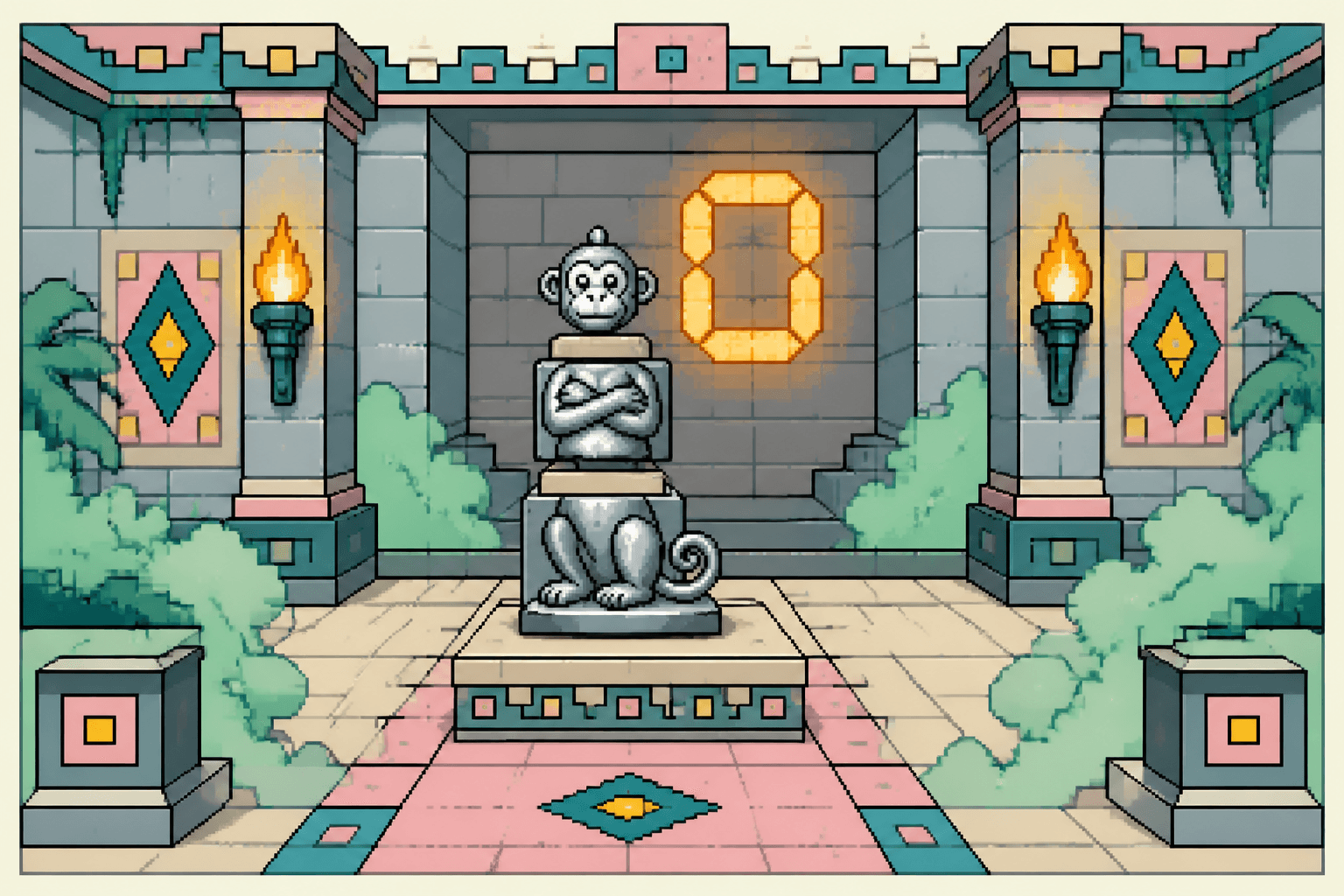
Inside was a small room. Inside the small room was a low pedestal. On the pedestal, in three pieces, was the Silver Monkey.
Base. Torso. Head.
You knew this. You had known this since the last commercial break. You had watched, at home, on a couch, while a kid you had never met went into this exact room and put the head on the base and stared at the statue for a full second before the torso started making sense, and by then, the temple guard came out of the wall and took her by the wrist and lifted her out of the room, and the game was over, and you screamed at the television, because it was right there.
The Show
Legends of the Hidden Temple aired on Nickelodeon from 1993 to 1995 and ran, in some form, until whatever channel your dad flipped it to at 4pm on a weekday afternoon. It was hosted by Kirk Fogg, who had the exact energy of a substitute gym teacher who has decided to be fun about it, and it was co-hosted by an animated stone head named Olmec, who had been carved for the show by someone who had clearly been told make it look ancient and also make it talk.
Olmec knew everything. Olmec told the legend. Olmec named the artifact. Olmec explained the rules to games where kids had to swim across an inflatable moat while carrying a jade monkey, and Olmec did this in a voice that sounded like your grandfather trying to sound scary at a Halloween party, and you believed him, because you were nine and he was a giant carved head with glowing eyes and there was fog coming out of him.
The show had six teams. Purple Parrots. Silver Snakes. Blue Barracudas. Orange Iguanas. Red Jaguars. Green Monkeys. Every kid in America picked a team. Every kid in America was disappointed when the Blue Barracudas lost, because the Blue Barracudas always lost, until suddenly one day they didn't, and it felt like the sun coming up.
Olmec had been carved for the show by someone who had clearly been told make it look ancient and also make it talk.
The Ladder
There was a whole show before the temple.
You forget this, because nobody remembers it. There was the Moat, where two kids had to get across a pool of water using half-inflated giant beach toys. There were the Steps of Knowledge, where a giant fake stone staircase had a fake stone slab under each step, and the kids stood on the top step and answered trivia questions and stepped down one step per correct answer, until only two teams were left. There was the Temple Games, where four teams played three physical challenges for pendants of life, and one of the challenges was almost always some variation on climb up a wall while a bungee cord tries to pull you back down.
None of this mattered.
Nobody watched Legends of the Hidden Temple for the trivia. Nobody watched it for the moat. You watched it for the last five minutes, when two kids in helmets ran into a room full of moving walls and glowing torches and had to grab a plastic doll off a shelf, and 92% of the time they did not.
The Temple Run
The Temple Run was the only television I have ever watched, before or since, where the entire show was structured to build up to a segment lasting three minutes that mostly consisted of two children getting body-tackled by adults in face paint.
The rules, as best I can reconstruct them:
- You had three minutes.
- The temple had twelve rooms, connected by doors, and you knew the layout because Olmec had told you the layout, and if you had not been paying attention when Olmec told you the layout, that was your problem.
- Hidden in three of those rooms were temple guards, played by grown men in loincloths and jaguar-print body paint, whose entire acting career on this show consisted of jumping out of a foam wall and grabbing a small child by the elbow.
- Each kid had two pendants of life, which they had earned in the Temple Games. Each pendant would buy off exactly one temple guard. If a temple guard grabbed you and you had no pendants, you were out. Your partner had to keep going alone.
- The goal was to grab the artifact, which was on a stand in one specific room, and bring it back out the front door.
The artifact was almost always something like the Shiny Belt of Whoever or the Golden Cup of Someone Else or a small plastic monkey. It was always a plastic prop with a spray-painted finish, and it looked, in your living room, like the most valuable object in the world.
- Silver Snakes. Won a lot. Silver was cool. Snakes were cool. Named themselves correctly.
- Purple Parrots. Improbable success rate for a team wearing purple.
- Blue Barracudas. Never won. Then won. Then never won again.
- Red Jaguars. Loud. Overconfident. Blew the Silver Monkey.
- Orange Iguanas. Everyone's second favorite team. Nobody's first.
- Green Monkeys. Doomed. Named after the exact statue that would end them.
The Shrine
Somewhere in that temple, in most episodes, was the Shrine of the Silver Monkey.
The Shrine was a small stone room. In the middle of the room was a chest-high pedestal. On the pedestal was the Silver Monkey. The Silver Monkey was a small statue - maybe eighteen inches tall - of a monkey sitting cross-legged, with its arms folded, and its tail curled around behind it, in what art historians would call a nonspecific vaguely Mesoamerican pose and what most of us would call a monkey looking pretty chill about the whole thing.
The Silver Monkey came apart. It came apart in three pieces. The base, which had the tail curled around it. The torso, with the folded arms. And the head, which had a face on it and, on the underside, a hole that fit onto a peg on top of the torso.
When you entered the Shrine, the pieces were scattered around the pedestal in some order that was not the correct order.
Your job, as a nine-year-old on national television, was to assemble the Silver Monkey.
You had watched this be done, in previous episodes, in something like eleven seconds. You had watched it be done in forty-five. You had watched teams walk into the Shrine of the Silver Monkey, look at three obviously identifiable pieces, and put the head on the base, and then look at the torso like they had never seen a torso before, and take the head off, and put the torso where the head had been, and then put the head on top of the torso, and then look at the assembled monkey, and it would be balanced fine, and it would be upside down, because you had put the torso on the base backwards, and the folded arms were now facing into the pedestal and not out at the camera.
The temple guard would come out of the wall.
The temple guard would take you gently by the wrist.
Kirk Fogg would say ohhh, so close.
The head went on the top. The torso went in the middle. The base went on the bottom. Every kid in America knew this and every third team choked.
Try it. It is a trick.
Thirty seconds. Base, torso, head. Wrong piece costs you three seconds off the clock. You will beat this on the second try and then you will lose it on the third, because your brain will decide, briefly, that the torso is the base, and by the time you notice, the temple guards will already be out.
The Actual Trick
Here is the thing that nobody on the show explained.
It was harder in the room. It was harder because the pieces did not look like the pieces looked on your TV screen. They looked, in person, like three pieces of a monkey, in silvery paint, sitting on a stone pedestal in a room with dim lighting and smoke coming out of the walls, while a man in an aloha shirt was yelling GO GO GO at you through a headset, and your friend, in an adjacent room, was screaming your name, and there was a countdown timer running somewhere behind you that you could not see but could definitely feel.
You had, at that moment, most of a working nervous system, but not all of it.
Also - and this is the part that I did not appreciate as a child - the pieces were all a similar size and a similar color, and if you had never seen the monkey assembled in person, you had to figure it out from the shapes. The base had a flat bottom, but the torso had a pretty flat bottom too. The head was clearly a head, sort of, but it was a monkey head, and monkey heads are basically small torsos with faces. You had a couple of seconds. You had a whole nation looking at you. You had one job.
You had, at that moment, most of a working nervous system, but not all of it.
The Guard
The temple guards were, technically, the villains of the show, but nobody actually thought of them as villains. They were more like forces of nature.
You didn't beat a temple guard. You bought one off, with a pendant. And if you didn't have a pendant, the temple guard did something that, in retrospect, was a small miracle of choreography: he grabbed you, gently, so gently that you have to squint to see it on the tape, and then he walked you out of the room, in a slow, faintly regretful way, like a bouncer removing a small child from a bar. There was no violence. There was no shouting. The temple guard was doing his job, and you had failed to pay the toll, and the temple guard was, on some level, a professional.
The kid, at that point, always did the same thing. The kid would look at the temple guard. The kid would look at the camera. The kid would look at the artifact, on its pedestal, twelve feet away, and unreachable now, forever. And then the kid would let the temple guard walk them out, because they were nine, and there were rules, and the rules said the temple guard won.
Sometimes the kid would cry, a little, and Kirk Fogg would say hey, you did great, and the kid would smile at Kirk Fogg through a wobbly face, and you, on the couch, would feel it in your chest, and you would say to your mom they were so close and your mom would say I know, honey, without looking up from her book.
The Argument
Every essay about a specific piece of 90s television, eventually, wants to argue that television back then was better. That kids were more resilient. That producers had respect for their audience. That we don't make things like this anymore because we, as a culture, have gotten soft.
I don't want to make that argument.
Legends of the Hidden Temple was a fine show. It was a good show for what it was. It was also, structurally, a game show that made children physically fail on live television, and it did this once a day for two years, and my only real defense of it is that the kids seemed to be having a good time and nobody appeared to actually get hurt. The Silver Monkey ate more contestants than the temple guards did. The Silver Monkey ate them because the Silver Monkey was, deliberately, a puzzle designed to be just hard enough to fail under pressure - the way a game of Perfection is just hard enough, the way a Bop-It is just hard enough, the way any children's game must be, to be watchable.
The people who made Legends of the Hidden Temple understood something about children's television that most people who make children's television forget, which is: the failure is the show. Kids watching at home did not want to see other kids win the artifact. Kids watching at home wanted to see other kids get this close, and blow it, and get walked out by a temple guard, and then next week it would be a different set of kids, and maybe next week the Blue Barracudas would finally win, and you would be there for it, and you would remember it, thirty years later, when you tried to explain to your child what a temple guard was.
I tried to explain the show to my niece last year. She is eleven. She has watched exactly enough television to think that television made in 2020 is a normal amount of televisiony. I told her about the moat, the Steps of Knowledge, the pendants of life, the temple guards. She listened politely, in the way an eleven-year-old listens to their uncle explain a Nickelodeon show from 1994.
Then I told her about the Silver Monkey. Three pieces. Base, torso, head. You had to put them in the right order or the temple guard would take you out.
She said why didn't they just practice on a fake one before they went in?
I said because you were a kid, and you were on television, and you had thirty seconds, and Kirk Fogg was yelling at you.
She said that seems mean.
I thought about it.
I said, I mean, kind of. But we watched it every day.
She said okay, but why.
I did not have a good answer for that. I still don't. I have a bad answer, which is because when the kid got the monkey together and grabbed the artifact and ran out through the front door and beat the temple, it was one of the best things you ever saw on television, and it was one of the best things because 92% of the time, it did not happen, and you knew it did not happen, and you kept watching anyway, because you were nine, and you wanted, more than almost anything, to see a stranger you had never met assemble a small silver statue in the correct order, on live television, in a stone room, with the timer running.
Sometimes they did.
I remember the feeling. I do not remember the kid's name.