The label came off in one piece if you were careful.
That was the second-best part. The first-best part was the cap. You held the bottle in one hand and twisted with the other, and there was a moment of resistance, then a small sharp pop as the metal safety button gave way in the middle of the cap, and then a whole second sound - a hiss, because the iced tea inside had been under a little bit of pressure, and now it wasn't. The bottle sighed. You had unsealed a document. You did not know the document existed yet, because you were nine, and you were thirsty, and you drank half of the tea before you got around to looking at the cap.
Then you looked at the cap.
The Underside
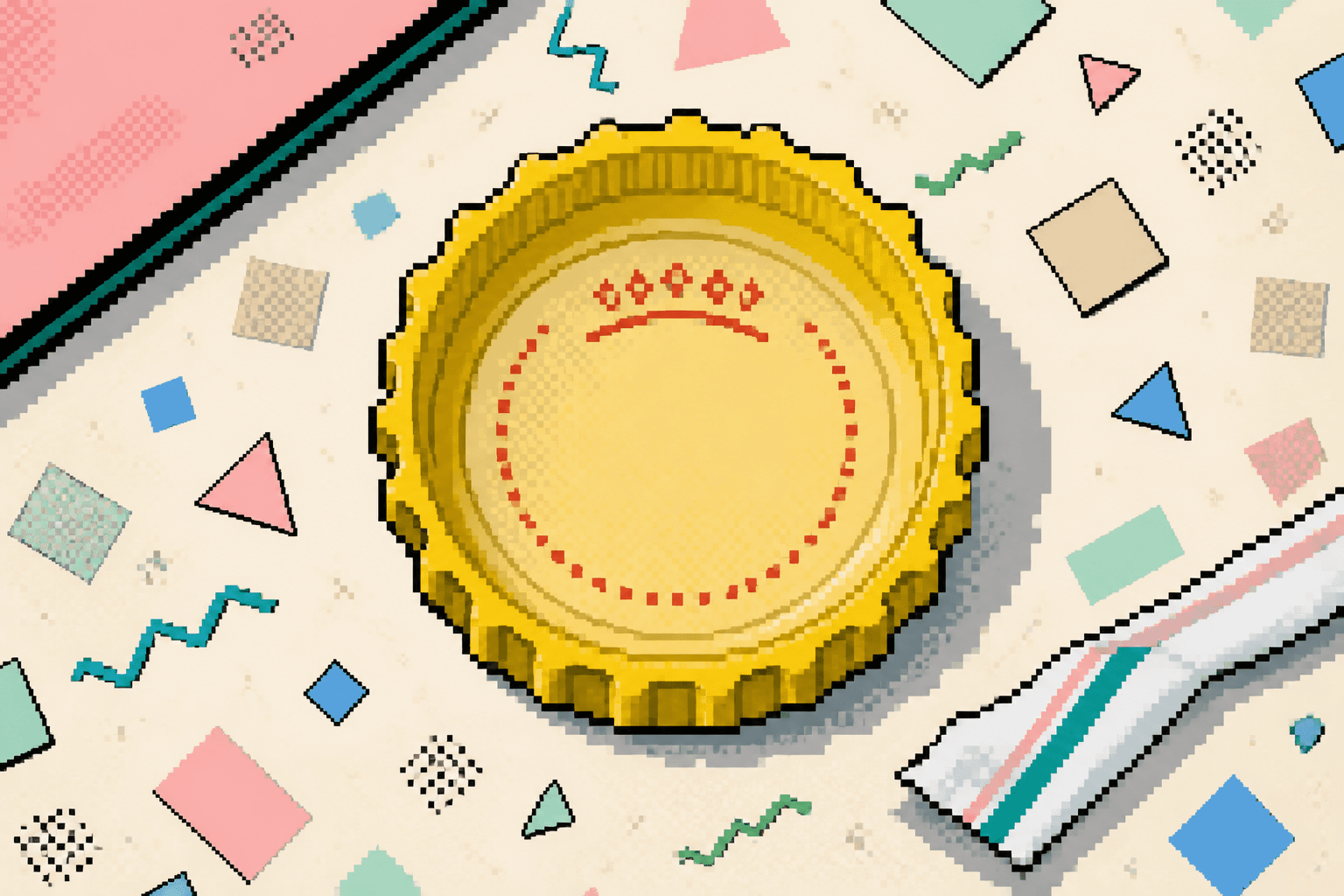
You flipped it. The outside of the cap was yellow, ridged, with the word SNAPPLE stamped into the top in raised letters and a red circle around it. The outside was for grownups. The outside was for the shelf.
The inside was for you.
The inside of the cap was flat and matte and printed in red, and it always said the same two things in a specific order. First, at the top, in a small serifed font: Real Fact. Then a number. #47. Or #12. Or #33. Then, below the number, in the same font, a single sentence.
Frogs never close their eyes, even when sleeping.
That was it. That was the whole thing. A number, a sentence, a bottle cap. You would carry that cap around for the rest of the day. Sometimes you would put it in your pocket. Sometimes, if it was Friday and you had earned some kind of dumb luck, you would forget it was in your pocket and it would go through the wash, and the print would blur, and you would still know the fact, because you had already told six people.
The Number
The number mattered as much as the fact.
Real Fact #47 was a serial. It implied there were forty-six other facts, in caps somewhere, in the possession of other people. It implied a list. Somewhere in a warehouse in New Jersey there was a master document, and this cap was one line of it, and if you drank enough Snapple you could theoretically collect the whole thing. You knew this on some level. You did not do this. But you knew you could. That was the point.
Somewhere in a warehouse in New Jersey there was a master document. This cap was one line of it. If you drank enough Snapple you could theoretically collect the whole thing.
Kids swapped them. Not in the way we had swapped Pogs, with rules and a slammer and an economy. Snapple facts were traded conversationally. You would sit down at the lunch table with a cap in your hand and you would say guess what, and the person across from you would say what, and you would read them the fact, and they would react in one of three ways.
They would say no way. This was the good response. This was the response that made you feel like a small librarian.
They would say my sister told me that one. This was fine. This was acknowledgment that you had contributed to the pool.
Or they would say that's not true, actually. This was the worst response. This was a kid at the lunch table telling you, without evidence, that the number-forty-seven fact printed on the underside of a Snapple cap by an American beverage company in a real font on real plastic was wrong. You did not have a way to check. Neither did they. You would stare at them, and they would stare at you, and you would put the cap back in your pocket. You would still believe the fact. But now there was a small hole in it.
The Facts Themselves
The facts were of three kinds.
The first kind was actually true. Butterflies do taste with their feet. Honey really doesn't spoil in any meaningful sense. Tigers actually have striped skin under their fur, not just striped fur. If you drew a Snapple cap out of a hat and it was one of these, you were fine. You could carry the fact into adulthood. You would encounter it again at a bar, at thirty-two, on a first date, and you would repeat it, and the person would say no way, and you would nod, and the small piece of the Snapple warehouse in New Jersey that lived inside your head would light up briefly, and you would smile.
The second kind was pretty likely made up. The average person laughs fifteen times a day. The average American spends two weeks of their life waiting for red lights. The average person walks the equivalent of three times around the world in a lifetime. Nobody at Snapple had ever measured any of this. Nobody had ever produced a study. The numbers were plausible-adjacent. They were the sort of numbers a magazine would print without a footnote in 1998. If you tried to source one of these facts today you would find a Snapple cap. That would be the source. The source would be the thing that made the claim, and you would blink at it, and you would move on with your life.
The third kind was wrong. This is the part I want to spend a minute on.
The Wrong Ones
The most famous Real Fact was Real Fact #12: A goldfish has an attention span of about three seconds. This was on the cap. It was on the cap for years. Every kid in America read this fact off a cap in 1998, and repeated it to another kid, and internalized it as a load-bearing piece of the world.
Goldfish, it turns out, have memories of several months. There are experiments. There is video. A goldfish can be trained to swim through a maze. A goldfish can recognize its owner. The three-second thing was not just a rounding error - it was, structurally, not a fact at all. It was a folk belief that had wandered into a beverage-company boardroom and been printed in red ink on a piece of plastic and distributed to twelve million American children.
The three-second thing was not a rounding error. It was a folk belief that wandered into a beverage-company boardroom and got printed on a piece of plastic and distributed to twelve million American children.
The frog one was also wrong. Frogs do close their eyes. They have a translucent third eyelid called a nictitating membrane, and when they sleep it slides across, and their eye is closed in every functional sense. The Snapple cap version of this was a half-fact. A kid-in-a-hurry version. And I believed it. I believed it hard. I told it to my dad, at ten, at a diner, and my dad said huh, and I felt like a scholar.
The duck fact - a duck's quack doesn't echo, and no one knows why - is also wrong. A duck's quack echoes. The University of Salford ran the experiment in 2003 with an actual duck named Daisy in an anechoic chamber and then in an echo chamber, and the quack echoed like anything else. The reason people thought it didn't is that duck quacks fade out slowly, so the echo blends into the tail of the original sound and you can't distinguish the two. That's a much more interesting fact than the Snapple version. Nobody at the lunch table wanted to hear the actual explanation. The cap said what the cap said.
Bulls are not colorblind, either. The bull charges the cape because it's moving. The color of the cape is irrelevant. You could wave a beige cape at a bull and it would charge. Bullfighters use red because it hides the blood at the end. That's the actual fact. That one is honestly kind of grim, and I understand why Snapple went with the shorter version.
The Argument
Here is where the essay is supposed to turn against Snapple, and I am not going to do that either.
Snapple was not a peer-reviewed journal. Snapple was a beverage company. The Real Facts program was a marketing invention, launched in 2002 by a Kraft ad exec named Ken Gilbert as a way to give kids a reason to keep buying twenty-ounce bottles of tea, and it worked, spectacularly, for about a decade. The facts were sourced from an old book of trivia and vetted by an intern in a New York office and printed in batches by the pallet. Some of them were true. Some of them were half-true. Some of them were wrong, and it did not matter to anyone at Snapple whether they were wrong, because the entire program was working - kids were buying tea, and reading caps, and repeating facts.
The scam, if it was a scam, was this: it made you feel like a knower. You held a piece of information nobody at your table had. You had authority for one lunch period. The authority was cosmetic. The authority was a beverage-company invention. And I want to argue that this was, on balance, a good thing.
Because the alternative was not no facts. The alternative was facts you looked up, and in 1998 that meant Encarta, and Encarta was in the living room, and you were at school. There was no way to look anything up. If you wanted to know that a frog closed its eyes, you had to find someone who had read that a frog closed its eyes. You had to find a human source. The Snapple cap was a human source in absentia. It was a note passed by an anonymous adult in a marketing department to a nine-year-old in a cafeteria, and the note said here is a thing about frogs, and the note was often wrong, but at least the note existed.
Now every fact is one search away. My kid asks me if bulls are colorblind and I look it up on my phone and read the answer to her out loud. She learns, immediately, that they are not colorblind. She does not learn what it feels like to carry a fact around for a year and then discover, at twenty-two, in a college dorm, that it is wrong. She does not have Snapple caps. She has Wikipedia. She is correct all the time.
I do not know if this is worse.
- #4 More chickens than people. True. (~2.6 chickens per human, at last count.)
- #12 Goldfish, three-second memory. False. (Months, actually. They can be trained.)
- #33 Glass ball bounces higher than rubber. True. (Glass returns more energy on impact.)
- #47 Frogs never close their eyes. False. (Nictitating membrane. They shut it.)
- #82 The dot over the i is called a tittle. True. (Also on the j.)
- #113 Bulls are colorblind. False. (They chase movement, not color.)
- #237 Peanuts are in dynamite. True. (Peanut oil, in some formulations.)
The Sound
The thing I actually miss is the pop.
The plastic safety button in the middle of a Snapple cap was engineered to invert with a small sharp click the moment the seal broke, so you could tell, by touch and by sound, that the bottle had not been opened before you got to it. That click was proof. You were the first person to open this bottle. Nobody had tampered with your iced tea. The cap said so. Grocery stores in the 90s were paranoid about this, for reasons I do not fully remember but which involved cyanide and Tylenol and a general national mood, and every consumable in the store had some version of this - a foil seal, a shrink band, a button in the cap - designed to snap in a way that a kid could hear.
The pop was for you. The pop said the world sealed this for you specifically.
The pop is gone from most drinks now. Bottled water still has it. Some sodas still have it. Snapple, if you buy a Snapple today - and you can, it is on the shelf at the same convenience store you remember - still has it. I bought one last month. It was Kiwi Strawberry. I twisted the cap. I heard the pop. I heard the hiss.
I flipped the cap over.
The underside was blank.
The Blank Cap
They stopped printing the facts in 2023.
I looked this up, because I am now the kind of person who looks things up. The Real Facts program ran, in some form, from the early 90s through 2022, and then Snapple, without much of an announcement, replaced the fact caps with a QR code that scanned to a daily fact on a website. Which means the caps are blank, and the facts are on a server, and the server is a website called snapple.com/real-facts, and if the server goes down, or the domain changes hands, or Keurig Dr Pepper decides that Real Facts are no longer a strategic priority, the whole apparatus disappears. Not fades. Disappears.
The old caps are still out there. In shoeboxes. In junk drawers. In the little tray in the console of a car that hasn't been driven in a decade. The old caps still say what they said. Real Fact #47. Frogs never close their eyes. Which is wrong, and which is permanent, and which is mine.
I still have three caps.
They are in a small ceramic dish on the shelf above my desk, along with a nickel from 1974 and a guitar pick I found on a sidewalk. The caps are #12, #47, and #199. Goldfish, frogs, honey. Two wrong, one right. I did not save them on purpose. They just ended up there, over the years, from bottles I bought while working on something else, and I could not throw them away, because they were not garbage exactly. They were also not information. They were somewhere in between. They were caps.
I don't check them anymore. I know what they say. I've known since 1998, and I've been wrong about goldfish since 1998, and I was right about honey by accident, and I am fine with all of it. I did not need Snapple to be a scientific institution. I needed Snapple to give me a small red sentence on the underside of a yellow cap, at the end of an unremarkable lunch period in the fifth grade, so that I could turn to the kid across from me and say guess what.
The kid said what.
I told them about the frogs.