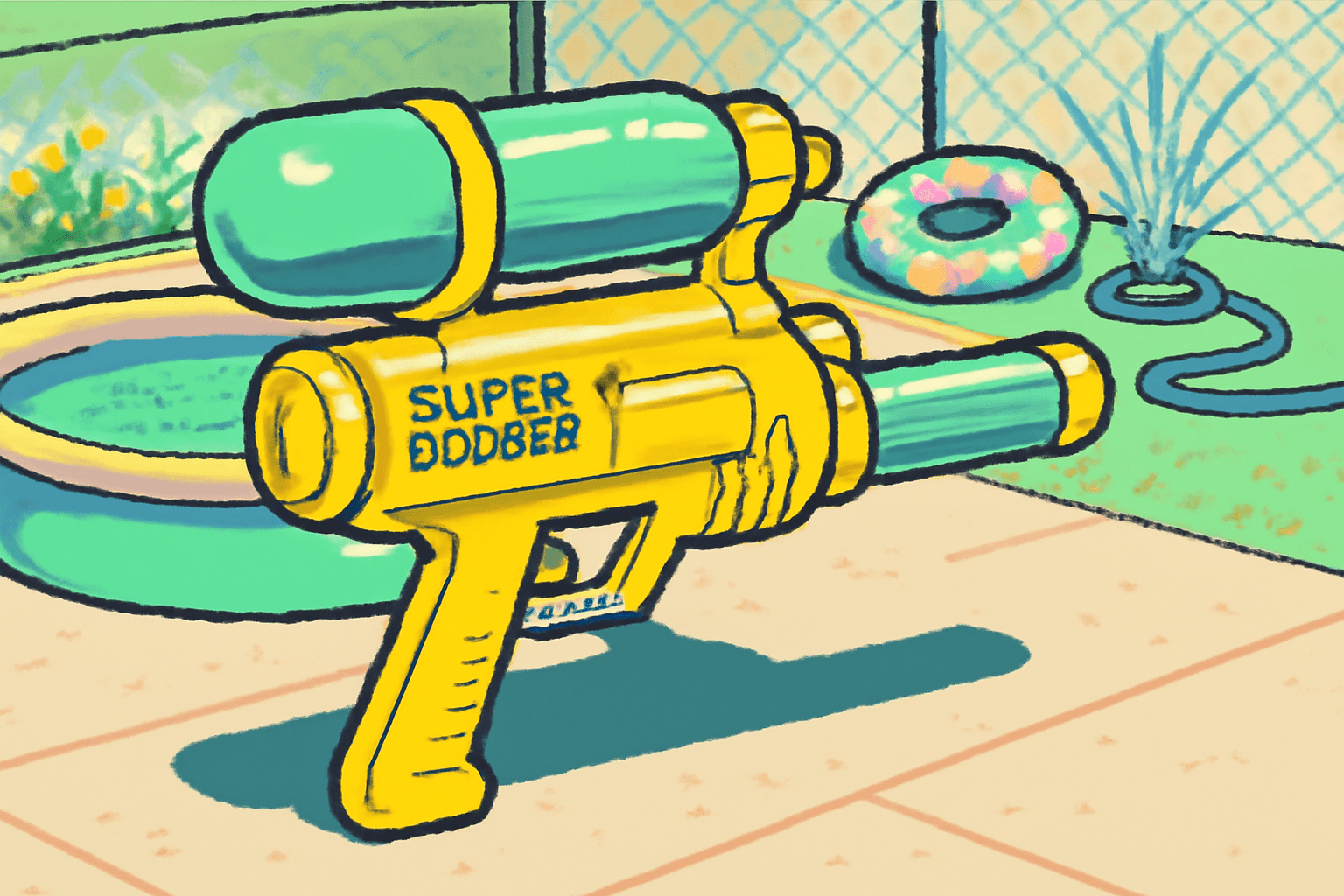
The pump was the whole toy.
You stood in the grass in your bathing suit, barefoot, holding a piece of yellow plastic that weighed a real amount now that the tank was full, and you worked the pump. Forward. Back. Forward. Back. It made a specific hollow sound - shwuck, shwuck - the sound of air being forced through a plastic o-ring by a seven-year-old who had committed to something. You did this eight, ten, fifteen times, until the handle started to fight you back, until the resistance told you the chamber was pressurized to the exact limit the toy would allow. Your shoulder was tired. You had not fired a single drop.
That was the deal.
Then you pointed it at your brother, who was crouched behind an overturned kiddie pool with a Super Soaker 50 that was, in every metric that mattered, an inferior weapon, and you pulled the trigger.
The Object
Super Soakers were made by Larami, which was later bought by Hasbro. They were invented in 1982 by an actual NASA engineer named Lonnie Johnson, who was trying to design a heat pump and instead invented the reason nobody in your neighborhood had a dry t-shirt from May to September. This is a true fact. A man who had worked on the Galileo mission to Jupiter went home and, in his bathroom, accidentally invented a plastic toy that would generate a billion dollars in retail and half a million ruined dinner plans.
The first Super Soaker to hit stores was the Power Drencher in 1990, renamed the Super Soaker 50 shortly after. It was yellow and green and looked, from a distance, like a small vacuum cleaner. It had a translucent bottle-shaped tank on top that screwed off so you could refill it from the hose. It had a pump handle on the underside. And it had a nozzle that fired a jet of water twenty feet, further if you tilted up.
Twenty feet was insane.
Twenty feet was insane. The best water gun you'd owned before this shot maybe six feet, dribbled the last four, and then required refilling from a bathroom faucet using an eyedropper.
The best water gun you'd owned before this shot maybe six feet, dribbled the last four, and then required refilling from a bathroom faucet using an eyedropper. The Super Soaker was a category shift. It was the moment plastic pump physics reached escape velocity and became a threat to the entire suburban peace treaty about what constituted a fair fight in the backyard.
The Contract
The pump was a contract.
You pumped to build pressure. The pressure lived in a chamber inside the gun. When you pulled the trigger, the pressure pushed water through the nozzle, and the water came out in a specific tight column that would knock the leaves off a small hedge if you were close enough. The trigger was not a valve you held open; it was a decision you made. You committed the pressure. Once it was gone, it was gone. You had to earn it back.
This meant every fight had a rhythm. Sprint, pump, hide, pump, pump, fire, run, pump. The kid who fired reflexively - who pulled the trigger the second he had any pressure at all - was the kid who ran out first and had to sit on the deck stairs while everyone else finished the round. The kid who over-pumped, past the point of resistance, was the kid whose gun whistled faintly and eventually stopped holding a seal entirely, at which point he was carrying around a piece of yellow plastic that leaked slightly onto his own foot.
The middle path was the game.
The Line
There was a line and every kid knew where it was.
The Super Soaker 50 was the line. Below it - the Super Soaker 25, the Super Soaker XP 40, the six-dollar off-brand water gun your grandmother bought at Rite Aid because she didn't know the difference - you were not really in the game. You were a straggler. You were a kid who came out of the house holding a Fisher-Price bath toy and got soaked before you had crossed the patio.
Above the line - the Super Soaker XP 150 with the two-nozzle selector, the SS 100 with the backpack tank, the SS 200 with the elevated water reservoir that made you look like a colonial-era firefighter - you were a serious combatant. You had, at minimum, negotiated your parents down from absolutely not to fine but not in the good clothes. You had committed.
- SS 25 - a suggestion.
- SS 50 - the classic. Table stakes. If you owned this, you were allowed in the yard.
- XP 40 - looked serious, was fine. Nobody's first choice.
- XP 65 - the sleeper. Great pressure-to-weight. My brother had one.
- SS 100 - backpack tank. Overkill. Got tangled on the fence.
- CPS 1000 - a mistake in the direction of God.
- CPS 2000 - the reason we're all here.
- The garden hose - illegal in tournament play. Also, if you turned it on, your dad noticed within four seconds.
Then, in 1996, the CPS 2000 came out.
The CPS 2000
The CPS 2000 was the moment the arms race broke.
CPS stood for Constant Pressure System. Instead of using an air chamber, the CPS models used a compressed rubber bladder that fired at a constant, insane pressure until it was empty. It didn't ramp up. It didn't taper off. It fired a hose of water for two solid seconds, and the hose was thick enough that if you got hit in the chest at close range, it hurt, and if you got hit in the eye at close range, you cried and told, and the round ended.
The CPS 2000 was the biggest model in the CPS line. It held a gallon of water. It weighed nine pounds loaded. Its main nozzle fired a stream so dense that, according to the internet's later fascination with it, it could strip paint off a wall if you held it there long enough. Which, at nine, was not a thing you were doing on purpose. You were pointing it at Zach.
Zach had brought a Super Soaker 50 to the fight.
Larami eventually pulled the CPS 2000 from stores. It was reportedly so powerful that they were worried about injury, and, more importantly, about lawsuits, and they replaced it with the CPS 2500, which was slightly less devastating. It became a semi-mythical object almost immediately. Ten years later, on eBay, in-box CPS 2000s were going for hundreds of dollars from adults who wanted to have, in a garage somewhere, the toy their parents wouldn't let them have.
The CPS 2000 was pulled from stores. It became a semi-mythical object almost immediately. Ten years later, on eBay, in-box units were going for hundreds of dollars from adults who wanted, in a garage somewhere, the toy their parents wouldn't let them have.
The Rules
Every backyard war had rules. The rules were never written down. They evolved by drift, argument, and the specific sound a mom made when she came outside.
Face was off-limits. Not officially - you fired at faces, everyone fired at faces - but it was understood that if you actually got somebody in the eye, the game was over and there was going to be a summit. The dog was off-limits, though the dog kept walking into the crossfire because the dog thought this was a game about the dog. The screen door was off-limits because if you opened it while carrying a Super Soaker your mother had a specific sixth sense for it. Dad's newspaper, on the deck, was theoretically off-limits, though it took getting hit once, badly, for anyone to learn that.
The good enemy was your best friend. The bad enemy was your sister, who did not want to be playing, was only outside because she'd been told to be outside, and would retaliate by taking your Super Soaker to her friend's house and returning it three days later empty and warm and with a spider inside the tank.
The garden hose, as noted, was banned. So was the pool. So was any adult with a bucket. The bucket was the nuclear option. Once somebody's uncle came out with a bucket, the entire economy of pump-and-pressure collapsed. There was no point pumping fifteen times when a grown man could just throw water at you.
The Refill
Refilling was its own moment.
You had to unscrew the cap on the tank, which was a little threaded plastic thing that always turned harder than you expected. You had to hold the tank right-side-up under the outdoor spigot, which meant crouching, which meant your bathing suit ended up cold and full of grass. You had to fill the tank without also filling your shoe. You had to screw the cap back on. You had to pump. You had to pressurize. This whole sequence took, if you were quick, forty-five seconds. In those forty-five seconds you were completely defenseless, which was why everybody's refill spot was on the shady side of the house, out of sight lines.
The pause between rounds was, honestly, the best part of the game. You'd sit on the concrete pad next to the spigot, breathing hard, waiting your turn under the hose. The Super Soaker was heavy against your knee. Your feet were caked with grass clippings. Somebody's mom yelled from a window not to come inside like that, which you took as tactical intelligence that at some point soon you were going to have to come inside like that.
The tank filled. You screwed the cap on. You pumped, once, twice, up to that fifteenth resistant stroke.
You went back out.
What It Really Was
Here is the thing about the Super Soaker.
It was not really a weapon. It was a pretense. It was a piece of engineering elaborate enough to license a pretend war that adults were mostly willing to permit. Your parents let you soak your brother because the soaking was mediated by yellow plastic and a pump handle and a threaded cap and a chamber and a nozzle and a set of unwritten rules that made the whole thing feel, at least on the surface, like a sport. The mediation was the point. Without the mediation you'd have just been kids throwing water at each other, which parents don't allow, because it's dumb. With the mediation you were operating a tool. You were doing something a NASA engineer had approved of.
That the tool sometimes escalated into a nine-pound, gallon-holding, paint-stripping bladder gun that your parents refused to buy you? That was, in a way, the American 90s in miniature. Every year the toy got bigger, the water column got tighter, the resistance on the pump got heavier, and the moment somebody's cousin showed up with something a size class beyond what you owned, you understood immediately that the treaty had been unilaterally renegotiated. You went home and asked for the next model up. Your mother said you already have one. You said not like this one.
She said no. She was right. You saved your allowance anyway.
I opened a plastic bin in my parents' basement last summer looking for something else. Christmas ornaments, probably. Instead I pulled out a Super Soaker XP 65 with a cracked pump seal and a tank full of dust, and I sat down on the concrete floor and pumped it. The pump made no sound, because the seal was gone and there was no air to compress. The trigger clicked. Nothing came out. I unscrewed the tank cap, which turned harder than I remembered, and looked inside, and there was, of course, a spider.
I put the cap back on. I put the gun back in the bin. I put the bin back on the shelf. I went upstairs.
My kid was watching a video of somebody unboxing a battery-powered water blaster with a digital ammo counter and a targeting laser. I said, you know, in my day you had to pump those, and she looked at me the way I had once looked at my father when he told me that in his day, a squirt gun was a mustard bottle.
Weird, she said, kindly.
The video kept playing. Somebody, in it, was aiming a purple plastic thing at a scoreboard on a wall, and the scoreboard kept a running tally of the hits, and everything was clean and dry and indoors, and nobody was pumping anything.