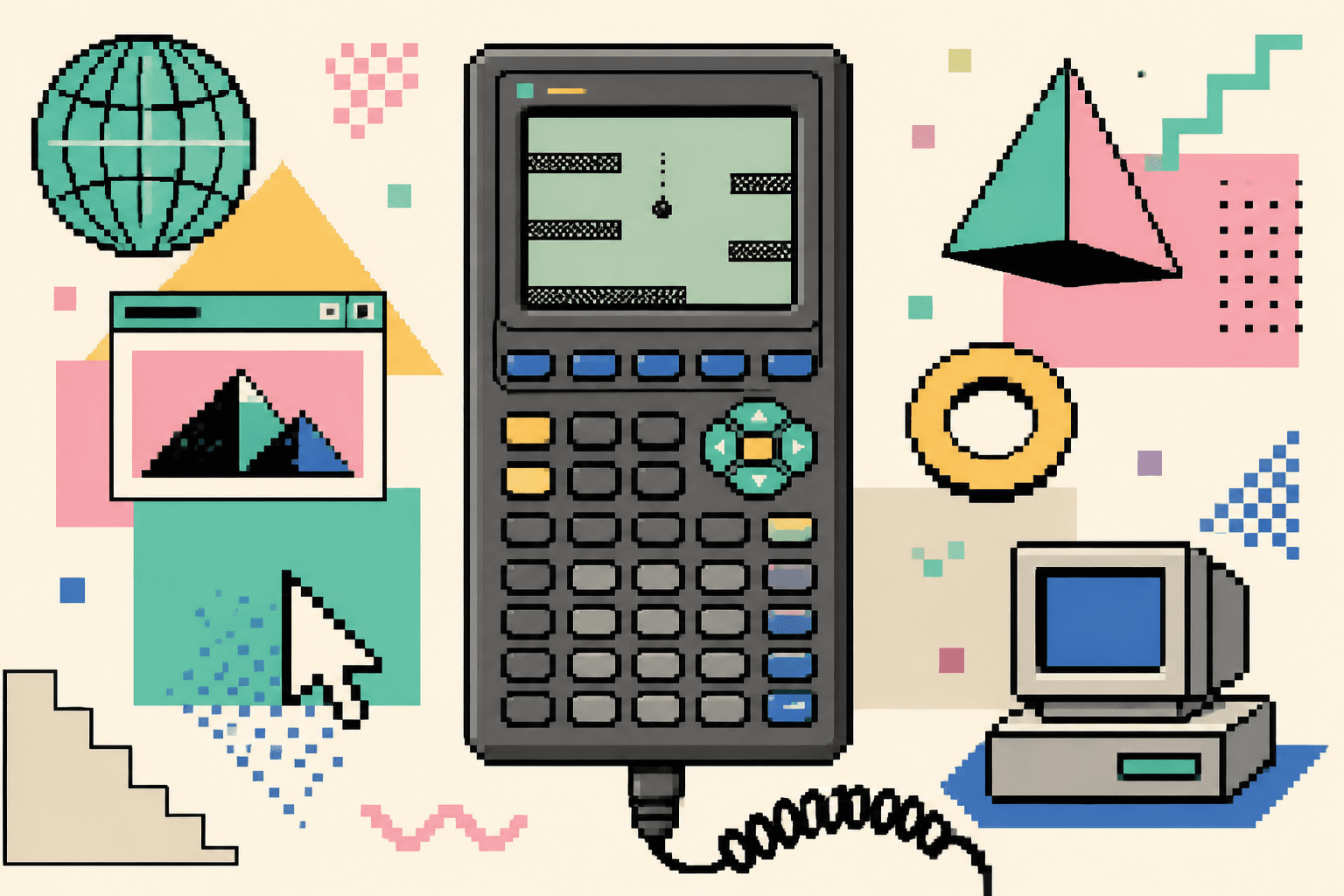
The teacher's back was turned. You unzipped your pencil case. There was a black cable in it, about a foot long, with two identical plugs. You pushed one end into the bottom of your calculator. The kid across the aisle pushed the other end into his. Then you both pressed a sequence of buttons you both somehow just knew - 2nd, then LINK, then SEND, then ENTER. A little progress bar started crawling across the screen.
Forty-five seconds later, he had a copy of Phoenix. You had a fresh save of Block Dude. Mrs. Whitaker was still writing equations on the overhead. None of this was on the syllabus.
Ninety Dollars
Your parents bought you a TI-83 because the high school supply list said you needed one. Algebra II, Pre-Calc, AP Stats, whatever it was. The line item appeared one August and your mom drove you to Office Depot and there it was, locked in a glass case like it might walk off the shelf on its own. They retailed for ninety-something dollars. Sometimes a hundred and ten. You handed it over, and your mom said, "Don't lose this." And you said, "I won't." And you both walked out of there feeling like you'd done a serious thing.
You'd use it for math, sure. You'd graph parabolas. You'd find roots. You'd stare at a sine wave that filled the whole screen and think it looked pretty cool, briefly, until the novelty wore off. That accounted for maybe three percent of the calculator's lifetime utility.
The other ninety-seven percent was games.
The Canon
There were a few that everyone had. Block Dude was the gateway. Sokoban-style. You're a little pixel man, there are blocks, there's a door. You stack the blocks and climb on top of them and eventually get to the door. Twelve levels. You played it under the desk during a quiz on the unit circle, telling yourself you'd put it down after the next level.
Falldown was the time-killer. A ball, falling through gaps in scrolling platforms. Left or right. Two buttons of input. You could play Falldown for an entire bus ride home, your eyes glazing over, only realizing at the end of it that you hadn't blinked.
Phoenix was the showpiece. A vertical shoot-em-up with actual sprites, actual bosses, actual upgrades. The kid who had Phoenix on his calculator was the kid who knew people. The kid who'd traded up. Phoenix didn't get distributed casually. Someone had to bring you in.
And then there was Drug Wars, which - look, it existed. It was a port of a turn-based market sim where you bought low and sold high, traveling between New York neighborhoods, occasionally getting jumped by police. Looking back, it is genuinely insane that this was one of the most popular programs on a calculator owned by twelve-year-olds. The 90s were a different time.
The Link Cable
The link cable was the whole infrastructure. Texas Instruments shipped them in the box, presumably so you could share datasets with a study partner or back up a program. What it was actually used for was peer-to-peer warez distribution at fluorescent-lit desks across America.
You'd find a kid who had a game. You'd plug your calculator into his. You'd both navigate to the LINK menu, set one to SEND and one to RECEIVE, hit ENTER at almost the same time, and watch a progress bar fill. The transfer felt slow but it was actually pretty fast, given that the entire program was a few kilobytes of compiled BASIC or assembly. By the end of homeroom, three more kids had Block Dude. By the end of the week, every calculator in the room had a games folder.
There was a class taxonomy. Some kids had nothing. Some kids had the basics. Some kids had a folder called MIRAGE or DOORS or ASM with thirty programs in it, half of which they didn't remember installing. You wanted to be the kid with the folder.
The link cable was peer-to-peer warez distribution at fluorescent-lit desks across America.
don't let the ball reach the top.
The Notes
The other compartment of the calculator was the cheat sheet. You could write a BASIC program that did nothing - or that pretended to be a calculator function - and tuck it in the PRGM menu next to the real math stuff. When the teacher said calculators are allowed but no notes, you nodded, and then during the test you opened your PRGM list, and there it was. Your hand-typed summary of trig identities, hiding in a program called QUAD.
Some kids took it further. They wrote programs that solved entire categories of problems. Plug in the values, press ENTER, get the answer. Mostly these did not actually save time, because writing the program took longer than learning the formula. But that wasn't the point. The point was that you could. You were running your own code on a device that the teacher had handed you a permission slip for.
You could store text in matrices too, if you were patient. A 5x10 matrix of ASCII codes that you decoded by eye while pretending to crunch numbers. This was insanely inefficient. People did it anyway.
The Teacher Knew
Everyone knew. Mrs. Whitaker knew. The principal probably knew. They had all been students once, and a TI-83 in a kid's hand during silent reading was not a mystery. But there was nothing they could really do. Calculators were required equipment. The link port was on the bottom of the device, factory-installed. Banning it would have required a policy document nobody wanted to write.
So the rules were unspoken. If you were obviously playing - thumbs flying, eyes locked on the screen, the unmistakable body language of someone losing a run of Falldown - you got it taken away. If you held it at a thoughtful angle and occasionally glanced up at the board, you got left alone. The compromise was that you had to be subtle. You had to look like you were thinking. You had to develop the specific facial expression of a kid using a tool for its intended purpose, which is a skill that has served some of us very well in office jobs.
The Calculator Is Still in a Drawer
The TI-83 is still in production. Same form factor. Same OS, basically. Same price, somehow. Texas Instruments figured out that a captive audience of high schoolers will pay whatever, and they have not raised or lowered the price in any meaningful way in twenty-five years. The Wikipedia page for the TI-83 has a section that is just a list of every minor variant they shipped, and it goes on for a while.
There's an argument that this is a scam. That kids could do all the same math on a $20 calculator, or on the phone in their pocket, and that the only reason the TI-83 is still on supply lists is because the College Board and Texas Instruments have arrangements I do not want to think about. The argument is probably right. None of that makes the calculator on my desk in 1999 less of a thing.
Mine is in a drawer at my parents' house, with a missing battery cover and a dead AAA inside. It still works when you put fresh ones in. I checked, last time I was there. The PRGM menu still has TETRIS, FALLDOWN, BDUDE, and a program called STUDY that contains, presumably, my entire 11th-grade trig cheat sheet, which I have not had occasion to consult since the spring of 2001.
I don't know why I haven't deleted it. It feels weird to delete it. Like, I haven't needed any of it for twenty years, but it's still there, ready, in case I'm called upon to derive a sine identity on the spot.
The calculator outlived everything else. The iPod is dead. The Game Boy is in pieces. The family desktop is in a landfill somewhere in Pennsylvania. The TI-83 is still in the drawer, full of games and notes and a couple of half-finished BASIC programs, waiting to be called up for active duty. It was a tool I owned. It still is. Nothing on my phone will ever be that.