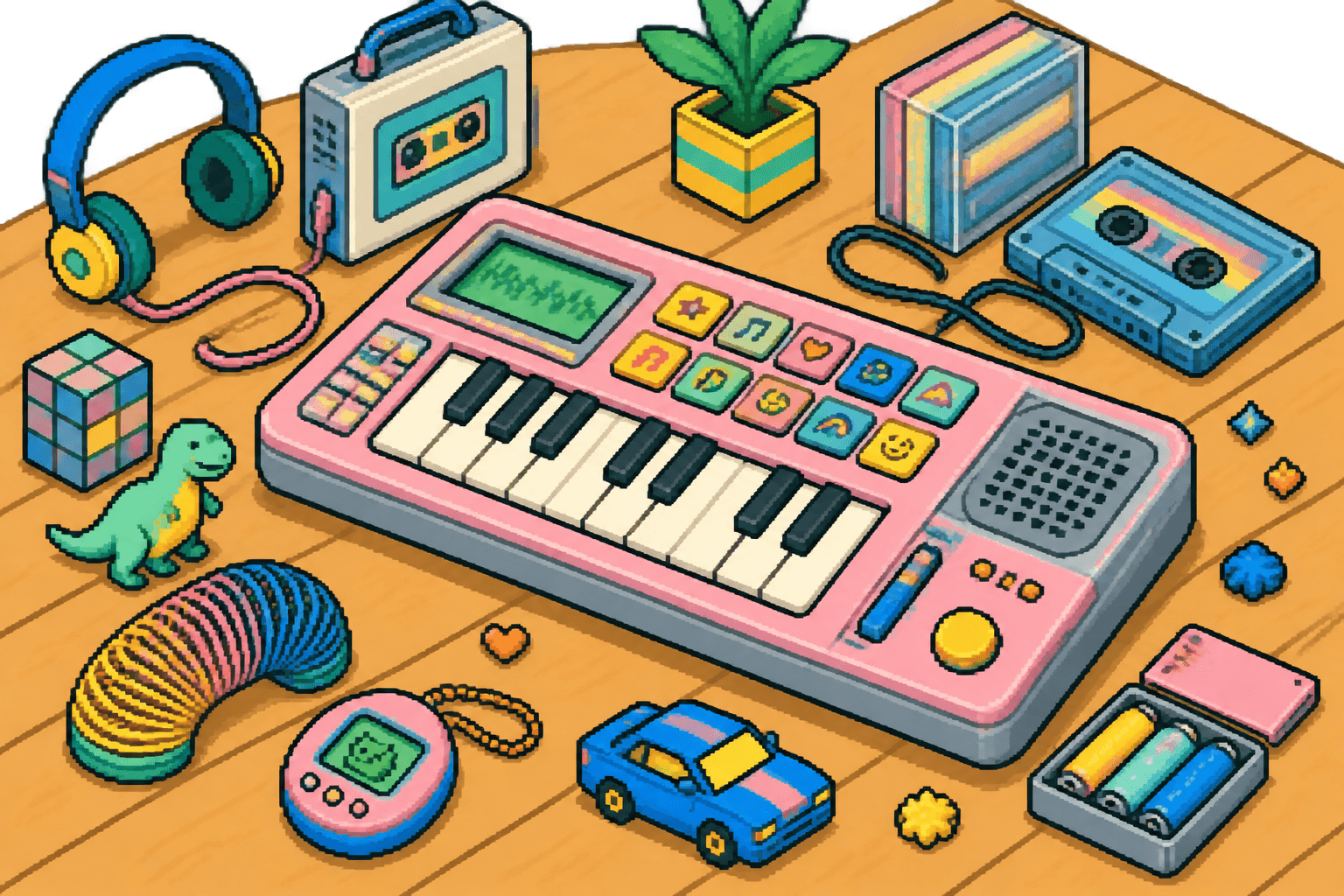
Somebody's grandma got you a keyboard for Christmas. It was small. It was pink or gray or that specific off-white plastic that yellowed by 1997. The keys were the width of your pinky. It ran on four AA batteries or an AC adapter that came with a warning label about a country you'd never heard of.
The box said it had 100 sounds.
You pressed the button that cycled through them. PIANO. ELECTRIC PIANO. HARPSICHORD. BRIGHT PIANO. HONKY TONK. There were seven pianos before you got to anything that was not a piano. Then ORGAN. CHURCH ORGAN. ROCK ORGAN. JAZZ ORGAN. PIPE ORGAN. You cycled. You were nine. You had time.
At sound number 43 or 68 or somewhere in there, the LCD screen showed the word HUMAN VOICE.
You pressed a key.
The Sound Was Not Human
The HUMAN VOICE preset produced a sustained aahh that sounded like a choir being held under a bathtub. It had the general shape of a person going aah. It had none of the physics. It went on for as long as you held the key down. When you took your finger off, it stopped mid-vowel, the way a person would stop if you unplugged them.
This was, according to the LCD screen, a human.
You pressed it with two hands. You pressed it with your elbow. You pressed it while your dad was on the phone. The keyboard, obedient, produced a five-note chord of choir-under-bathtub that filled the family room for as long as you kept your elbow there. Your dad walked into the kitchen with the cordless. He shut the door.
Casio, a public company with an engineering department, shipped a preset called HUMAN VOICE that sounded like a person being held under water. They put it between HARPSICHORD and BAGPIPE. Nobody had a meeting about it.
The Demo Song
Every one of these keyboards had a demo song. It was called ODE TO JOY, or WALTZ FOR DEBBY, or the box did not say and you never found out. You pressed the button labeled DEMO. The keyboard, for the next forty-five seconds, played the demo song at you.
The demo song used all the sounds at once. It would start with a piano intro. Then the drums would come in, sounding like someone tapping a Tic Tac container. Then the strings would drop, which weren't strings but were, per the LCD, STRINGS. Then, at the crescendo, a solo would rip through - a saxophone that sounded like a kazoo, or a trumpet that sounded like a saxophone, or, if you were unlucky, the HUMAN VOICE, arriving at speed.
The demo song was proud of itself. You could hear the ambition. Somebody in a factory outside Osaka had spent a week programming a MIDI arrangement designed to show off every one of the 100 sounds in under a minute, and it was, structurally, a virtuosic piece of writing. It was also, sonically, being played by four AA batteries through a two-inch speaker aimed at a wood-paneled basement.
You pressed DEMO. Then you pressed it again. Then you did homework.
The Rhythms
There was a button labeled RHYTHM.
The rhythms were: 8 BEAT. 16 BEAT. ROCK. WALTZ. SLOW ROCK. SAMBA. BOSSA NOVA. MARCH. DISCO. There were sixteen or twenty and none of them was the rhythm of any song you knew. They were the ideas of rhythms. Vague memories of what a rhythm might be, run through a chip designed to make sound with as few transistors as possible.
The bass was a thoink. The kick was a whoomp. The snare was a tk. The hi-hat was a pss, and the pss was actually the same sample as the snare, played quieter and faster. You would put on BOSSA NOVA. You would layer HUMAN VOICE over it. You would sit on the couch and hold a chord for two minutes and it was, for a moment, indistinguishable from music.
- 8 BEAT
- 16 BEAT (8 BEAT, hi-hat sped up)
- ROCK (8 BEAT, harder kick)
- SLOW ROCK (ROCK, slower)
- DISCO (8 BEAT, open hi-hat every four)
- POP (all of the above, admitting nothing)
The Auto Chord Was Cheating and We Loved It
There was a mode called AUTO CHORD, or ONE FINGER CHORD, or CASIO CHORD. You would turn it on. You would press one key on the left side of the keyboard. The keyboard would play an entire three-note chord, and then it would play an entire bassline under the chord, in the rhythm you had chosen, using the sound you had chosen, indefinitely, forever.
You had done nothing. You had pressed one key with one finger. The keyboard was now playing a full arrangement in the style of BOSSA NOVA with the ORGAN preset and a walking bassline, and you had contributed a single index finger.
This was the moment you understood, for the first time, that music was a lie. That the thing you were listening to on the radio was probably a machine doing most of the work while a person pressed one button. That an entire genre of pop music was, on inspection, someone holding down a key.
You did not think this in words. You just held down the key and it played.
The AUTO CHORD button on a $39 toy keyboard, in 1994, taught you the whole model. That was the day you found out that music was mostly the button and only a little the finger.
Try It
Cycle the sound. Try HUMAN VOICE. Press DEMO. The rhythm is in there too.
The Batteries Died in a Way That Was Its Own Sound
The Casio ran on four AA batteries in a compartment on the underside, sealed with a little door that you had to press and slide simultaneously in a way that broke every time. When the batteries got low, the keyboard did not power off. It got, instead, musically depressed. Pitches went flat. The demo song slowed down, sagged, stretched. The HUMAN VOICE went from choir-under-bathtub to whale-under-bathtub. Notes trailed off before you released the key.
You could play the keyboard for another hour like this, if you wanted. It was the same instrument, technically. It was just slowly dying. You would eventually shake it and put in new batteries and everything would snap back to its original terrible fidelity, and you would forget, briefly, what the death-throes sounded like.
Then a week would pass and it would happen again.
The Speaker Was a Betrayal
The speaker was two inches wide and rear-facing. You could feel it, if you put your palm on the back of the keyboard while you played - a small vibrating disc, buzzing against the plastic housing. This was the entire output of the instrument. There was no headphone jack, or if there was, it was labeled PHONE and it was a 3.5mm output that hissed.
If you put your ear directly against the speaker grille, the keyboard sounded almost good. You could hear the actual PCM samples in there, muffled but present. Take your ear away. Suddenly the same instrument was tinny, plastic, distant. The Casio was making sound in secret, mostly for itself, and letting a small percentage escape into the room.
The Argument, Briefly
I want to give the counter-argument, which is: the toy Casio was, by any technical measure, a bad musical instrument. The keys were not weighted. Velocity did not exist. Polyphony was four notes at most. The samples were 8-bit or lower and looped audibly. The speaker was, again, two inches. The instrument was a plastic toy that produced an approximation of music the way a picture of food produces an approximation of dinner.
Real keyboards existed. Yamaha DX7s existed. Kurzweils existed. Kids who took piano lessons had piano lessons, on pianos, and they learned to play actual music, and none of it involved a preset called HUMAN VOICE.
I hear this. I concede that if the goal in 1994 was to become a musician, the toy Casio was, at best, a distraction, and at worst, a way to teach your ear that a bossa nova rhythm was seven beats of a plastic click.
The Other Side
But here is the thing.
The Casio was not sold to a musician. The Casio was sold to a kid who did not have a piano and would probably not have a piano and had never taken a lesson and did not know what a chord was. And the Casio said, press any key. And you pressed any key, and it made a sound, and it was called HARPSICHORD, and you did not know what a harpsichord was, but now, in a specific way, you did.
The Casio was a catalog of instruments a kid in an apartment complex in 1994 was never going to see in person. Bagpipe. Sitar. Marimba. Ocarina. Steel Drum. Accordion. Shamisen. The keyboard had them all, ranked in a list, one button-press away. You cycled through them. You heard, for the first time in your life, an approximation of what a sitar sounded like. It was wrong. It was 30 percent right. But it was 30 percent more than zero percent, and you were nine, and the point was not fidelity, the point was encounter.
Later, when you heard a real sitar on a Beatles record, you thought: oh. That. I know that one.
The toy keyboard was not a musical instrument. It was a first draft of the world's instruments, shipped to a kid who would otherwise never meet them. HUMAN VOICE was the wrong answer. But it was an answer, delivered to a bedroom, in a list, next to a bagpipe.
The Keyboard Is Still in a Closet Somewhere
Mine is in my mom's basement, in a plastic tote labeled TOYS in Sharpie. The tote is next to another tote also labeled TOYS. The keyboard is in the second one.
I got it out at Christmas last year. Batteries had died in 1998 and leaked into the compartment, but the AC adapter still worked, more or less, if you jiggled the plug. The LCD, remarkably, still worked. Half the keys were sticky. The demo song still played. It was thirty seconds instead of forty-five - some capacitor had aged, some clock had drifted - but the song was intact, in the same eight or ten preset sounds, cycling through in the same order.
The HUMAN VOICE was still in there. I found it. I held down a C major chord. It sounded exactly the same. Choir under water. A little more water than I remembered. But choir.
My nephew, who is seven, watched me press the button. He did not know what a Casio was. He watched me hold down the chord for a while.
"That sound is weird," he said.
"That sound is called HUMAN VOICE," I said.
"But it doesn't sound like a person."
"No."
He nodded. He asked if he could try. He pressed a key. He pressed the button that cycled the sound. He was already, in the specific way I had been, thirty years ago, doing the thing you do with a toy keyboard. Which is: press every button, one at a time, until the LCD shows you something you did not expect, and then hold that one down until someone in the next room shuts the door.