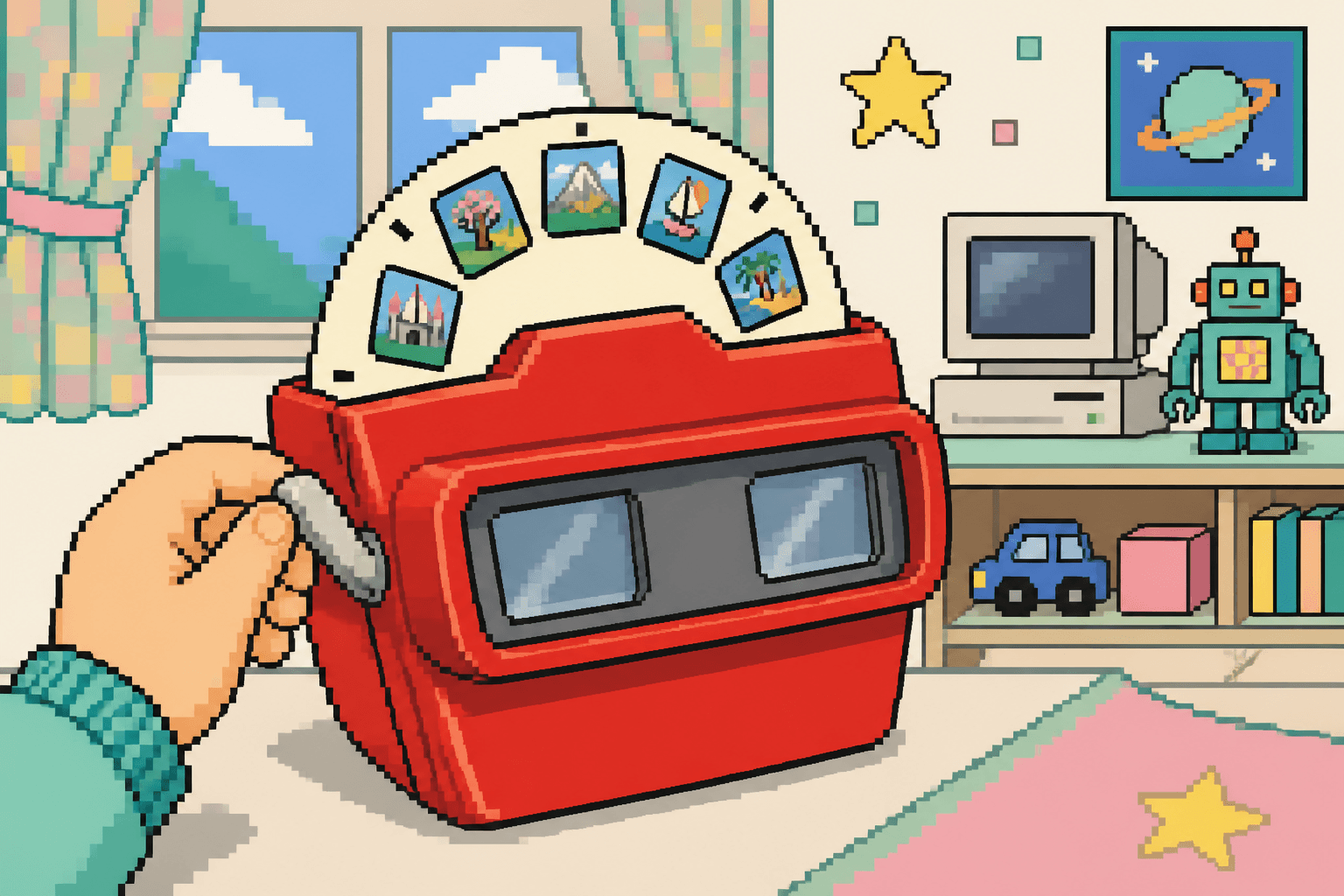
It was on a shelf in your grandma's spare room, between a porcelain bell and a tin of buttons. A red plastic brick the shape of a flattened binocular, with a slot on top where the reel went in and a small white lever on the side that did the only thing the toy could do.
You picked it up. You held it to your face. You closed your left eye and opened your right and looked through the rubber-rimmed eyepiece into a tiny dark space, and inside that space, blurry and improbable, was a photograph of the Eiffel Tower. Or Mickey Mouse. Or a cross-section of a frog. You couldn't tell at first. You had to turn it toward the window.
That was the trick. The View-Master needed light, and not just any light - it needed the kind of dusty afternoon sun that came through your grandma's lace curtains at a slant. You'd angle the whole brick like a sundial until the reel lit up from behind, and then the picture would appear, sort of, and you'd squint, and you'd wait for the 3D to kick in.
The Reel
The reel was the actual product, technically. The viewer was just the gun. The reel was the bullet.
It was a thin cardboard disc, about three and a half inches across, with fourteen tiny color slides arranged in seven pairs around its edge. Each pair was the same picture taken from two slightly different angles - a left-eye photo and a right-eye photo, two inches of imaginary skull-width apart, the way your actual eyes saw the actual world. When the reel slotted into the viewer, each eye got one of the two photos. Your brain did the rest. Most of the time.
The reels came in white paper sleeves with a glossy color print on the front and a description on the back, written in the bright Eisenhower-era prose of a tourism board. Soar with us above the misty grandeur of NIAGARA! Visit DISNEYLAND, the magic kingdom where dreams come true! Every reel was a brochure pretending to be a story.
The reel was the actual product. The viewer was just the gun. The reel was the bullet.
You bought them three to a pack, in a cellophane sleeve, at the gift shop of a place you had just visited or a place you were never going to visit. The Grand Canyon. Mt. Rushmore. Sea World. The Last Supper. There was no organizing logic. There was just a shelf of cardboard wheels and your mom's decision about which one was worth $7.99.
The Lever
Here is the thing about the lever.
It only went forward.
You could not back up. You could not flip back to the picture of the camel at Giza if you wanted to look at it again. You pressed the lever down with your right thumb, the reel inside clicked one position, and you got the next slide. If you wanted the camel back, you pressed the lever six more times to go around the whole wheel and arrive at it again.
That was the architecture. Seven slides, one direction, no rewind. It was the inverse of a real-life experience, where you can always look back at the thing you just looked at. The View-Master made you commit.
- Reel A: the famous parts
- Reel B: the parts they had spare photos of
- Reel C: a map, a sunset, and a confused goat
- A folded paper insert with captions in tiny serif type
- One reel that was just almost the same as a reel from a different pack
The click was satisfying. That was the whole industrial design. A small tk sound, mechanical, definitive, like a film projector with a single frame. It was the sound of looking at one thing and being done with it. Tk. Now you look at this. Tk. Now you look at this.
The Picture
The picture was small. Smaller than you expected.
In your memory, the View-Master is a screen the size of a car window. In reality, the actual slides were about the size of a thumbnail. The viewer's lenses magnified them to fill what felt like your whole visual field, but only because your face was pressed into a piece of plastic and your peripheral vision was a wall.
The pictures had a specific quality. They were oversaturated. The skies were too blue. The grass was too green. The 1962 family in front of the Liberty Bell was wearing colors that no human eye had ever actually seen. The film stock and the lens and the backlight all conspired to make the world look like a postcard that had been left in a sunny window too long.
And the 3D effect, when it worked, was real. The Eiffel Tower had depth. The pyramids receded. You could tell, in a way you could not tell from a flat photograph, that one thing was in front of the other thing. There was an actual middle distance. It was not the trick. It was the medium.
When it didn't work - because the reel wasn't seated right, or because one eye was getting more light than the other, or because the photo had been registered slightly off when the reel was assembled at the factory in Beaverton, Oregon in 1971 - you got a headache. The two pictures didn't fuse. You got a doubled image, your brain refusing to merge them, and after about twelve seconds you'd lower the viewer and rub your eyes and turn the reel around in the slot to try again.
When it worked, the Eiffel Tower had depth. When it didn't, your brain just refused to do it, and the picture stayed two pictures.
The Toy
Anyway. Here. The reel is loaded. The lever is on the right. Pull it.
I want to point out that you are not actually getting the 3D effect, because the 3D effect required two photographs separated by your interpupillary distance and routed independently to each eye, which is not a thing the web does. You're getting an animated picture of a picture, with a small wobble I added to suggest the parallax. The lever clicks. The reel rotates. You go forward, and you cannot go back.
That much, at least, is accurate to the form.
The Argument
Here's where I want to argue with myself.
There is a version of this essay where I say the View-Master was a precursor to VR. That it was the first immersive consumer device. That its premise - shut out the world, look through two lenses, watch a slideshow your brain assembles into space - is a direct line to the headset on your face today, and that the toy was visionary, ahead of its time, an early sketch of a hundred-billion-dollar industry. There are people who have written this essay. Wired has run that essay. The Beaverton, Oregon company that made the View-Master - which was, by the way, originally bought by Mattel in 1997 and then folded - has been name-checked in every VR retrospective for thirty years.
I don't want to disagree with them, exactly.
But the View-Master was also, in practice, a small, cheap, kind of broken toy that you used for about nine minutes and then put back on the shelf. The picture was tiny. The 3D was inconsistent. The reels you actually owned were of places you didn't care about - your dad bought you the Cape Canaveral one because he thought you should be interested in rockets, and you wanted the Land Before Time one, and you flipped through the rockets twice and never picked it up again. The viewer sat in a drawer with the wrong reel still loaded for two years.
It wasn't an immersive experience. It was a brochure you held to your face.
And maybe that's fine. Maybe the point of a thing like the View-Master is not that it transports you, but that it gives you a small contained ritual to do with your hands while you wait for the world to be more interesting. You sit on the bedroom carpet. You hold the brick. You click through seven things. You set it down. You go outside.
We did not need an immersive medium. We were nine. The world was already immersive. We needed something to do for nine minutes.
The Dentist's Office
Every dentist had one. I don't know why this is true but it is.
You'd be in the waiting room, and there would be a small table with a stack of Highlights magazines and a Tonka truck with three wheels and, somewhere in the chaos, a red View-Master with a single reel still loaded. The reel was always called Wonders of the Sea or Inside the Human Body. You'd pick it up. You'd click through seven pictures of a coral reef you'd never visit while waiting to be told you needed a filling.
The reel was almost always missing the paper insert, so you didn't know what you were looking at. Tk. A fish. Tk. A different fish. Tk. What is that, a sponge? Tk. A diver. Tk. A starfish, maybe. Tk. Another fish. Tk. The dentist would call your name. You'd put the viewer down with the reel still half-clicked.
The next kid who picked it up would start where you left off. That was the only way reels propagated through dentist's offices. By stranger.
The Last Click
I found one in a yard sale last fall. Five dollars. The viewer was the orange one - a later model, harder plastic, less elegant than the red original but more durable. There were three reels with it, all of them faded, all of them missing inserts. Yellowstone National Park. Wonders of the Reef. And one unmarked white reel, slot worn down to fuzz on one edge, somebody's homemade thing or a custom corporate reel from a defunct company.
I took them home. I held the viewer up to the kitchen window. The sun was wrong - too low, too orange - and the picture was hard to see, but I clicked through Yellowstone anyway. Old Faithful. A bear. A mountain. A different mountain. A river. A sign that I'm pretty sure said NO BEARS but might have said YES BEARS, the photo was too small. The end.
I clicked through it again. Tk. Tk. Tk. Tk. Tk. Tk. Tk. The lever still only went forward. The reel still only had seven slides. I sat there at the kitchen table for maybe ninety seconds total. I did not feel transported. I did not feel anything, exactly. I felt the click.
Then I put the viewer down on the table next to the toaster, and there it sits, and I have not picked it up again.
The picture is still in there. The reel is loaded to slide three. Somebody will come over and find it and click through it once, and they will not know I was the last person to use it, and they will set it down with the reel one click further along than I left it. That's how reels work. That's how they always worked. Forward, click, forward, forward, forward, and eventually whoever picks it up has no idea what slide they're on, only that it's somebody else's turn now.