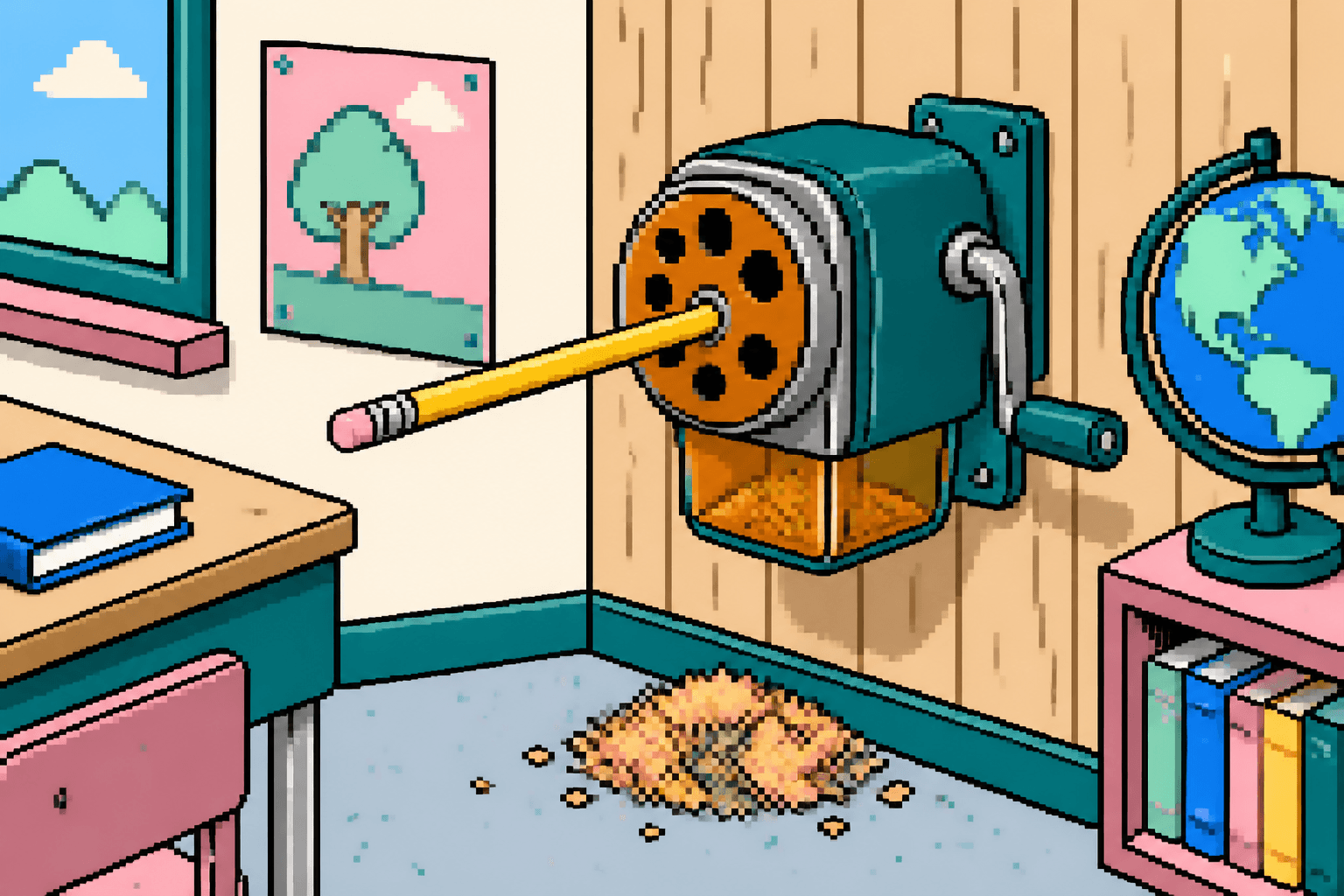
It was bolted to the wall next to the chalkboard, or by the coat hooks, or just inside the door so anyone walking past could see who was using it. Brown or beige or a kind of institutional teal that didn't show up in any other object in the building. About the size of a tissue box, with a small chrome crank sticking out the side and a black dial on the front that rotated to expose one of eight different round holes, each one a slightly different size. Underneath was a removable drawer the color of nothing in particular. The drawer was always full of shavings. The drawer was never empty. Nobody knew whose job it was to empty the drawer.
This was the wall-mount pencil sharpener. It was a Boston, usually. Sometimes a Hunt. The brand name was stamped on the side in a font that suggested the year 1962. It had been mounted to that wall before you started kindergarten and it would still be mounted to that wall when you came back to visit ten years later. The same one. The same dial. Probably the same shavings.
The Dial
The dial on the front had eight holes. Eight different pencil diameters, arranged in a circle, each one a slightly bigger circle than the last. You were supposed to rotate the dial until the hole matched the pencil you were trying to sharpen.
You did not do this.
You used hole number three. Everyone used hole number three. Hole number three was the standard #2 yellow pencil hole and that was the only pencil anyone in the room owned. The other seven holes existed for some imaginary universe in which children carried around a curated assortment of pencil widths, which we did not, because we were eight, and a pencil was a pencil. The dial was a marketing decision. The dial was the manufacturer adding features. The dial was the reason this thing cost forty dollars in 1992 dollars instead of twelve.
Sometimes a kid would rotate the dial out of curiosity, mid-sharpen, and the pencil would jam, and the gears inside would make a sound like a coin getting eaten by a vending machine, and the kid would freeze, and you'd freeze, and then the teacher would walk over without saying anything and rotate the dial back to three and pull the pencil out and hand it back to you with two fewer millimeters of wood than it had previously possessed.
Hole number three was the only hole anyone used. The other seven existed for an imaginary universe in which children owned pencils of multiple diameters, which they did not.
The Crank
The crank was on the side. A little chrome handle with a black plastic grip. You'd insert the pencil into hole number three, you'd hold the body of the sharpener with your other hand because if you didn't the whole thing would try to twist off the wall, and you'd turn the crank.
The first three rotations did nothing. You could feel that. The pencil was just spinning in the chamber, not biting yet. Then on the fourth rotation the blade would engage and the sound would change - a low grinding, the resistance suddenly there, the wood beginning to surrender. You could hear the shavings falling into the drawer below. Tick, tick, tick.
You'd turn until the pencil felt right. There was no instrument for this. The pencil told you when it was done. The resistance would lighten and you'd be cranking against almost nothing, and that meant the lead was at full pointed glory, and then if you turned three more times for good measure you'd discover that the pencil was now actually a needle, capable of stabbing through the paper on the first letter, and you'd have to walk back to your desk and sit there embarrassed and write very, very lightly.
The over-sharpened pencil was its own genre. It looked like a weapon. It made a scratching sound. The point would break inside the first word and you'd have to go back to the sharpener and start over, having now consumed approximately a quarter inch of your pencil in service of being slightly too enthusiastic about the crank.
The Privilege
You did not just walk up to the wall sharpener.
Mrs. Carlson had a system. You had to raise your hand. You had to wait. She had to nod. Then you could stand, push in your chair, walk to the sharpener, sharpen the pencil, and return. You were not allowed to talk to anyone on the way. You were not allowed to take more than one pencil. You were not allowed to sharpen during the lesson, only during silent reading or independent work, and even then she might say "not right now" and you'd have to sit down with a broken pencil and write nothing for fifteen minutes.
The sharpener was, in this way, a small bureaucracy. A two-step approval process for the production of writable graphite. You had to want to write badly enough to perform a small public ritual in front of the whole class. Most of the time you decided you didn't want to write that badly. You'd push the broken pencil around with your finger and stare out the window.
- Your pencil was broken (rare)
- You wanted to get out of the lesson for forty seconds (common)
- You wanted to walk past the kid you had a crush on (also common)
- You wanted to see who else was using the sharpener (always)
- You actually needed to write something (occasional)
But then there was the other thing. The other thing was that sometimes - rarely, glittering, life-altering - Mrs. Carlson would pick someone to sharpen all the spare classroom pencils. The ones in the can on her desk. She'd say "I need someone to sharpen the pencils for the spelling test" and she'd scan the room, and you would sit up straight, and she would not pick you.
She'd pick Heather. She always picked Heather.
The Errand
To be picked for the sharpening errand was to receive a small public knighthood.
You got to stand at the wall for fifteen minutes. You got to ignore the lesson. You got to use both hands on the crank and lean into it, the way the sharpener wanted to be used. You'd work through the entire can of dull pencils, one at a time, building a small pile of beautifully pointed graphite on the chalk ledge. Every kid in the room could hear you working. Click, click, click. You were producing something. You were the only person in the room who was producing something.
When you finished, you'd walk back to Mrs. Carlson's desk with the can full of sharpened pencils, and she'd say thank you, and you'd say you're welcome, and you'd sit back down with a small pulse of importance in your chest that would last approximately twenty minutes, until you got a question wrong about the Louisiana Purchase and were once again a person with no special role in the room.
I was picked once. Fourth grade. I remember the pencils were a mix of yellow Ticonderogas and a few of those weird mottled-green ones with no eraser. I remember the shavings drawer was almost full when I started and overflowing by the time I finished, and I remember not knowing what to do about it, so I left it overflowing, and the next day it was empty and nobody told me why or how. The drawer cleaned itself overnight, apparently. The wall sharpener took care of its own.
The Shavings
The shavings drawer was where the system broke down.
In theory, you removed the drawer, you walked it to the trash can, you dumped the shavings, you replaced the drawer. In practice, nobody did this. The drawer was full when you arrived in September and it was full when you left in June. You'd open it, sometimes, out of curiosity, and stare at a compacted brick of pencil shavings and dust that had reached an archaeological density. There were probably shavings in there from before you were born. There were definitely shavings from sixth grade. There was no system. There was just accumulation.
When the drawer was finally too full to allow further sharpening, shavings would start to fall out the bottom of the housing onto the floor. There would be a small drift of curled wood and graphite dust on the linoleum below the sharpener. The janitor would sweep it up overnight, every night, for the entire school year, and never mention it to anyone, and the next day there would be a fresh small drift.
The drawer was full when you arrived in September and it was full when you left in June. You'd open it and stare at a compacted brick of pencil shavings that had reached an archaeological density.
The shavings themselves were a thing. You'd dig your fingers into them sometimes, looking for nothing in particular. They smelled like cedar and lead. They had a specific texture - dry and curled and slightly oily from the graphite - that you have probably not encountered since. There are not many things in adult life that smell like a pencil sharpener drawer. The closest is maybe a hamster's bedding. The exact smell is gone.
The Replacement
We have, mostly, gotten rid of the wall pencil sharpener. Schools have electric ones now, the kind you stick a pencil into and it makes a sound like a small turbine and stops automatically when the pencil is sharp. There are battery-powered ones the kids can pass around the room. There are mechanical pencils, which never need sharpening, because they were specifically invented to remove the wall sharpener from the equation.
These are better in every measurable way. They sharpen faster. They don't jam. They don't require a kid to leave their seat and stand by the chalkboard for ninety seconds. They produce a more uniform point. They have a smaller shavings receptacle that someone actually empties.
But.
But the wall sharpener was the only mechanical privilege a third-grader had access to. It was the only legitimate excuse to stand up. It was the only piece of classroom infrastructure that required you - your hand, your shoulder, your judgment about when the pencil was done. The electric sharpener removed all of that. You stick the pencil in. The pencil comes out. There is no decision. There is no exertion. There is no walking back to your desk slightly winded, holding a freshly sharpened #2 like it was a small trophy you had personally manufactured.
We removed the friction. The friction was the part where you got to feel like you had done something.
The Argument
I'm not trying to say the wall sharpener was good. The wall sharpener was inefficient and over-engineered and the dial was a lie and the drawer was a public health concern. The wall sharpener wasted time on purpose, by design, because it had been designed in 1962 by people who assumed children had whole afternoons to spend on small mechanical tasks. The wall sharpener was bad equipment.
But it was also the only piece of equipment in the room that gave you something to do with your hands. School was, mostly, sitting still and not doing things. The wall sharpener was one of maybe four moments in a school day when you were allowed to stand up, walk somewhere, operate a machine, and walk back. The other three were the bathroom, the water fountain, and the pencil sharpener. Two of those did not involve a crank.
You miss that, maybe, without quite knowing what you're missing. The right to walk across the room and operate something. The right to do a small physical thing in the middle of an information-delivery session. The right to spend ninety seconds producing one good pencil, in front of everyone, with your shoulder.
The electric sharpener gives you the pencil. It does not give you the ninety seconds.
I saw one last year. Mounted to a wall, somewhere - I want to say a community center bathroom hallway, but I am not sure - the same off-beige body, the same chrome crank, the same dial with eight holes that nobody was going to use except number three. I cranked it once. Empty, no pencil. It made the sound. The little gear-grinding noise I had not heard in thirty years. It was instantly recognizable, in the way certain sounds are: not a memory, exactly, just a fact about the world that I had forgotten I knew.
I did not have a pencil. I did not need a pencil. I cranked it a few more times and walked away. The shavings drawer was empty, which I had also never seen before. I checked. I don't know why. I just wanted to know.
The wall sharpener is still out there. Bolted to walls in old buildings, in church basements, in the back hallways of community centers, in classrooms in districts that haven't gotten around to replacing them. They still work. They will probably still work in 2050. They are not going anywhere. They were built to outlast the children who used them, and they have, and they will keep doing it, dial set to three, crank ready, drawer slowly filling, waiting for someone to be picked.