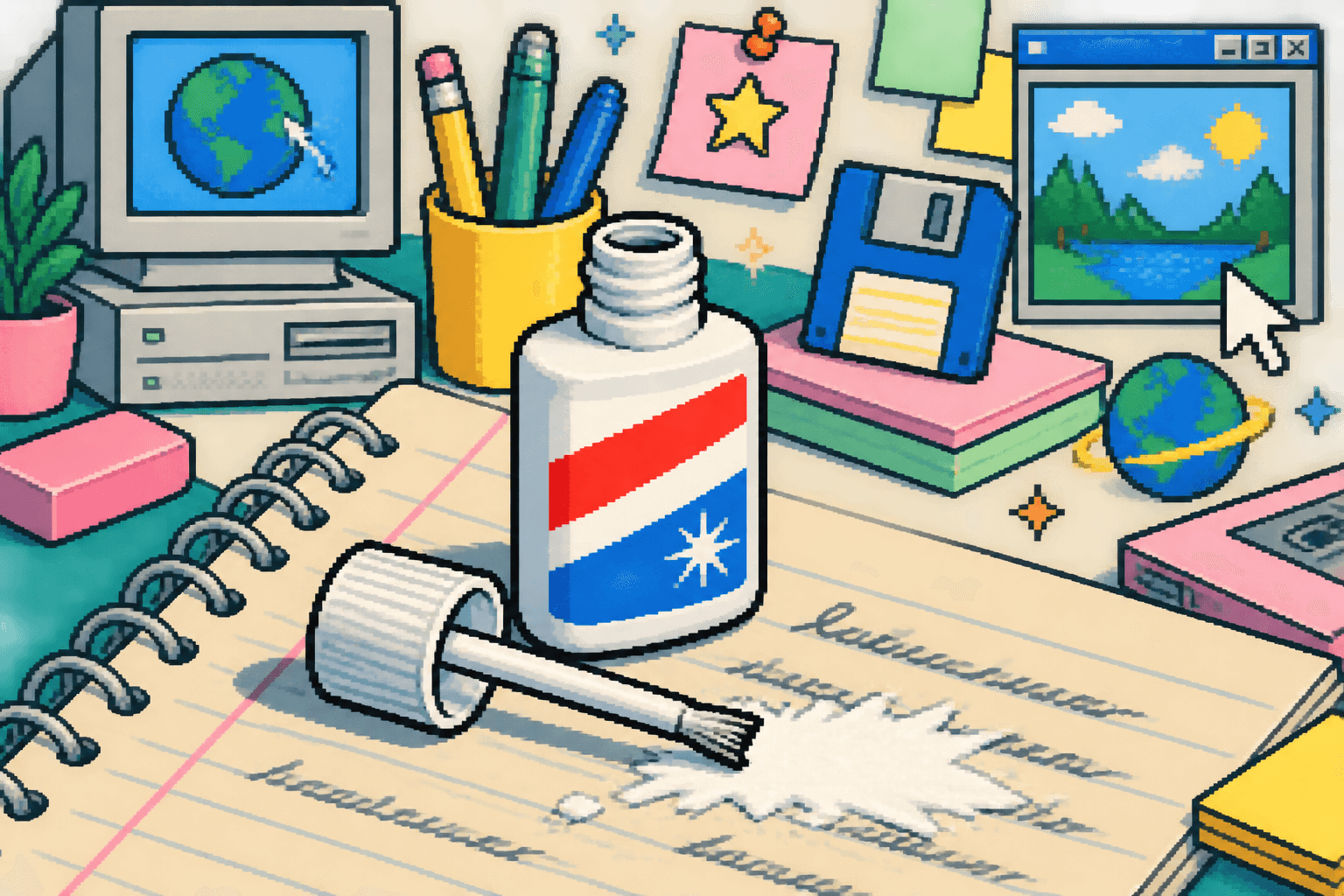
The bottle was in the back of the desk drawer, behind the paper clips and the pencil sharpener you never used, and you dug for it because you had just written recieved instead of received on your homework, and the homework was in pen, and there was no other move.
The Bottle
The bottle was two inches tall. White plastic with a red and blue label. The cap was screwed on tight and had a little skirt around it that got sticky and glued the cap to the neck if you left it for a week, so half the time you had to twist it with your teeth to get it open. Inside was a stiff-bristled brush the size of a match head, glued to the underside of the cap. Around the brush was a thick white liquid that was, you understood without being told, some kind of paint.
You held the brush up to the light. It was crusted. The fluid had dried on it from last time, and now the tip was a small white claw, and you scraped it against the mouth of the bottle to dislodge the flake, and the flake fell into the fluid and floated for a second and then dissolved. The brush loaded up. You lifted it out. A drop hit the notebook and spread, and you tried to draw it back with the brush and made it worse.
The Smell
Old Wite-Out had a smell.
It was a chemical smell, mild but distinct, and you would find out much later that the fluid contained trichloroethane, or something like it, one of those solvents that got quietly reformulated in the mid-90s once somebody figured out that ten million kids were huffing it out of a bottle on their homework. The reformulated version was less lively. It smelled less. It also dried slower. Nobody at your school made the connection out loud.
The smell was the smell of fixing something. In the same way white glue smelled like art class and Sharpie smelled like the eighth-grade bathroom stall, Wite-Out smelled like the moment you realized the S was upside down and there was no way to move on.
The reformulated Wite-Out was less lively. It smelled less. It also dried slower. Nobody at your school made the connection out loud.
The Ritual
Every mistake had a five-step procedure:
- Say a word out loud.
- Get the bottle. Twist the cap loose. The brush comes up sticky.
- Load the brush. Drag it across the word. Try to keep the coat thin. Fail. Put on a second coat because the first one showed the word through.
- Blow on it.
- Wait.
You blew on it. Everybody did. There is no evidence blowing on Wite-Out actually made it dry faster - the solvents evaporated at whatever rate the ambient air allowed, and your breath was mostly warm water vapor - but every kid in America, from second grade through high school, held the notebook up to their face and blew on the wet white blob like they were cooling soup. Somebody had told us. Somebody's older sister had told us. We knew.
The wait was the problem. Wite-Out took what felt like a full minute to dry, and in the middle of a spelling test that was seven and a half years long. You would eventually get impatient and touch it with your finger to check, and it would still be tacky, and now there was a fingerprint in the white blob, and you would blow on it some more. This was your punishment for existing in a fifth-grade classroom with ink pens.
Try It
Pick the brush. Cover a mistake. Blow on it, or wait. Then switch to the pen and write over the ridge.
The Ridge
Here is the thing about Wite-Out.
When it finally dried, it was not flat. It was a ridge. A small raised topographic feature on your homework, the color of chalk, with a slight sheen and a slight roughness, and when you tried to write over it, your pen caught. The ballpoint would skip across the ridge, deposit a thick blob of ink where it snagged, and then fly off the other side leaving a scratch. Whatever correction you wrote on top of the dried Wite-Out was in a different, worse handwriting than the rest of the page.
This was the entire problem. The mistake was gone, technically. But there was now a small white scar, roughly word-shaped, with the corrected word floating on it in an angrier, spikier version of your handwriting. The teacher could see the scar from across the room. The teacher knew what had been there. The teacher had also used Wite-Out, in college, on a term paper. Everybody was in on it. The pretense that the mistake was gone was a shared fiction that nobody, not even the teacher, believed.
- First coat: word visible through the paint like a submerged fish
- Second coat: word gone, ridge visible, chalky
- Third coat (a mistake): cracks like a dry lakebed, flakes off in a week
- Corrected text on top: ballpoint that skipped, kerned wrong, angrier
- The eventual peel: the whole thing lifts off in fourth period, three weeks later, revealing the original mistake, preserved
The Pen-Shaped Kind
Bic made a Wite-Out pen. It looked like a felt-tip marker. You pressed the tip against the paper and squeezed the barrel and it dispensed a little bead of fluid through a rollerball at the tip. This was, on paper, a huge improvement. No brush. No drip. No wait for the brush to load.
In practice, the pen clogged every time you tried to use it. You would squeeze. Nothing would come out. You would squeeze harder. Nothing. You would squeeze so hard that the entire barrel would flex, and then all the fluid would come out at once in a thumb-sized blob, and now the mistake was under a puddle that would take five minutes to dry.
The pen also dried out. It sat in your pencil case with the cap on and, two weeks later, the tip was a hard white bead of nothing, and you couldn't unclog it with anything, and it went in the trash. By 1998, this was the primary way Wite-Out pens ended their lives: not by running out, but by drying up while being carried around unused.
The Correction Tape Was a Betrayal
Then, around 1996, the correction tape showed up. Bic Wite-Out EZ Correct. A little plastic dispenser, sort of the shape of a small computer mouse, that laid down a strip of white tape as you dragged it across the mistake. You could write on top of the tape immediately. It was dry. It was thin. It didn't smell.
Everybody hated it.
The correction tape didn't have the ceremony. The bottle had a whole procedure - the twist, the smell, the brush, the blow, the wait - and the tape had, essentially, one motion. Drag. Done. It felt like cheating in a way that the fluid never had. It also skipped, sometimes, and left little gaps where the mistake showed through, and if you dragged over the same spot twice the tape would peel up in one long white curl and you'd have to start over. It was Wite-Out that had lost its personality and gained an interface designer.
You used it because it worked. But when a substitute put a bottle of the old stuff on your desk in ninth grade, because the tape was out, you felt a small unexpected wave of good. The smell hit. The brush caught the light. You made a mistake on purpose so you'd have something to cover.
The Argument
I want to be honest about the counter-argument.
The counter-argument is that Wite-Out was a bad product. It was slow. It smelled toxic (because it was toxic). It didn't actually hide the mistake - it built a small white monument to it. It dried into a crust. It clogged the brush. It leaked in your pencil case and dried on your pens. The pen version was worse. It never fully solved the problem it was made for, and by the late 90s a whole new category of product had shown up to solve it better.
And - the deeper counter-argument - the need it addressed was itself a bit weird. You needed Wite-Out because your teacher made you write in pen. Your teacher made you write in pen because pen was formal, and formal was serious, and serious was the point of a homework assignment. But pen was formal because it couldn't be erased, which meant the entire point of writing in pen was that mistakes would stay, and the entire point of Wite-Out was to break that. The bottle in your desk was a small, cheerful sabotage of the reason you were using pen in the first place. If everybody agreed the mistake shouldn't stay, why did we all agree the paper had to be in pen?
Nobody asked. You just kept the bottle in the drawer.
The Other Side
But here is what I want to say about it anyway.
Wite-Out was the first physical evidence, to a kid, that a mistake could be retracted. Before Wite-Out, a mistake in ink was a permanent record. You wrote the when you meant they, and the was there forever, and the paper had the on it, and there was no version of the paper without the on it. Wite-Out said: no. That is not the deal. The deal is that you can go back. The deal is that it will cost you a little time and some solvent and a small white scar, and the mistake will not really be gone, and everybody will know, but the paper can still, eventually, say what you meant it to say.
That was the trade. That has always been the trade. Every undo you have ever used - every backspace, every ctrl-Z, every restored version, every unsent email - is the same deal Wite-Out was making. You can go back. It will cost you something. It will not really be gone. But the record can still, at the end, say the thing you meant.
Wite-Out was the first physical evidence, to a kid, that a mistake could be retracted. It cost you time and a small white scar. Every undo you have used since is the same deal.
The Bottle Is Still in a Drawer Somewhere
I have a bottle of Wite-Out in a drawer in my apartment right now. I don't know where it came from. It's been there since I moved in. I unscrew it maybe once a year to check on a paper form and find that the fluid inside has, over the course of some years, become a solid white puck at the bottom of the bottle. The brush is welded into the puck. The cap is welded to the neck.
I could throw it out. I don't. I keep buying new pens. I keep the bottle. Every so often I open a drawer and there it is, waiting, in case I need to fix something that I will almost certainly not fix with it.
The last time I used the actual liquid was probably in 2003, on a passport application, and I over-painted the correction so aggressively that the ridge came up in a peak, and when I flipped the page over to see if the ink had bled through I saw that the underside of the ridge was still tacky, and now there was a small white pyramid stuck to the back of the sheet under it, and I sat there with a hair dryer for six minutes and then eventually printed the form again.